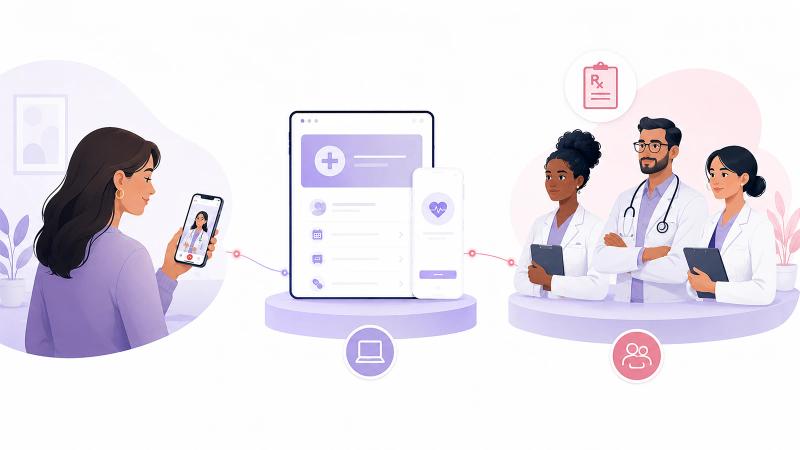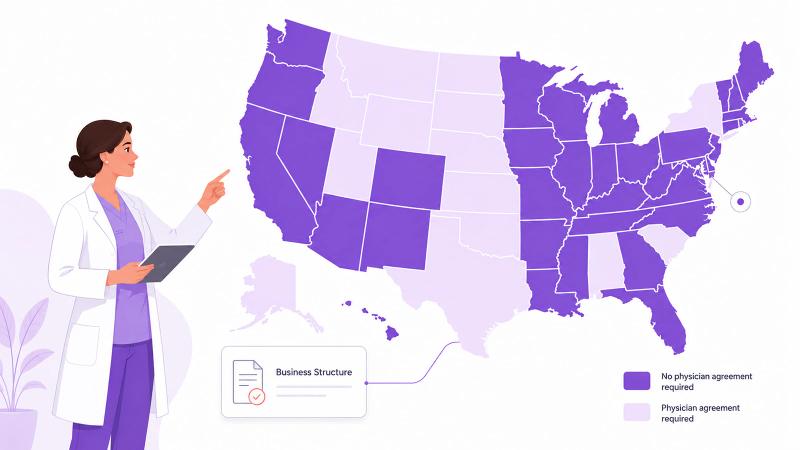
Healthcare operations software is the infrastructure layer that determines whether a telehealth business reaches profitability at 500 patients or needs 5,000 to break even. Non-clinical operators, brands and wellness companies without in-house clinical teams, face a specific evaluation problem: most platforms were built for clinical practices, not DTC operators. This guide covers what the software actually manages, what poor operations cost in measurable terms, and the five criteria that matter most for non-clinical teams choosing a platform in 2026.
What Healthcare Operations Software Actually Manages
Healthcare operations software is a category of platform infrastructure that manages the administrative, clinical coordination, and logistical workflows between patient acquisition and revenue recognition. It is not an EHR. It does not replace clinical judgment. It handles everything that needs to happen around clinical decisions to make a compliant telehealth program function at scale.
The category is broader than most operators assume when they first evaluate it. A complete healthcare operations platform manages the following functions:
Patient intake and identity verification covers collecting and validating demographic data, health history, and consent documentation before clinical review begins. Without this layer, patient submissions arrive incomplete and require manual follow-up before a provider can evaluate them.
Case routing directs intake submissions to licensed providers based on state licensing, program type, and queue availability. Manual case routing is the first bottleneck that breaks when patient volume increases.
Prescription generation and routing facilitates the provider's prescribing decision and transmits approved prescriptions to pharmacy partners electronically. Manual prescription handoffs between provider systems and pharmacies are a common source of fulfillment delay.
Pharmacy fulfillment coordination tracks prescription processing, shipment initiation, and delivery status. Automated pharmacy coordination is the function most directly tied to patient retention because fulfillment failures are the most visible operational problem a patient experiences.
Subscription and refill management triggers renewal billing, refill workflows, and patient communications on the defined program cycle. Without this layer, operators manage renewal timing manually for every active patient.
Compliance documentation maintains audit logs, Business Associate Agreement records, and prescribing documentation required for HIPAA and state regulatory compliance.
Not all healthcare operations platforms cover all of these functions. Some handle intake and provider management but leave pharmacy coordination to manual processes. Some provide pharmacy integration but lack subscription management. Every gap in a platform's coverage becomes your team's manual workload, and that workload scales directly with patient volume.

The Real Cost of Poor Operations
Poor healthcare operations software creates specific, measurable financial problems for DTC telehealth operators. The costs are not abstract operational friction. They are quantifiable revenue leakage at each stage of the patient journey.
Pharmacy coordination failures are the most patient-visible problem. Delayed shipments, missing refills, and no automated patient notifications about fulfillment status generate support tickets, refund requests, and subscription cancellations. For programs with monthly refill cycles, a single fulfillment failure can cost a patient relationship that took between $40 and $750 to acquire through paid digital channels. The acquisition cost range reflects the variance between organic and paid acquisition in competitive telehealth categories like GLP-1 and hormone optimization programs.
Provider queue bottlenecks occur when intake submissions accumulate faster than a manual routing process can assign them to licensed providers. Slow assignment creates intake abandonment: patients who completed the clinical questionnaire but lost confidence during the waiting period and never converted. Intake abandonment is a conversion problem with an operational root cause.
Billing failures from manual subscription management create involuntary churn, patients who would have stayed but were dropped because a payment failed without an automated retry or dunning sequence. Research from Paddle (Profitwell) indicates that involuntary churn accounts for 20 to 40 percent of total subscription churn in digital health programs. Virtually all of it is preventable with automated billing and retry logic built into the platform.
These failures are operational, not clinical. A program can have strong clinical outcomes and still fail commercially if the operations layer does not hold together at scale.
Evaluation Criteria for Non-Clinical Operators
Non-clinical operators need healthcare operations software that handles clinical coordination without requiring clinical expertise to manage. These five evaluation dimensions separate platforms built for this use case from those built for traditional clinical practices.
Provider network scope is the first dimension. The question is whether the platform includes a licensed provider network covering your target states, or whether you source providers independently. For non-clinical operators, provider-inclusive platforms eliminate the most complex and regulated operational dependency. Sourcing, credentialing, and managing a provider network independently requires legal and clinical expertise that most DTC operators do not have in-house.
Async prescribing capability is the second dimension. Asynchronous clinical review enables significantly higher provider throughput than synchronous video consultation models and eliminates scheduling infrastructure. Confirm that the async workflow is purpose-built for the platform rather than retrofitted onto a system originally designed for synchronous care.
Integrated pharmacy network is the third dimension. Verify the specific pharmacy partners by name, confirm their certification status as 503A compounding pharmacies or 503B outsourcing facilities, and ask how the platform handles fulfillment continuity if a pharmacy partner changes status. Pharmacy partner quality directly determines patient fulfillment reliability.
HIPAA compliance documentation is the fourth dimension. Request the Business Associate Agreement before signing any platform agreement. Ask specifically about encryption standards for data at rest and in transit, audit log access, and the platform's breach notification history and process. Do not accept general claims of HIPAA compliance. Request the documentation.
LegitScript certification is the fifth dimension. LegitScript certification is required to advertise on Google, Meta, and Microsoft. A platform that is not LegitScript certified, or that cannot provide guidance on how operators obtain certification through the platform, blocks the primary paid acquisition channels for most DTC telehealth brands.
How to Compare Integrated vs Fragmented Platforms
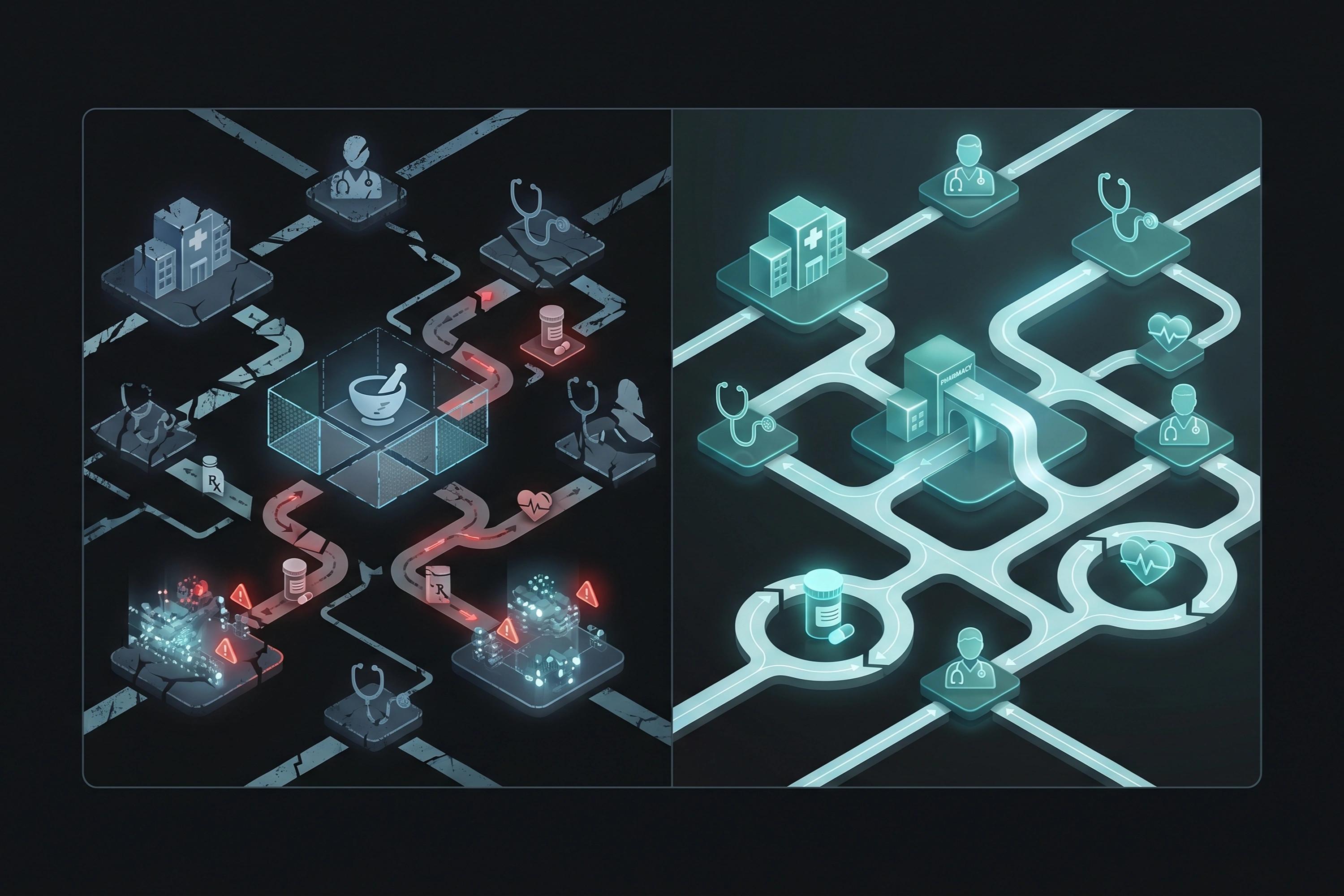
Integrated healthcare operations platforms and standalone point-solution stacks represent two fundamentally different operational architectures. Understanding the difference is the most important platform decision a non-clinical telehealth operator makes before launch.
A standalone stack combines separate tools for each operational function: a form builder for patient intake, a scheduling system for provider assignment, a separate pharmacy portal for prescription routing, and a standalone CRM for patient communication. Each tool solves one problem. Each tool also creates an integration dependency with every other tool in the stack.
The integration problem is where standalone stacks fail DTC telehealth operators at scale. Patient intake completion does not automatically trigger provider assignment in a separate scheduling tool. Provider approval in a clinical system does not automatically route the prescription to a pharmacy portal. Fulfillment status from the pharmacy does not automatically update the patient communication tool. Every handoff between systems is a potential failure point and a manual coordination task that requires staff time to manage.
Integrated platforms trade some theoretical depth in individual components for operational reliability across the full patient journey. The clinical review interface, prescription routing, pharmacy coordination, and subscription management all operate inside a single connected system. A patient who completes intake automatically enters the provider queue. A provider who approves a prescription automatically triggers pharmacy routing. A pharmacy shipment automatically triggers patient notification.
In practice, the best-of-breed components in a standalone stack rarely justify the integration overhead for operators without dedicated engineering teams maintaining those integrations continuously. For DTC telehealth operators specifically, the failure points are at the handoffs between systems, not within them. An integrated platform that handles the full patient journey inside a single system eliminates the category of failure that causes the most patient-visible problems.
Healthcare Operations Software and FUSE Health
A purpose-built healthcare operations platform for non-clinical DTC operators handles a specific and complete scope of operational functions. Understanding what that scope includes helps operators evaluate whether a platform they are considering actually fits the use case or requires significant manual work to fill gaps.
The intake layer should handle patient identity collection, eligibility pre-screening, and case submission to the provider queue without requiring manual intervention between patient submission and provider review. Pre-screening that identifies disqualifying conditions before provider review reduces provider cost per case and improves provider throughput.
The clinical layer should provide a licensed provider network with async review capability across the states where the operator intends to run their program. The operator should not be responsible for provider credentialing, scheduling, or clinical workflow management. Those functions are the platform's responsibility.
The pharmacy layer should include established relationships with licensed compounding pharmacies, electronic prescription transmission, and automated patient fulfillment notifications. The operator should not need direct pharmacy contracts or technical integrations.
The subscription and billing layer should handle refill timing, renewal billing, payment retry logic, and patient re-engagement sequences without requiring the operator to manually track each patient's protocol status.
FUSE Health is built to this specification. Intake, provider routing, prescription transmission, pharmacy fulfillment, subscription billing, refill management, and patient communications operate inside a single connected system. Operators configure program parameters: product catalog, pricing, subscription cycles, refill timing. The platform manages operational execution. Clinical decisions are made by licensed providers within the platform.
Before selecting any healthcare operations platform, evaluate it against the five criteria in the previous section and request documented evidence on each. A platform that answers all five clearly, with verifiable documentation, is describing the correct architecture for a compliant and scalable DTC program.

Conclusion
Healthcare operations software is not a supporting tool. It is the infrastructure your entire revenue model runs on. Programs that launch with manual operations in place of integrated software reach their operational ceiling quickly: support tickets multiply, fulfillment failures compound, and the team that should focus on growth spends its time managing logistics.
The operators who scale DTC telehealth programs profitably are not the ones with the largest budgets or the most technical resources. They are the ones who launched on purpose-built infrastructure, validated their program economics early on warm audiences, and compounded a subscriber base on a platform that handles operational execution automatically.
FUSE Health provides the complete operations infrastructure for non-clinical operators who want to launch prescription wellness programs without building or managing a clinical operations team. The infrastructure is built. What operators bring is the brand, the program, and the audience.
| ⚠ Medical & Legal DisclaimerThis article is for informational purposes only and does not constitute medical advice, legal advice, or a guarantee of clinical or financial outcomes. All telehealth programs should be developed in consultation with qualified legal and clinical professionals. Revenue projections referenced are illustrative and not guarantees of financial performance. Regulatory requirements change — verify current requirements with qualified counsel before launch. |
|---|
References
- LegitScript, Healthcare Certification Standards
- HHS Telehealth.gov, Telehealth policy
- ATA, Principles of Practice: Telehealth as an Imperative Modality of Care (2024)
- McKinsey, Making healthcare more affordable through scalable automation
- Rock Health, 10th Consumer Adoption of Digital Health Survey

Daniel is a two-time founder who has scaled service businesses across major U.S. markets. A Y Combinator competition winner, he focuses on removing operational and regulatory barriers so operators can build and scale modern healthcare businesses.
- Background
- Startup Operations & Service Systems
- Experience
- 2x Founder, Multi-Market U.S. Scaling
- Qualifications
- Healthtech Market Expertise & Operational Scaling
- Key Achievement
- Scaled Premier Staff & Eventstaff across major U.S. markets