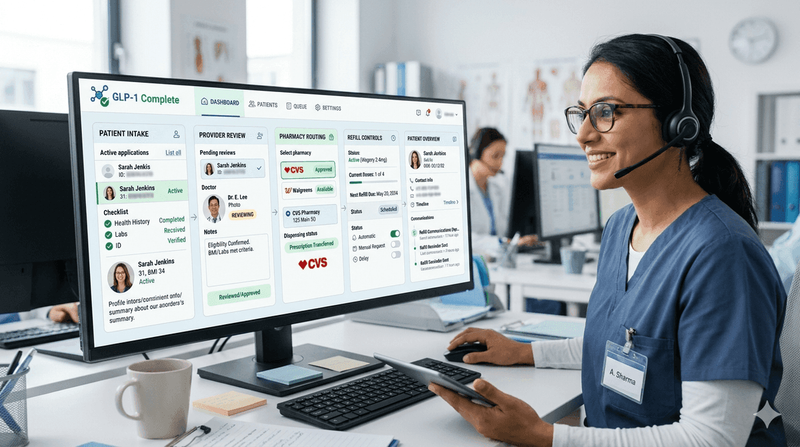
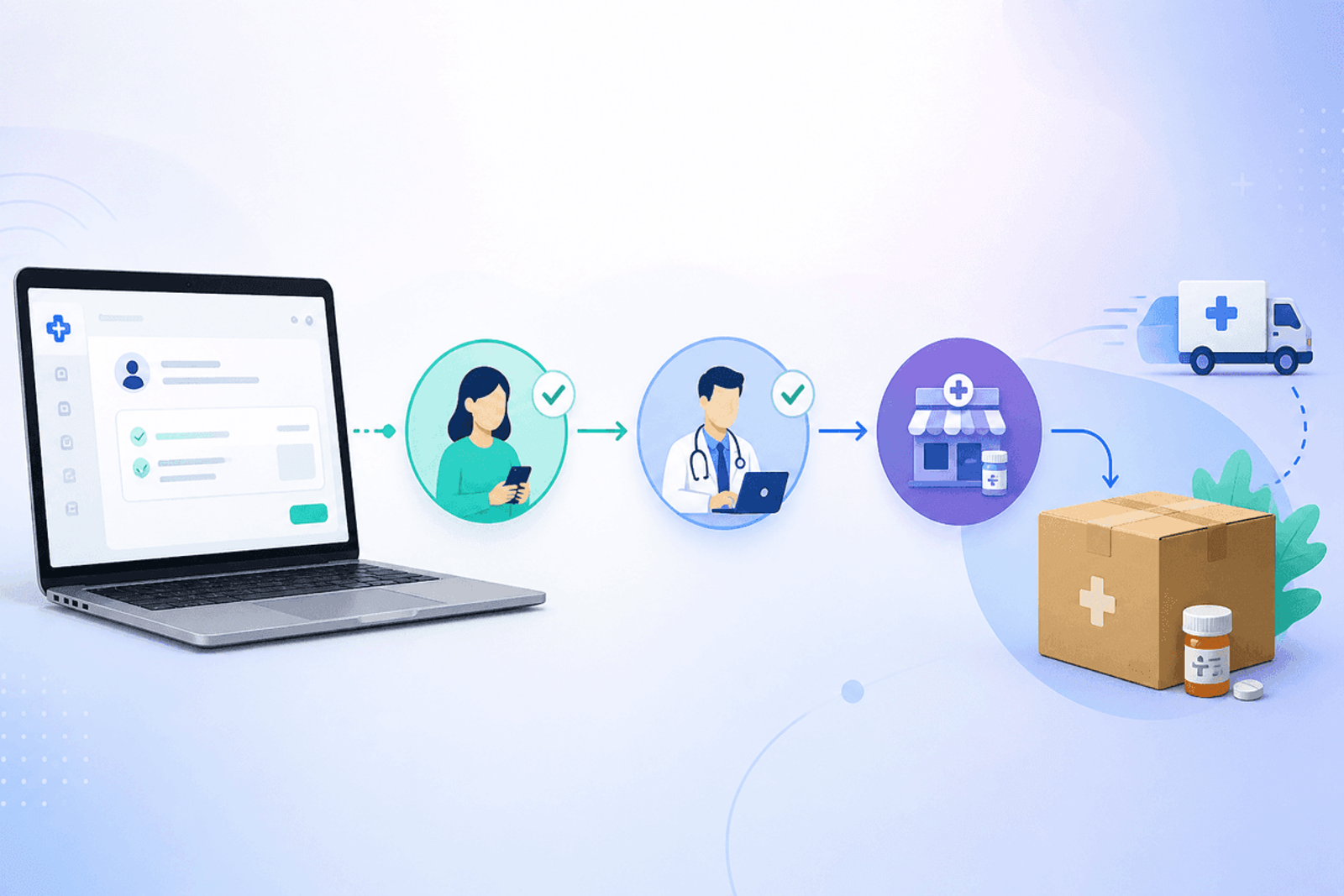
Compounded semaglutide programs operate through a defined clinical workflow: intake, provider review, prescribing decision, pharmacy fulfillment, and refill cycle. Operators selling these programs through white label infrastructure own the brand and patient relationship while the platform handles the clinical layer. Understanding how each workflow stage connects determines whether the program scales or stalls at the first operational constraint.
What Compounded Semaglutide Is and Why It Matters Operationally
Compounded semaglutide refers to semaglutide prepared by a licensed compounding pharmacy rather than purchased as a branded product from the original manufacturer. The distinction is not primarily clinical. It is regulatory and operational.
Branded semaglutide is manufactured under an NDA and sold at manufacturer-set prices through standard pharmaceutical distribution channels. Compounded semaglutide is prepared by 503A compounding pharmacies or 503B outsourcing facilities under conditions governed by FDA guidance and state pharmacy law. The compounding pathway exists to serve patients when branded products are unavailable or inaccessible, not as a parallel commercial channel for branded medications that are in adequate supply.
During the period when branded semaglutide faced significant supply constraints, FDA guidance allowed compounding pharmacies to fill the gap under specific conditions. That guidance has evolved as branded supply recovered. The current landscape for compounded semaglutide is more restricted than it was during peak shortage, and it continues to shift as FDA updates its position on shortage status and compounding permissibility.
For operators, the implication is operational: which pharmacies can currently compound semaglutide, under what conditions, and what documentation is required to demonstrate compliance with current FDA guidance. A white label platform that maintains active pharmacy partnerships manages these changes as part of infrastructure. Operators who source pharmacy relationships independently carry that regulatory monitoring responsibility themselves.
Understanding this operational context before launch determines whether the program is built on a stable foundation or one that requires significant operational attention every time FDA updates its shortage guidance.
The Full Workflow From Intake to Refill Cycle
A compliant compounded semaglutide program moves through five defined operational stages. Understanding each stage and what happens at the boundaries between them is what separates operators who build durable programs from those who discover operational gaps when volume arrives.
The first stage is structured intake. The patient completes an intake form that collects health history, current weight, prior treatment experience, relevant contraindications, and consent to program terms. The intake form must collect sufficient clinical information for provider review while maintaining a completion rate that makes acquisition economics viable. Both requirements are achievable in a well-designed intake workflow. Neither should be sacrificed for the other.
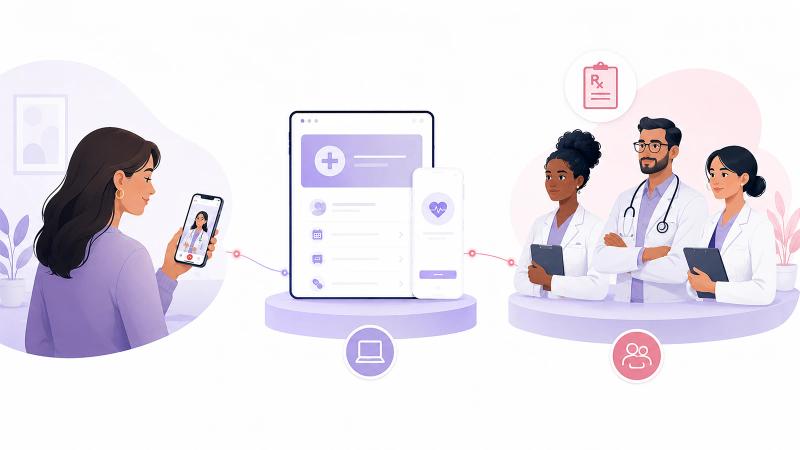
The second stage is asynchronous provider review. A licensed provider reviews the intake submission, evaluates program appropriateness for the specific patient, and makes an independent prescribing decision. The review is asynchronous: the provider works through a structured review queue without requiring a scheduled appointment with the patient. Asynchronous review scales significantly better than synchronous models and removes the scheduling bottleneck that limits synchronous telehealth at volume.
The third stage is prescription generation and pharmacy routing. Where the provider determines the program is appropriate, a prescription is generated and transmitted electronically to the configured pharmacy partner. The transmission happens immediately on provider approval without a manual handoff. The pharmacy receives a structured prescription that includes all documentation required for compliant compounding.
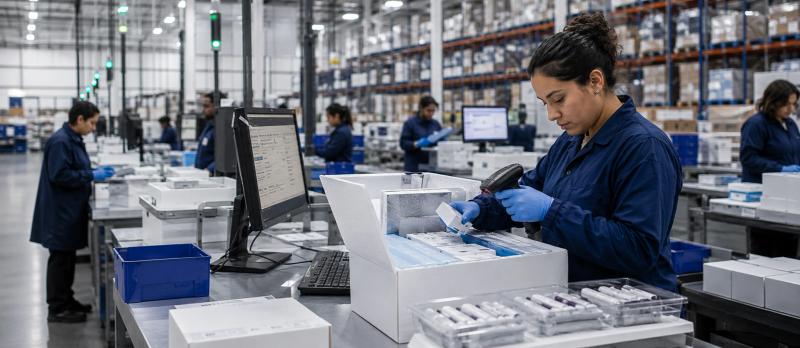
The fourth stage is pharmacy fulfillment and patient communication. The pharmacy compounds the semaglutide preparation, packages it for shipment, and ships directly to the patient. The patient receives automated notifications at each fulfillment milestone: prescription received, compounding begun, shipped, and delivered. These notifications are not optional quality-of-life features. They are retention mechanisms that close the uncertainty gap between prescription approval and medication receipt.
The fifth stage is the refill cycle. At the defined interval, the refill workflow triggers: clinical check-in where required, refill prescription generation, pharmacy routing, and patient communication all run within the documented protocol. The refill cycle is where program LTV is generated. A program with a well-configured refill workflow compounds revenue with each cycle. A program where patients must manually reorder does not.
What Changed After FDA Shortage Guidance and What It Means Now
The FDA shortage guidance that permitted compounding pharmacies to produce semaglutide at scale was issued in response to documented supply constraints on branded versions. As Ozempic and Wegovy supply recovered, FDA updated its shortage status determination, which directly affects the permissibility of compounded semaglutide under 503A and 503B frameworks.
The practical consequence of this update is that not all compounding pharmacies that produced semaglutide during peak shortage are currently operating with the same regulatory standing for continued production. Some pharmacies have identified alternative compounding bases, such as semaglutide sodium or semaglutide acetate, as distinct compounds not subject to the same shortage guidance restrictions. FDA has indicated that it is evaluating these alternatives. The regulatory position on these bases is not yet settled.
For operators, this creates a specific due diligence requirement: confirming the current regulatory basis on which your pharmacy partner is producing semaglutide, understanding what FDA has said about that basis, and having a clear understanding of how your platform handles routing continuity if the regulatory position changes.
A platform that monitors FDA announcements as part of infrastructure operations can update pharmacy routing and operator guidance when positions shift without requiring each operator to independently monitor regulatory publications. This is a practical operational advantage of platform-based launch over independent clinic builds. The regulatory monitoring workload is absorbed by the platform rather than distributed to operators who typically have neither the expertise nor the bandwidth to track it accurately.
The Pharmacy Questions Every Operator Must Ask Before Launch
Not all compounding pharmacies that handled semaglutide at peak shortage volume are operating at the same capacity or under the same regulatory standing today. The confirmation process before launch is not optional, and it is not sufficient to confirm that a pharmacy can compound semaglutide in general. The confirmation must be specific to current conditions.
The first question is which pharmacies the platform currently routes semaglutide prescriptions to. This should be answered with specific pharmacy names, not general descriptions. A platform that can name its current pharmacy partners and describe their current operational status is providing real infrastructure information. One that responds with general assurances about pharmacy relationships is not.
The second question is what the current fulfillment timelines are for each pharmacy. Compounding timelines vary by compound complexity, current order volume, and pharmacy capacity. An operator who communicates a 5-day delivery expectation to patients based on generic estimates when the actual current timeline is 12 days generates patient complaints and churn that accurate expectation setting would have prevented.
The third question is how the platform handles fulfillment routing if a pharmacy partner relationship changes. Regulatory updates, capacity limitations, and business decisions can all affect a pharmacy partner relationship. A platform with a single pharmacy dependency creates a single point of failure for operator programs. A platform with diversified pharmacy routing and documented backup procedures provides resilience that single-partner dependencies cannot.
The fourth question is specific to the current regulatory environment: what is the current basis on which the pharmacy is producing compounded semaglutide, and how is the platform monitoring FDA guidance updates that affect that basis? This question distinguishes platforms that actively manage regulatory risk from those that pass it to operators by default.
Building a Semaglutide Program That Scales Beyond the Current Regulatory Moment
The operators who build durable GLP-1 revenue channels in the current environment are not the ones who launch the fastest on whatever compounding basis is currently available. They are the ones who build programs on infrastructure designed to adapt as the regulatory landscape evolves.
A program that depends entirely on a single compounding approach for a single compound is exposed to single regulatory changes. A program built on diversified pharmacy infrastructure, with routing flexibility across multiple pharmacy partners and multiple compound bases, can adapt to regulatory shifts without full program disruption.
The clinical workflow matters independently of the compound. Operators who build compliant intake, reliable provider review, documented prescribing protocols, and automated refill infrastructure create a program structure that can evolve across compound changes. When compounded semaglutide was the highest-demand option, that infrastructure served it. As the regulatory landscape shifts toward alternative GLP-1 compounds or different compounding frameworks, the same infrastructure serves the updated program without a full rebuild.
FUSE Health manages pharmacy partner relationships, monitors FDA guidance updates, and updates platform routing and operator guidance as the regulatory position evolves. Operators on the platform receive those updates through infrastructure rather than discovering them through patient complaints or compliance issues. The operational burden of regulatory monitoring is a platform function, not an operator function.
Semaglutide remains a significant revenue opportunity in digital health regardless of the regulatory shifts around compounding. The operators who access that opportunity durably are those who build on infrastructure designed for regulatory adaptation rather than infrastructure optimized for a specific regulatory moment.
Conclusion
Compounded semaglutide programs remain a significant revenue opportunity in digital health. The operators who launch on structured infrastructure, with defined intake, clear provider review workflows, documented pharmacy routing, and configured refill cycles, scale without the operational disruptions that independent builds face.
FUSE Health manages the clinical workflow, pharmacy relationships, and regulatory monitoring as platform infrastructure. Operators configure their brand and program parameters. The platform handles the operational execution from intake to refill cycle.
References
- FDA GLP-1 announcements (2025)
- HHS Telehealth.gov
- American Med Spa Association (2025)
- McKinsey Consumer Health Survey (2024)

Daniel is a two-time founder who has scaled service businesses across major U.S. markets. A Y Combinator competition winner, he focuses on removing operational and regulatory barriers so operators can build and scale modern healthcare businesses.
- Background
- Startup Operations & Service Systems
- Experience
- 2x Founder, Multi-Market U.S. Scaling
- Qualifications
- Healthtech Market Expertise & Operational Scaling
- Key Achievement
- Scaled Premier Staff & Eventstaff across major U.S. markets