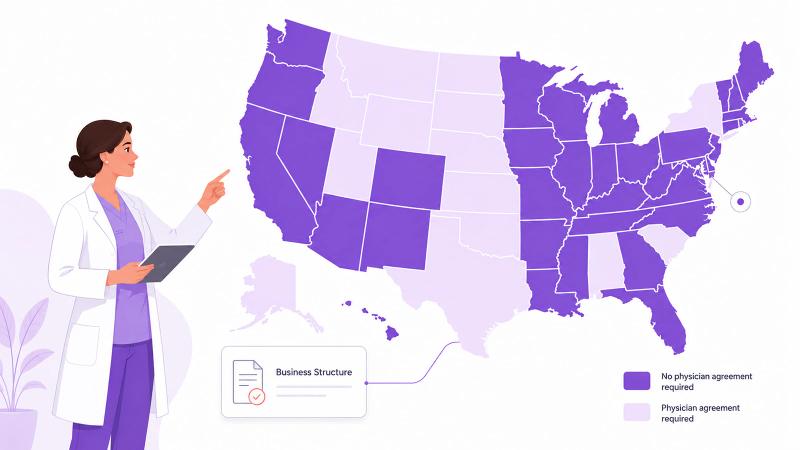

How to start a telehealth business comes down to seven cost lines, not one platform fee. Built from scratch, the published figures put year one between $62,000 and $406,000. Rented, the same stack runs about $13,289 in year one on Growth and breaks even at eight subscribers.
The cost question everyone asks, and almost nobody answers
How to start a telehealth business is a spreadsheet question long before it is a strategy question. If you already have an audience, demand is not your bottleneck. The bottleneck is a cost stack that nobody publishes in one place, and the order you pay for it in.
Search the phrase, and you get the same seven steps on every page. Form an entity. Pick software. Find a doctor. Handle compliance. Launch. Not one of those pages tells you what a state medical license costs, what a medical director charges, what LegitScript takes to certify a site, or how many customers you need before any of it pays for itself.

That gap is not an accident. Most of the numbers sit on fee schedules and pricing pages that nobody bothers to collect, and the rest sit behind a demo request.
So this article does the plainer thing. It collects them. Every dollar figure below comes from a published source listed in the References at the end: state medical board fee schedules, the Interstate Medical Licensure Compact, LegitScript's own pricing page, Stripe's pricing page, development vendors quoting their own work. Where a real number does not exist publicly, and there are three places where it does not, the article says so rather than filling the gap with a guess.
What follows is the full cost stack, a build versus buy comparison at first-year totals, a break-even model you can run in ten minutes, and the five questions worth asking before you commit a dollar.
Want the same math run against your program, your states and your price point? Book a walkthrough and we will map your storefront, intake, provider review and refill flow line by line. Bring your numbers.
First, the split that decides your entire budget
There are two ways to own a telehealth business, and they cost different amounts by an order of magnitude.
Own the workflow. You build or license the software, form the professional entity, recruit and license the clinicians, carry the malpractice, contract the pharmacy, apply for certification, and pass your own security audit. You control everything, and you pay for everything, in cash and in months.
Own the storefront. You keep the brand, the offer, the customer relationship and the growth. The clinical review, prescribing, pharmacy routing, refills and compliance infrastructure run behind it in a structured workflow you configure rather than build. This is the storefront-first model, and it is what most operators actually mean when they ask how to start a telehealth business.
Getting this split wrong is the most expensive mistake in the category. An operator who budgets for a $99-a-month scheduling tool and expects to sell a prescription program has bought the front counter and none of the pharmacy. A team that commissions a $200,000 custom build to prove demand has spent the validation budget on infrastructure before learning whether anyone wants the offer.
The cost lines below apply either way. What changes is who writes the cheque.
The full cost stack, line by line
Seven lines. They show up whether you launch in one state or thirty.
| Cost line | Published range | What moves it | Recurring? |
|---|---|---|---|
| Entity and legal structure | $110 to $500 in filing fees, plus counsel (no published rate) | State of formation, whether a professional entity is required | Annual agent and franchise fees |
| Provider licensure | $35 to $895 per state, plus $700 IMLC letter of qualification | Number of states, physician vs NP, compact eligibility | Yes, at renewal, per provider |
| Malpractice and oversight | $375 to $25,000 a year cover; $500 to $5,000 a month oversight | Specialty, state, provider type, scope | Yes |
| Platform | $40,000 to $300,000+ to build; $19 to $149 a month for software tools | Build vs buy, and whether prescribing is included | Yes if licensed |
| Pharmacy and fulfillment | No published rate card | 503A vs 503B, states, cold chain, exception volume | Yes |
| Payments | 2.9% + $0.30 standard; 3% to 6% high risk, plus 5% to 10% reserve | Category risk, chargeback history, volume | Yes, per transaction |
| Certification and security | $975 + $2,150 a year per site; SOC 2 from $7,000 | Number of domains, audit scope | Yes |
Acquisition sits outside that table because it is not a launch cost. It is the permanent one, and it is covered further down.
1. Entity and legal structure
Filing is cheap. Structure is not.
A Delaware LLC certificate of formation is $110 and a certificate of incorporation is $109, per Delaware's own August 2026 fee schedule. Registered agent service runs about $125 a year for a single state, dropping to about $100 per state at five or more.
The real spend sits behind those numbers. Most states apply the corporate practice of medicine doctrine, which restricts who may own a medical practice and who may influence a clinical decision. The standard answer is a two-entity structure: a professional corporation owned by a licensed physician that delivers care, and a management services organization that holds the brand, the marketing and the administration under contract.
Here is the first honest gap in this article. No health law firm publishes a price for that work. Firms that write extensively about friendly-PC and MSO structuring publish no rate card at all, so any number you see quoted for it is somebody's guess. Get a written quote before you budget it, and treat the quote as a real line rather than a rounding error. Skipping the structure entirely is the single most expensive shortcut available in this category, because unwinding it after you have customers is slower and costlier than doing it first.
2. Provider licensure, state by state
This line scales with your state map, not with your revenue, which is what makes it easy to underbudget.
Board fees vary by more than 25x. A sample of published fee schedules:
| State | Published fee | Source |
|---|---|---|
| Pennsylvania (MD) | $35 | IMLC state fee table |
| Missouri | $102 | IMLC state fee table |
| Wisconsin | $120 | IMLC state fee table |
| Colorado | $362 | IMLC state fee table |
| Florida | $500 ($300 application + $200 initial licensure) | Florida Board of Medicine |
| Illinois | $500 | IMLC state fee table |
| Maryland | $790 | IMLC state fee table |
| Nevada (MD) | $805 | IMLC state fee table |
| Texas | $895 ($867 application + $28 required add-ons) | Texas Medical Board |
| California | $1,850 ($674 application + $1,176 initial license) | Medical Board of California |
The Interstate Medical Licensure Compact shortens the path for eligible physicians. A letter of qualification costs $700, adding states later costs $100 per request, and each state still charges its own fee from the range above.
Two things follow. Ten states is a four-figure to five-figure line, repeated at renewal, per provider. And there is no published benchmark for how many states a typical telehealth business licenses in, so anyone quoting you an average has made it up. The number is set by where your customers are, not by an industry norm.
3. Malpractice cover and clinical oversight
Mira's 2024 breakdown puts nurse practitioner telemedicine cover at roughly $375 to $1,000 a year and physician cover between $5,000 and $25,000. Physicians Thrive puts the average physician premium near $7,500, with non-surgical specialties between $4,000 and $12,000. Specialty and state move these more than any other variable, and both sources predate 2025, so treat them as an order of magnitude rather than a quote.
On oversight, Medical Director Co. publishes retainers from $500 to $1,000 a month at the basic tier and $2,500 to $5,000 and up at the enhanced tier. Worth reading with care: that is a vendor selling the service, and their own guidance notes the ranges are framed around med spas while telehealth operations often run per-visit models instead. It is illustrative vendor pricing, not an independent benchmark.
4. The platform
This is where budgets go to die, and where the two-products split from earlier does the most damage.
| Platform route | Published cost | What you still supply |
|---|---|---|
| Custom build | $40,000 to $70,000 MVP, $100,000 to $300,000+ enterprise (Cleveroad); from $150,000 (ScienceSoft) | Everything: clinicians, PC, pharmacy, certification, audit |
| Practice management software | $19 to $149 a month (Healthie); $49 to $99 a month solo (SimplePractice) | Clinicians, PC, pharmacy, prescribing workflow, certification |
| Full-stack infrastructure | $499 a month DIY, $699 a month Growth, $3,000 a month Partner (FUSE Health) | Brand, offer, growth |
Both development quotes come from shops pricing their own work, which is why the spread is a spread rather than a number.
The middle row is the trap. Practice management tools are competent at what they do, and what they do is scheduling, visits and notes. They do not supply a prescribing workflow, pharmacy routing or rule-based refills. That gap does not show up in month one. It shows up in month two, when the first refill cycle lands and somebody realises it is being run from a shared inbox.
5. Pharmacy and fulfillment
No public rate card exists for this line, because it is a routing and relationship problem rather than a SKU.
Budget for pharmacy onboarding, state availability checks, cold chain handling where the category needs it, exception handling and refill timing. Then budget for the designation question, because it is not cosmetic. A 503A pharmacy compounds against a patient-specific prescription and is exempt from current good manufacturing practice requirements. A 503B outsourcing facility registers with the FDA, operates under cGMP, is inspected on a risk-based schedule and can fill office stock. Which one fills your orders changes what you may hold, how you may advertise and what a state board expects to see.
Underbudget this line and it does not arrive as an invoice. It arrives as support tickets, refunds and a brand problem, because customers do not blame pharmacy routing. They blame you.
6. Payments and processing
Stripe's published rate is 2.9% plus $0.30 per successful online charge, with 1.5% added for international cards.

Healthcare and prescription categories frequently get routed to high-risk underwriting instead. TailoredPay, a high-risk processor, publishes 3% to 6% per transaction plus $0.10 to $0.50 per charge, monthly account fees of $15 to $50, gateway fees of $10 to $30, chargeback fees of $15 to $35, and rolling reserves of 5% to 10% held for 90 to 180 days. That is a self-interested source, so plan around the reserve rather than the headline rate.
The reserve is the line that hurts and the one nobody models. A 10% reserve held 180 days against a growing subscription book is working capital sitting in someone else's account during exactly the months you need it. The question is not whether you can take cards. It is what happens when volume triples, refunds appear and the processor asks what you sell.
7. Certification, security and trust
LegitScript healthcare merchant certification is $975 per website to apply and $2,150 per website annually, with a $2,500 expedited option that only guarantees review begins within two business days. Card networks and major ad platforms commonly require it, which makes certification a growth dependency rather than a badge.
Two details matter for planning. LegitScript publishes no standard review timeline, stating that duration depends on application complexity and applicant responsiveness. And the fee is per website, so a multi-brand operator multiplies it.
SOC 2 Type II audits start around $7,000 for a small startup and rise steeply with scope, according to Secureframe, which sells compliance automation and has an interest in the higher end of the range.
The cost that never stops: acquisition
Everything above is a launch cost. Acquisition is the permanent one, and it is the line that decides whether the business works.
First Page Sage puts B2C customer acquisition cost for medical practices at $120 organic and $176 paid, drawn from client data through 2025. There is no telehealth-specific line item in that dataset, so treat medical practices as the closest published proxy rather than an exact match.
For a sense of scale at the top of the market, Hims and Hers reported $919.3 million in marketing spend against $2.35 billion in 2025 revenue. That is roughly 39 cents of every dollar going to acquisition at a company with 2.5 million subscribers and every efficiency advantage scale provides.
Want to see what your first program can launch with, and what should wait? Book a demo and we will walk your category, your states and your real launch timeline against the gate that actually binds, which is almost never the software.
Build versus buy, at first-year totals
Here is the same stack priced both ways, using only the published figures above.
| Line | Build it yourself, year one | Rent the stack, year one |
|---|---|---|
| Entity filing and registered agent | $235 to $500 | Same, you still form the entity |
| Legal structure (PC and MSO) | Quote required, no published rate | Quote required |
| Licensure, ten states | $700 LOQ + $350 to $8,950 | Included in a 50-state provider network |
| Malpractice cover | $5,000 to $25,000 | Carried by the network |
| Medical direction | $6,000 to $60,000 | Included |
| Platform | $40,000 to $300,000 | $13,289 (Growth: $5,600 upfront including the first month, then $699 a month) |
| Pharmacy setup and routing | Not published, yours to arrange | Configured, 503A/503B routing |
| Payment setup | $0 to $500, plus reserves | Yours, plus reserves |
| LegitScript, one site | $3,125 | Compliance infrastructure included, confirm which fees remain yours |
| SOC 2 Type II | $7,000+ | SOC 2 Type II at the infrastructure layer |
| Subtotal, excluding counsel, pharmacy and acquisition | $62,000 to $406,000 | $13,289 |
Two caveats, because a table this favourable deserves them. The right column still leaves you the entity, the counsel, the payment reserves and every dollar of acquisition. And building is genuinely the right answer when the workflow itself is your product, when you are selling infrastructure to other operators, or when you need something nobody currently offers.
The honest comparison is not $13,289 against $150,000. It is $13,289 against $150,000 plus licensure, plus oversight, plus certification, plus the audit, plus the four to eight months during which you were paying for all of it and selling nothing. For a fuller treatment of that decision, see the build or buy guide.
The break-even model, in ten minutes
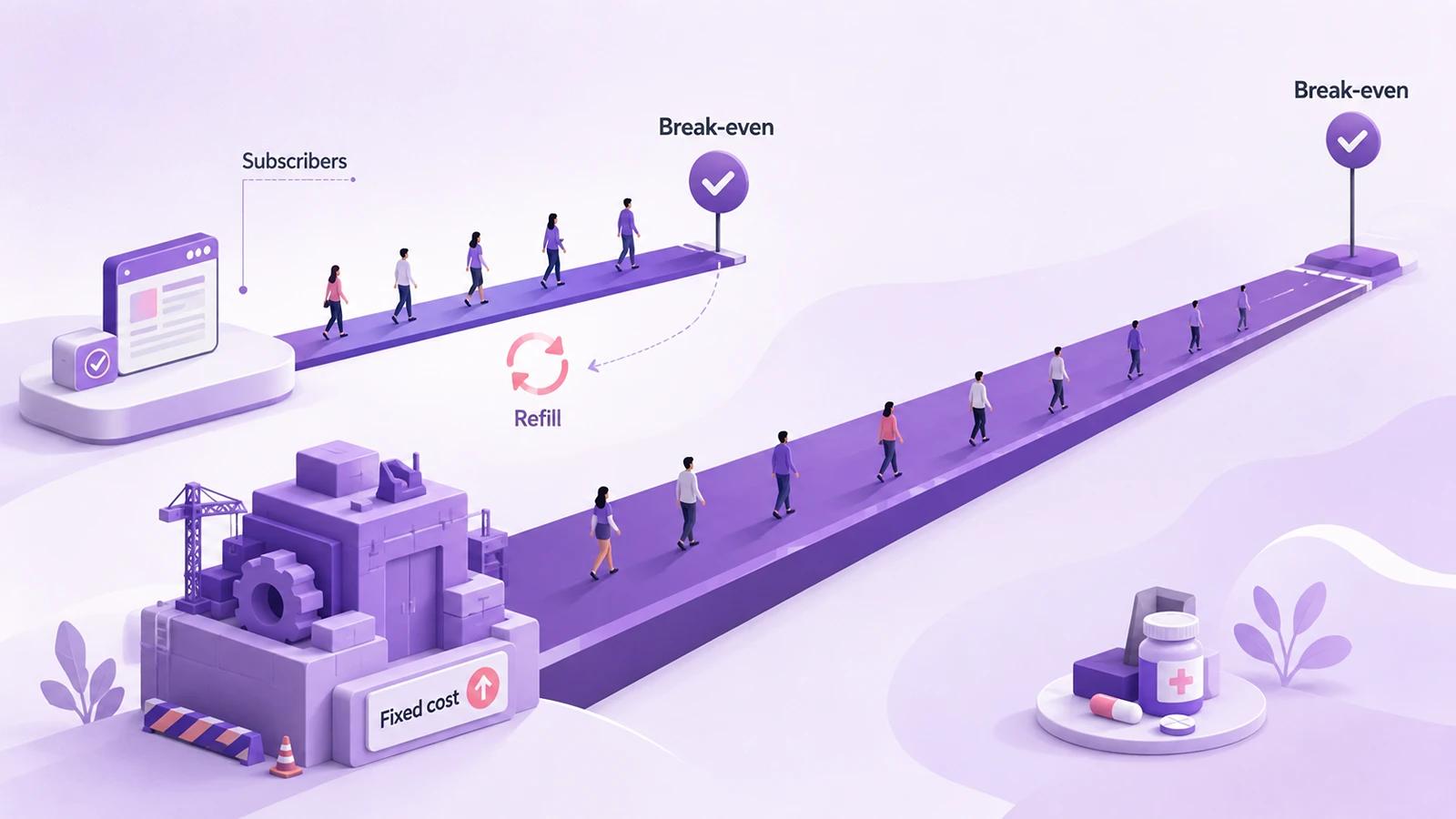
The arithmetic is simple enough to do on a napkin, which is why it is strange how rarely it gets done before the budget is set.
Take your program price. Subtract product and fulfillment cost to get contribution. Subtract processing. Divide your fixed platform cost by what remains. That is how many active subscribers you need before the infrastructure pays for itself.
Three scenarios, all assuming 40% contribution after fulfillment, Stripe's published 2.9% plus $0.30, and a $699 monthly platform cost:
| Program price | Contribution at 40% | Processing | Net per subscriber | Subscribers to break even | CAC payback at $176 |
|---|---|---|---|---|---|
| $150 a month | $60.00 | $4.65 | $55.35 | 13 | 3.2 months |
| $250 a month | $100.00 | $7.55 | $92.45 | 8 | 1.9 months |
| $400 a month | $160.00 | $11.90 | $148.10 | 5 | 1.2 months |
Now run the same table against a $150,000 custom build amortised over three years, which adds roughly $4,167 a month in fixed cost. At $250 a month, break-even moves from 8 subscribers to 53. At $150 a month, it moves from 13 to 88.
That is the whole argument, in one row. Not that building is bad, but that it moves the finish line far enough that you will likely never learn whether the offer worked.
Run it at your real price, your real fulfillment cost and your real CAC. If break-even lands above a couple dozen subscribers, the problem is the cost stack rather than the offer. And remember that the second month is where the model actually lives, because a subscription business is a refill business with a first month attached.
Where these launches actually break
Four patterns repeat, and none of them involve the storefront.
Payment captures before clinical review clears. The order is charged, the provider declines, and now you are issuing refunds at volume. Refund rate climbs, the processor notices, underwriting starts asking questions, and a growth channel becomes a compliance conversation. Authorising before approval and capturing after is a one-line configuration decision that prevents all of it.
Refills run on memory. The first order is easy. The 500th exposes the system. When refill timing lives in a shared inbox or a spreadsheet, subscriptions churn quietly and nobody sees it until the cohort report, by which point you have already paid CAC for customers who left in month three.
Certification is treated as an advertising task. It gets handed to whoever runs paid media, two weeks before launch. LegitScript publishes no standard review timeline, so the campaign stalls on a clock nobody controls.
Intake asks the wrong questions. Provider review slows down because the information needed to make a decision is not there, support absorbs the difference, and the operating cost per order rises with volume instead of falling.
Each one is a sequencing failure rather than a budget failure, which is exactly why order of operations belongs inside the cost plan. There is a longer breakdown of these in where telehealth launches break at scale.
Five questions to ask before you budget a dollar
Ask these of any vendor, any developer and your own team, in writing, before the money moves. Treat a non-answer as an answer.
What is the total first-year cost, including setup, per-visit and per-prescription fees? Not the monthly figure. The number on your bank statement twelve months in. At 400 consults a month, a $25 per-consult fee adds $10,000 to a single month's bill. Model any platform at your target volume rather than your launch volume.
How many prescribers hold active licences in my top five states? Almost nobody publishes this. Everybody can answer it. Get it in email.
Is my product compounded at a 503A pharmacy or a 503B outsourcing facility, and can I see the registration? These are different legal animals with different advertising, holding and inspection consequences.
Who is the merchant of record, and who owns the customer relationship if I leave? This determines whether you have built a business or rented an audience. Ask the same question about your data.
Does the quoted launch date include certification and merchant account approval? Software configuration is fast. Certification review and payment underwriting run on clocks your vendor does not control, and that is where the months actually go.
The workflow that makes the math work
Cost control in this category is mostly sequencing. The workflow that keeps the numbers stable looks like this:
- A customer chooses a program on your branded storefront and completes structured intake.
- Intake routes to a licensed provider for review, asynchronous or live depending on your model.
- If clinically appropriate, the prescription moves forward under defined rules.
- Fulfillment runs through the configured pharmacy flow.
- Refills and follow-ups run on rules rather than staff memory.
You own the brand, the customer relationship and the growth. Licensed providers own every clinical decision. That boundary is what keeps the cost model stable as volume rises, and it is the practical answer to how to start a telehealth business without becoming a clinic.
The resiliency layer, in plain terms
| What breaks at scale | How a structured stack handles it |
|---|---|
| Refunds and chargebacks | Payment authorises before approval, captures after |
| Processor review | Category, claims and workflow documented before volume |
| Data ownership disputes | Boundaries defined at launch, not negotiated at exit |
| Pharmacy outage or state gap | Routing has a fallback path |
| Ad account stalls | Certification readiness built into version one |
| Provider capacity ceiling | Network capacity rather than your hiring pipeline |
On that fifth row, certification readiness is the difference between an ad account that clears and one that stalls on a clock nobody controls.
For what this looks like when an operator with an existing customer base runs it, FUSE publishes case studies including a med spa that added telehealth revenue in 30 days.
Want a written cost model for your specific program, states and price point? Book a consultation and bring the five questions above. You should get every answer in writing before you decide anything.
Price the operating loop, not the website
How to start a telehealth business is not a software question. It is a question about which of seven cost lines you own and which you rent.
Own all seven and the published figures put year one somewhere between $62,000 and $406,000, before counsel, before pharmacy setup and before a single dollar of acquisition. Rent them and break-even lands in single digits of subscribers, which means you find out whether the offer works before the budget decides for you.

That is the case for the storefront-first model, and it is why FUSE Health publishes what it publishes. $499 a month for DIY once you go live, $699 a month for Growth after a $5,600 upfront fee, and $3,000 a month for Partner after a $30,000 onboarding, with no per-visit or per-prescription fees. Licensed providers across all 50 states, 503A and 503B pharmacy routing, SOC 2 Type II, LegitScript certified. 1,200+ programs launched, 94% refill retention and average provider review under 24 hours, all published on the site where a buyer can check them before a sales call rather than after one.
If you already have an audience and a store, the fastest version of this is not a build at all. Start a telehealth business without starting from zero, then let the model tell you whether to keep going.
This article is for operational and budgeting purposes only. It is not legal, medical, tax, insurance or payment processing advice. Fees, board requirements, platform policies, state licensing rules and controlled substance requirements change, and every figure here was read from its published source on 27 August 2026. HHS explains how HIPAA applies when remote communication technology is used in care, and the FTC requires competent and reliable scientific evidence behind health-related claims. Nothing here recommends any treatment. Prescribing decisions are made by licensed clinicians. Work with qualified counsel, licensed providers and compliant pharmacy and payment partners for your model. Operating figures attributed to FUSE Health are published on fusehealth.com.
References
- FUSE Health, Pricing and Plans.
- FUSE Health, Pricing and Access.
- FUSE Health, How FUSE Health Works.
- FUSE Health, Corporate Practice of Medicine: A 50-State Guide.
- FUSE Health, MSO Structure for Telehealth and Med Spa Operators.
- FUSE Health, Which States Allow Telehealth Across State Lines.
- FUSE Health, Inside the White Label Telehealth Software Stack.
- FUSE Health, Telehealth Pharmacy Integration Before You Launch.
- FUSE Health, 503A vs 503B: Which Pharmacy for Your Program.
- FUSE Health, White Label Telehealth Platforms: Build or Buy Guide.
- FUSE Health, How Subscription Refills Drive Margin in Telehealth.
- FUSE Health, Where Telehealth Launches Break at Scale.
- FUSE Health, Telehealth Compliance Without the Legal Rabbit Hole.
- FUSE Health, How a Med Spa Added Telehealth Revenue in 30 Days.
- FUSE Health, How to Start a Telehealth Business Without Starting From Zero.
- Delaware Division of Corporations, Corporate Fee Schedule, August 2026.
- Northwest Registered Agent, Registered Agent Service Pricing.
- Interstate Medical Licensure Compact Commission, What Does It Cost (state fee table).
- Interstate Medical Licensure Compact Commission, Information for Physicians (letter of qualification fee).
- Florida Board of Medicine, Board of Medicine Fees.
- Texas Medical Board, Full Texas Medical License Application, September 2025 fee schedule.
- Medical Board of California, Physicians and Surgeons License Fees.
- Mira, Telemedicine Malpractice Insurance Cost, June 2024.
- Physicians Thrive, Malpractice Insurance Costs, December 2023.
- Medical Director Co., Medical Director Cost Guide, 2026.
- Cleveroad, Telemedicine App Development Cost, May 2026.
- ScienceSoft, Telemedicine App Development Costs.
- Healthie, Pricing.
- SimplePractice, Pricing.
- Stripe, Pricing.
- TailoredPay, High-Risk Merchant Account Fees, February 2026.
- LegitScript, Healthcare Merchant Certification: Process and Pricing.
- Secureframe, SOC 2 Audit Cost, 2025.
- First Page Sage, Average CAC by Industry: B2C Edition, July 2025.
- Hims and Hers Health, Inc., Q4 and Full Year 2025 Financial Results, February 2026.
- U.S. Department of Health and Human Services, HIPAA and Telehealth.
- Federal Trade Commission, Health Products Compliance Guidance.

Daniel is a two-time founder who has scaled service businesses across major U.S. markets. A Y Combinator competition winner, he focuses on removing operational and regulatory barriers so operators can build and scale modern healthcare businesses.
- Background
- Startup Operations & Service Systems
- Experience
- 2x Founder, Multi-Market U.S. Scaling
- Qualifications
- Healthtech Market Expertise & Operational Scaling
- Key Achievement
- Scaled Premier Staff & Eventstaff across major U.S. markets