
White label telehealth software is not a single product. It is a stack of interconnected components that together enable a brand to offer compliant prescription wellness programs without building clinical infrastructure. This guide breaks down each layer of the stack, what operators control, what the platform provides, and what to verify before committing to a platform.

The Technology Stack Inside White Label Telehealth Software
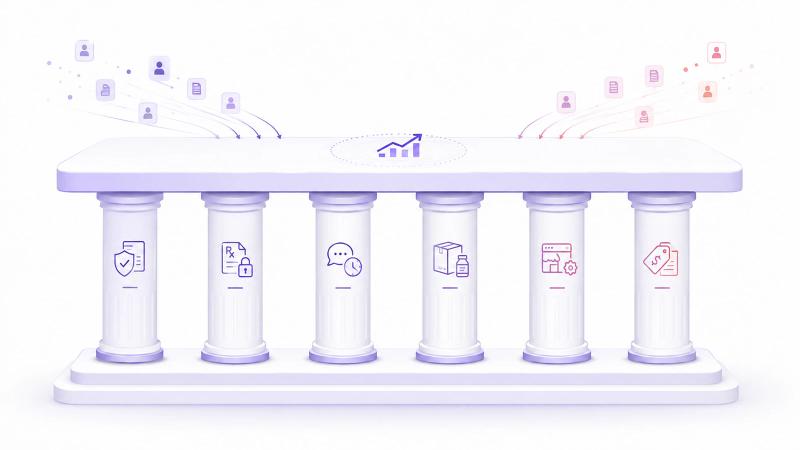
A complete white label telehealth software stack includes several interconnected layers, and understanding what each one does is the first step to evaluating whether a platform is actually ready to support your program at scale.
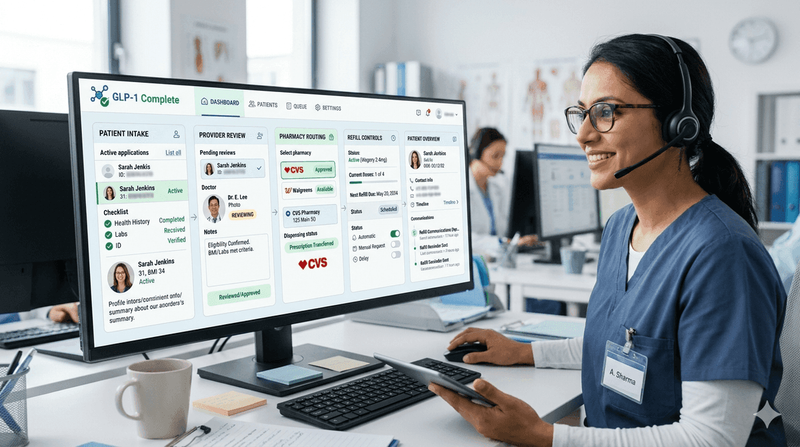
The patient-facing intake and identity layer is what your patients interact with first. It collects health history, verifies eligibility, and gathers the clinical information a licensed provider needs to review the case. The quality of this layer directly determines your intake completion rate. Intake forms that are too long, poorly designed, or technically unreliable create drop-off before a patient ever reaches the clinical review stage.
The async clinical review interface is the provider-facing layer. Licensed providers log into this interface to review patient intake submissions, evaluate clinical eligibility, and make prescribing decisions. In an asynchronous workflow, providers do not meet with patients in real time. They review structured intake data and make clinical decisions based on the information provided. This is what makes telehealth scalable: a single provider can review significantly more cases per day through async review than through live video consultations.
The prescription generation and signing workflow is the layer that connects a provider approval to a pharmacy order. Once a provider approves a case and signs a prescription, the system generates the appropriate prescription documentation and transmits it to the designated pharmacy partner. This layer must be compliant with state prescribing regulations, which vary considerably across the United States.
The pharmacy integration layer routes approved prescriptions to partner pharmacies, receives fulfillment confirmation, and returns shipping and tracking data to the patient notification system. The quality of this integration determines how reliably patients receive their medication and how well the platform can support proactive refill management and retention.
HIPAA data handling, state-specific prescribing rule enforcement, and LegitScript-compliant advertising infrastructure sit across all of these layers and are not optional. They are the compliance foundation that determines whether your program can legally operate and advertise across the channels your patient acquisition strategy depends on.
The Branding Layer: What You Own vs What the Platform Provides
White label software gives operators control over brand identity. Your logo, your domain, your color palette, your product names, and your patient-facing copy are all yours. Patients interact with your brand at every touchpoint. The platform remains invisible throughout the patient journey.
This distinction matters for operators who are building long-term brand equity in a specific health or wellness category. Every patient interaction that happens under your brand, from the first intake screen to the fulfillment notification to the renewal reminder, is reinforcing your brand identity rather than the platform provider's. Over time, patients associate the experience with your brand.
What the platform provides is the operational and clinical infrastructure underneath that brand experience. The provider network, the pharmacy integrations, the compliance certifications, the async review interface, and the subscription management logic are all platform functions. The operator does not build or manage any of these. The operator configures their specific program on top of the infrastructure that is already built.
The practical implication is that operators who choose a full-stack white label platform like FUSE Health can launch a branded telehealth program in weeks rather than months, because the infrastructure underneath the brand is pre-built and pre-certified. The operator's effort goes into configuring their program, their intake questions, their pricing, and their brand presentation rather than into building the clinical and compliance systems that make the program possible.
Compliance Architecture in White Label Software
Compliance architecture is the least visible but most important part of any white label telehealth software stack. Operators who evaluate platforms primarily on UI quality, pricing, or feature lists and treat compliance as an afterthought tend to discover compliance gaps at the worst possible moment: when a platform is delisted from an ad network, when an enforcement action occurs, or when a pharmacy partner terminates a relationship because of documentation failures.
LegitScript certification of the platform matters directly for operators because it is required to advertise on Google, Meta, and Microsoft. These are the primary paid acquisition channels for DTC telehealth brands. A platform that is not LegitScript certified means operators building on it cannot run paid performance marketing for prescription wellness programs. This is not a minor limitation. For most consumer telehealth businesses, paid digital advertising is the primary or only patient acquisition channel at scale.
HIPAA compliance covers data storage, transmission, access controls, and audit logging for all patient health information. The platform must provide a Business Associate Agreement to operators, documenting the platform's responsibilities for protecting patient data under HIPAA. Operators remain responsible for their own HIPAA policies and staff training, but the technical safeguards sit with the platform.
State prescribing rule enforcement is a compliance layer that many operators underestimate until they attempt to scale across multiple states. Prescribing regulations vary by state, by compound, and by patient condition. A compliant platform enforces these rules at the intake and prescribing level automatically, preventing providers from prescribing in states where they are not licensed and preventing programs from operating in jurisdictions where the compound is restricted.
Operating on a LegitScript-certified platform provides the compliance foundation that would take 12 to 18 months and significant capital to build independently. For most operators, this is the single most valuable feature of a full-stack white label platform.
What to Ask Before Choosing a Platform
The platform evaluation conversation is where operators most commonly make costly mistakes. Marketing language around white label telehealth is inconsistent. Platforms that describe themselves as full-stack vary significantly in what they actually provide. Operators who rely on marketing copy rather than direct verification of specific platform capabilities often discover gaps after they have already committed.
Ask specifically: Is the platform LegitScript certified, and can you provide documentation? Can you provide the Business Associate Agreement for HIPAA compliance before we sign? Which pharmacy partners are integrated, are they licensed 503A or 503B compounding pharmacies, and how is prescription transmission handled technically? What states does your provider network cover, and how is state prescribing compliance enforced at the platform level?
Ask about implementation timeline: what is the typical time from signed agreement to first patient enrolled, and what does that process require from the operator? Ask about provider capacity: how many providers are in the network, how is provider throughput managed at scale, and what happens to review turnaround time if patient volume increases significantly?
Ask about ongoing support: who manages the pharmacy relationships, who handles provider credentialing, and what level of operational support does the platform provide when fulfillment issues arise? These are the operational functions that determine patient experience at scale, and operators who assume the platform handles them without verifying this assumption often end up managing clinical operations themselves.
A credible platform answers all of these questions clearly, completely, and with documentation. Vague answers, requests to discuss compliance details after signing, or inability to provide the BAA before contract execution are all signals that warrant significant caution.
How to Evaluate a Platform Before You Commit
The final step before selecting a white label telehealth platform is a structured evaluation that goes beyond the sales conversation. Most platform providers will present their capabilities favorably. The operator's job is to verify what is being claimed before signing, not after.
Start with documentation requests. Ask for the LegitScript certification number and verify it directly on the LegitScript registry. Ask for the Business Associate Agreement before the contract is signed, not as a post-signature onboarding step. Ask for a list of active pharmacy partners with their license classifications, specifically whether they are 503A compounding pharmacies, 503B outsourcing facilities, or retail dispensaries. These are not difficult requests for a credible platform to fulfill. Hesitation or delay on any of them is a meaningful signal.
Next, ask for a realistic implementation timeline with a breakdown of what that timeline requires from your team. Some platforms advertise rapid launch timelines but front-load significant operator effort in configuration, content creation, and compliance documentation that the marketing materials do not make clear. Understanding what the operator is responsible for versus what the platform handles during implementation prevents surprises after the agreement is signed.
Ask about patient volume capacity. A platform that performs well at 100 active patients may not have the provider throughput or pharmacy integration reliability to support 2,000 patients without degradation in review turnaround time or fulfillment speed. Ask specifically how provider review capacity scales with patient volume and what the platform's track record is at higher patient counts.
Finally, request a live walkthrough of the operator dashboard and the patient-facing intake flow before committing. The interface quality, the intake completion logic, and the dashboard reporting capabilities are all visible in a demo. Operators who skip this step and rely on screenshots or recorded demos often encounter UX issues after launch that affect both intake conversion and daily operations.
FUSE Health provides full documentation, a signed BAA before contract execution, verified LegitScript certification, and a live platform walkthrough as part of the standard evaluation process. Operators know exactly what they are building on before they commit.
Conclusion
White label telehealth software is the infrastructure layer that makes branded prescription wellness programs possible without building a clinical operation. The quality of the platform determines the quality of the patient experience, the compliance posture of the business, and the operational scalability of the program.
Operators who evaluate platforms carefully, verify compliance certifications, confirm pharmacy integrations, and understand what the platform actually provides versus what it markets are the ones who launch with confidence and scale without rebuilding. Operators who skip this evaluation often discover platform gaps after they have already invested in patient acquisition on top of infrastructure that cannot support the program they intended to build.
FUSE Health is a full-stack white label telehealth platform. LegitScript certified. HIPAA compliant with BAA documentation. Licensed provider network across multiple states. Integrated compounding pharmacy partners. Async clinical review. Subscription and refill management built in. Operators configure their program and launch. The infrastructure runs underneath.
References
- LegitScript Healthcare Certification (2025) · HHS Telehealth.gov · HIPAA Journal (2025) · American Telemedicine Association (2025) · FUSE Health Platform Documentation

Daniel is a two-time founder who has scaled service businesses across major U.S. markets. A Y Combinator competition winner, he focuses on removing operational and regulatory barriers so operators can build and scale modern healthcare businesses.
- Background
- Startup Operations & Service Systems
- Experience
- 2x Founder, Multi-Market U.S. Scaling
- Qualifications
- Healthtech Market Expertise & Operational Scaling
- Key Achievement
- Scaled Premier Staff & Eventstaff across major U.S. markets