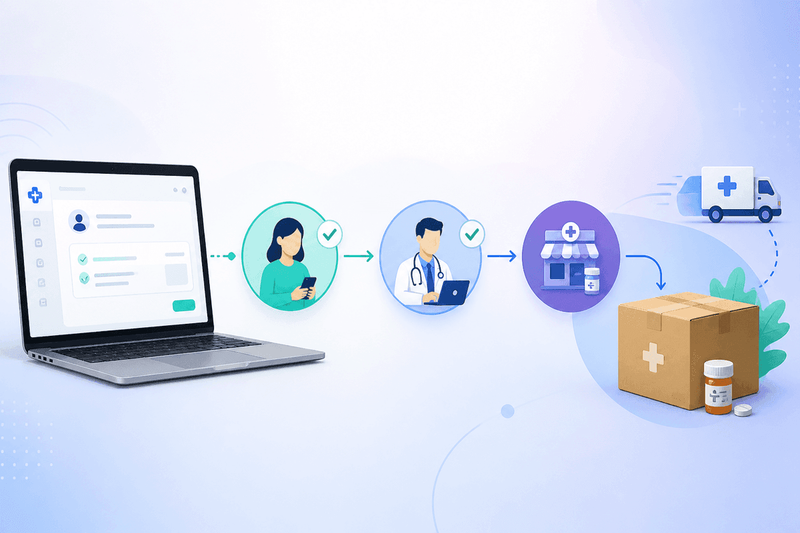

Where can I buy GLP 1 injections is usually the wrong first question. For operators, the safer path is storefront-first infrastructure: sell the program through your brand while review, fulfillment, payment logic, refills, and records run in a controlled workflow
Where Can I Buy GLP 1 Injections Is the Wrong First Question
Where can I buy GLP 1 injections was the first thing a founder asked after opening three supplier tabs, two pharmacy tabs, and one spreadsheet named “GLP launch.” His wording was honest. His sequence was risky.
The outcome he wanted was simple: launch a branded GLP-1 revenue channel fast, without building a clinic and without letting the workflow buckle when orders rise. FDA has warned about unapproved GLP-1 drugs used for weight loss and dosing concerns, so supply cannot be separated from the structure around review, fulfillment, payments, records, and refills.
When operators ask where I can buy GLP 1 injections, I treat it as an infrastructure question. FUSE Health is built for that moment. Your brand sells through its own storefront, while clinical review, pharmacy routing, payment logic, and refill workflows run behind the scenes in a defined path.
The Buying Question Is Too Small
Where can I buy GLP 1 injections sounds like purchasing. At scale, it is a durability question. Can the program survive the first traffic spike, denied payment, refill cycle, ad review, and support rush? That is where storefront-first becomes the practical path.
What breaks when supply comes first
- The storefront launches before claims are reviewed, so ad copy and checkout language can drift into risky territory.
- Intake acts like a form instead of a decision point, which creates cleanup work for providers and support teams.
- Refills stay manual, turning subscription revenue into a support queue.
The same pattern appears in peptide programs. A team asks how I can buy peptides because demand is already visible. Another asks where to buy real peptides because quality and legitimacy matter. Both questions are valid. Neither is complete until review, sourcing, documentation, fulfillment, payments, and support are mapped together.
Storefront-first models start with the operator’s revenue channel and place clinical review and fulfillment behind it in a controlled workflow. For brands with an audience, that model matches how customers buy while giving the regulated pieces a stable path.
The storefront-first model in plain English
- Your brand owns the storefront, offer, checkout experience, audience, and customer relationship.
- The customer completes intake before any clinical decision is made.
- Licensed providers review according to the program model and state requirements.
- Fulfillment routes through configured pharmacy paths when a prescription is appropriate.
- Payment, renewal, support, and data handling are organized before volume arrives.
FUSE Health’s platform materials describe branded storefront infrastructure with intake, provider review, pharmacy routing, subscription billing, and compliance workflows for operators that want healthcare revenue channels without hiring clinical teams internally
How the Workflow Actually Runs
A customer lands on the branded storefront, chooses a program, reads clear eligibility and disclaimer language, and completes intake. The offer is commercial. The decision is clinical.
A licensed provider reviews the intake. If the customer is not a fit, the workflow stops or routes appropriately. If treatment is appropriate, the prescription and fulfillment path follow the configured pharmacy process. Refill timing, follow-up prompts, payment authorization, support notes, and data access are defined before launch.
The five checks before launch
- Storefront ownership: the customer sees your brand, not a generic marketplace.
- Clinical review: intake reaches licensed review before prescription action.
- Fulfillment routing: the pharmacy path is configured before the first order.
- Payment resilience: authorization, capture, refunds, and renewals are planned.
- Scale control: refills, support, data, and provider workload are ready for volume.
This discipline also matters when an operator asks how can I buy peptides. Start with program design, not a catalog. When the team asks where to buy real peptides, define what “real” means inside the business: appropriate sourcing, documentation, clinical review where required, fulfillment controls, and support that avoids medical claims.

Compliance Is a Workflow, Not a Vibe
The risky version of a GLP-1 launch depends on memory. Someone remembers which claims are allowed. Someone remembers which customers need review. Someone remembers which refill rule applies. That may work for ten orders. It fails when volume rises, staff change, ads expand, or support starts answering questions in a hurry.
Regulatory pressure makes this more than a style preference. The FTC’s health products guidance says health-related advertising claims should be truthful, not misleading, and backed by competent and reliable scientific evidence. HHS guidance explains that protected health information needs appropriate handling under HIPAA rules. FDA’s 2025 GLP-1 shortage and compounding updates also show why operators need current, documented fulfillment decisions.
What structured compliance looks like
- Marketing copy avoids outcome promises that the business cannot substantiate.
- Intake captures the information providers need for review.
- Provider decisions stay attached to the workflow and record trail.
- Refills follow defined rules instead of support-team guesswork.
- Data ownership and access boundaries are known before customers enter the system.
This is where FUSE Health earns trust. It does not make regulated categories feel casual. It makes them legible. The operator can see what they own, what the clinical workflow handles, where fulfillment routes, and what happens when the program grows.
Peptides Need the Same Operating Discipline
The peptide search path has its own trap. how can I buy peptides often begins as a revenue question, then turns into a sourcing chase. where to buy real peptides often begins as a quality question, then gets treated like a vendor comparison. Serious operators need both questions moved into a controlled program workflow.
A peptide storefront should answer the same checks: what can be sold, what requires review, how claims are written, where fulfillment happens, who handles support, how records are stored, and how renewals work. Asking how can I buy peptides without that structure is like buying traffic before checkout exists. Asking where to buy real peptides without documentation and review standards creates confidence where the business needs proof.
The safe decision framework
Before your team searches where can I buy GLP 1 injections again, force the answer through a four-part filter. If any part is missing, the launch is not ready for scale.
The four-part filter
- Revenue path: Can the brand sell through its own storefront and keep the customer relationship?
- Clinical path: Does intake route to licensed review before prescription decisions?
- Fulfillment path: Is pharmacy routing configured with fallback planning?
- Resiliency path: Can payments, refills, support, data, and provider workload handle growth?
Use the same filter for how can I buy peptides and where to buy real peptides. If the answer starts with a supplier list and ends with vague promises, slow down. A real program starts with workflow ownership. The supply decision belongs inside that workflow.

Conclusion
Where can I buy GLP 1 injections is still a useful term because it reveals urgency. The operator wants launch speed, margin, and control. The better answer is to build the channel in the right order: storefront first, structured review behind it, configured fulfillment after that, and refill logic ready before the first cohort renews.
References
- FDA, “FDA’s Concerns with Unapproved GLP-1 Drugs Used for Weight Loss,” accessed May 2026.
- FDA, “FDA clarifies policies for compounders as national GLP-1 supply begins to stabilize,” February 21, 2025.
- Federal Trade Commission, “Health Products Compliance Guidance,” 2022.
- U.S. Department of Health and Human Services, “HIPAA Guidance Materials.”
- FUSE Health, “GLP-1 Program vs Marketplace Dispensing.”
- FUSE Health, “How D2C Brands Launch White Label Telehealth.”
- FUSE Health, “GLP-1 Retail Distribution vs Telehealth Program Infrastructure.”

Daniel is a two-time founder who has scaled service businesses across major U.S. markets. A Y Combinator competition winner, he focuses on removing operational and regulatory barriers so operators can build and scale modern healthcare businesses.
- Background
- Startup Operations & Service Systems
- Experience
- 2x Founder, Multi-Market U.S. Scaling
- Qualifications
- Healthtech Market Expertise & Operational Scaling
- Key Achievement
- Scaled Premier Staff & Eventstaff across major U.S. markets