

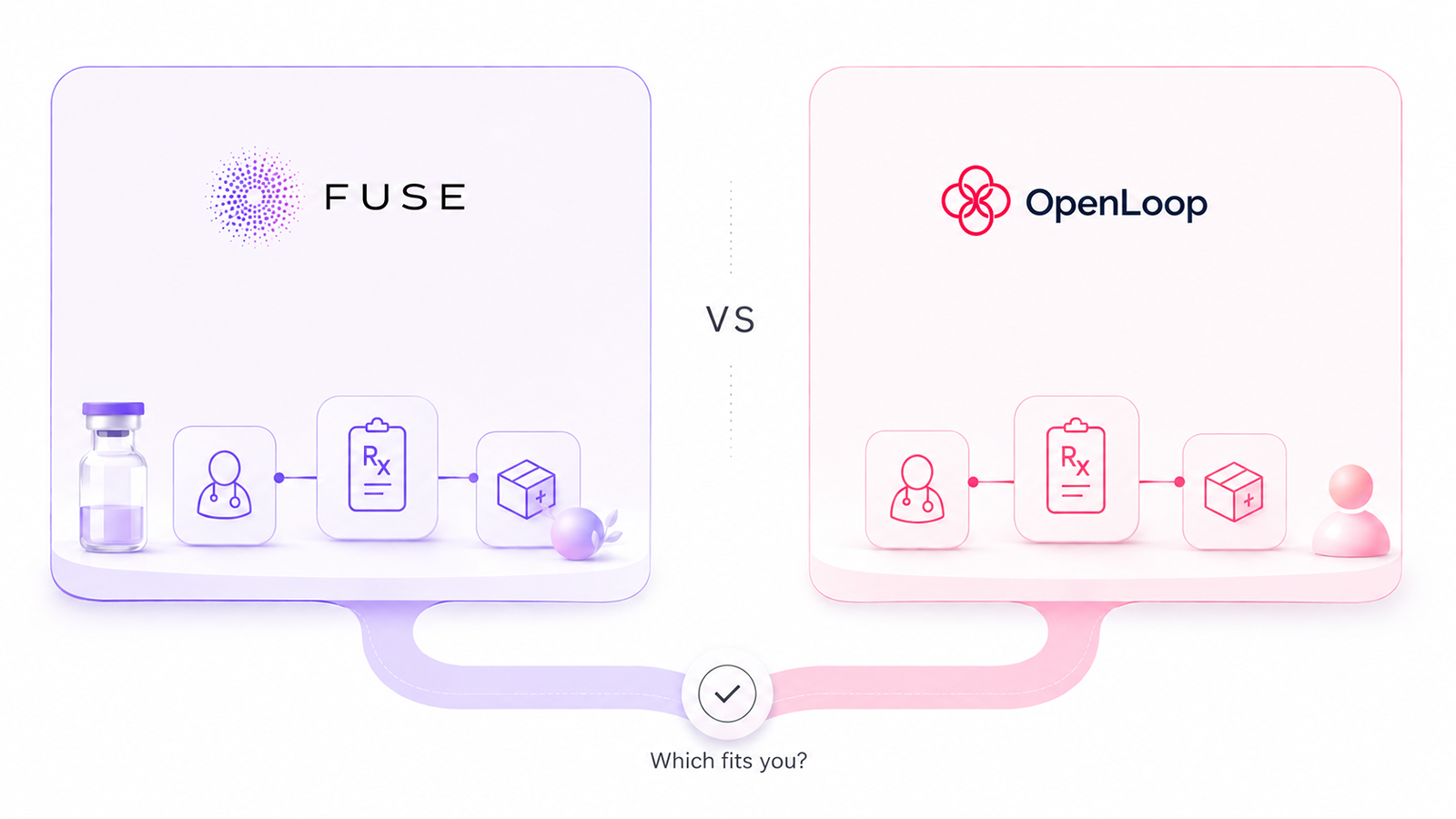
FUSE vs OpenLoop comes down to one question: are you selling cash-pay programs under your own brand, or building insurance-billed virtual care at enterprise scale? FUSE publishes its price and gets an operator live in days. OpenLoop quotes on request and serves a broader clinical and payer footprint.
FUSE vs OpenLoop, Decided in One Paragraph
FUSE vs OpenLoop is not a better-or-worse question. It is a business-model question, and the answer shows up in the pricing page. FUSE lists every plan price in public, from $499 to $3,000 per month, including the upfront fees on Growth and Partner, with no per-visit or per-prescription charge. OpenLoop does not publish rates and routes buyers to a sales conversation. That single difference tells you who each platform was built for. If you are the operator with an audience, a domain and no prescriber, you are pricing a program this quarter, not scoping a procurement cycle.
Both companies do the same core thing at a high level, which is what a white-label telehealth platform actually provides. Your brand sits on the front. Licensed providers, pharmacy and compliance run behind it. What separates them is how much of the healthcare system each one is trying to carry, and what that weight costs you in time before your first patient checks out.
See the workflow before you pick a model. Book a platform walkthrough and see intake, provider review and pharmacy routing running end to end. Book a platform walkthrough
What Each Platform Says It Is
Neither description below is our interpretation. Both are taken from what each company publishes about itself.
FUSE Health positions as the compliance and infrastructure layer behind modern peptide and GLP-1 brands. The pitch is an operator storefront: you bring the brand and the demand, FUSE supplies licensed providers in all 50 states, pharmacy fulfillment, the patient portal and the certifications that payment processors ask for. FUSE states that no medical license is required to run a program on it.
OpenLoop Health positions as the white-label operating system for virtual care. Founded in 2020 and based in Des Moines, it publishes a wider surface area: provider staffing across 35+ specialties and 15+ languages, a private-label EHR with API access, NCQA-accredited licensing and credentialing, chronic care management, remote patient monitoring, diagnostic imaging, and revenue cycle management against 600+ payer contracts.
Read those two paragraphs again and the split is obvious. One is a storefront with clinical rails underneath. The other is a care-delivery organization you can rent.
The Comparison Table
| Factors | FUSE Health | OpenLoop Health |
|---|---|---|
| Self-description | Compliance and infrastructure layer behind peptide and GLP-1 brands | White-label operating system for virtual care |
| Published pricing | Yes. $499/mo DIY, $699/mo Growth, $3,000/mo Partner | No. Quoted after a sales conversation |
| Setup or onboarding fee | $0 DIY, $5,600 Growth, $30,000 Partner (published) | Not published |
| Per-visit or per-prescription fees | None. Wholesale pricing on every order | Not published |
| Contract posture | Billed monthly; Partner includes the first 12 months | Not published |
| Stated time to launch | Signup to first patient in hours; compliant program in days | 48 hours out of the box; 5 to 7 weeks with integrations |
| Provider coverage | All 50 states | All 50 states, 35+ specialties, 15+ languages |
| Program focus | Peptides, GLP-1, NAD+, testosterone, minoxidil and compounded programs | Weight loss, hormones, sexual health, mental and behavioral health, urgent care, dermatology, sleep, peptides, diagnostics |
| Insurance billing | Not offered. Cash-pay model | Yes. 600+ payer contracts, RCM included |
| Pharmacy | 503A and 503B network, routing included | Pharmacy and diagnostics network |
| Certifications stated | LegitScript, SOC 2 Type II, HIPAA | LegitScript approved, SOC 2 via Vanta, HIPAA |
| Credentialing | Providers credentialed and verified by FUSE | NCQA-accredited licensing and credentialing service |
| Developer access | Pre-built checkout or API connection | API-driven platform with staging and production environments |
| Scale stated | 1,200+ programs launched, under 24 hours average provider review | 400+ virtual care brands, 700,000+ patients monthly |
Every row above is drawn from each company's own published material. Where a company does not publish a figure, the cell says so rather than guessing.
Where FUSE Is the Stronger Choice
You can price your program before you take a sales call
This is the practical difference and it is worth naming first. A published number lets you build a margin model on a Tuesday afternoon. $699 a month, wholesale product cost, your retail price. That is the whole calculation. FUSE also publishes its upfront fees and takes no per-visit or per-prescription cut, which means your unit economics do not degrade as volume climbs. Growth stays $699 a month whether you run 40 patients or 400.
Quote-based pricing is not a flaw. It is a signal about deal size. It tells you the platform expects a scoping call, a legal review and a procurement path. If your launch window is measured in weeks, that path is a cost even when the software is excellent.
Speed to first revenue, not speed to kickoff
FUSE publishes a signup-to-first-patient window measured in hours and a compliant program launch measured in days. The mechanism is that nothing gets built for you. Intake templates, provider review queues, pharmacy routing and the branded storefront already exist, and configuring them is a settings exercise rather than an implementation project.
OpenLoop publishes a comparable out-of-the-box figure of 48 hours, and a 5 to 7 week track once integrations, workflow mapping and testing enter the picture. Both numbers are honest. They describe two different scopes of work. The question is which scope your business actually needs.
Cash-pay programs, built as cash-pay programs
FUSE runs a cash-pay model on purpose, and the operator use cases are grouped by business type rather than by feature. There is no payer billing layer, no claims workflow and no eligibility check sitting between a customer and checkout. For an operator selling a subscription peptide or GLP-1 program, that removes an entire category of failure. Payment is a card charge, not a claim that can be denied ninety days later.
FUSE states 94% refill retention across its programs and average provider review under 24 hours. Those two numbers are the same story told twice. Subscription revenue survives when the refill clears quickly, and it dies when it does not. The pharmacy is the product.
The certifications a payment processor asks for
LegitScript certification, SOC 2 Type II and HIPAA are listed on the FUSE site as platform-level, not as something you assemble yourself. This matters more than it sounds. Health payments get frozen for missing certification more often than for anything clinical, and a frozen processor stops the business, not just the transaction. Stripe does not send a warning.
Map your program before you sign anything. Bring your category, your target price and your state list, and we will map the intake, provider and pharmacy path. Book a program consultation
Where OpenLoop Is the Better Fit
Honesty here buys credibility everywhere else on this page, so here is the plain version.
Choose OpenLoop if you need insurance billing. FUSE does not offer it. OpenLoop publishes 600+ payer contracts and an integrated revenue cycle management service, and that is a genuinely hard thing to build. If your model depends on reimbursement, this comparison ends here.
Choose OpenLoop if you need clinical breadth beyond program-based prescribing. Chronic care management, remote patient monitoring, diagnostic imaging, urgent care and behavioral health are on their published list. FUSE is built around program categories, not general virtual care.
Choose OpenLoop if you are an enterprise buyer with an engineering team. The API-first platform with staging and production environments, plus NCQA-accredited credentialing sold as a standalone service, is aimed at organizations that want components rather than a finished storefront.
None of that competes with the operator use case. It sits next to it.
How the FUSE Workflow Actually Runs
Understanding the mechanism is what makes the decision feel safe, so here are the rails an order travels.
Step one. The customer lands on your storefront, on your domain, under your brand, and completes intake. FUSE operates behind your logo rather than beside it.
Step two. Intake syncs to a HIPAA-compliant EMR. Only the reviewing provider sees clinical detail.
Step three. A licensed provider in that patient's state reviews the intake asynchronously and approves or declines. State rules are enforced at intake, so a patient in a state where a program is unavailable cannot complete the order.
Step four. Approved prescriptions route to the partner pharmacy network, 503A or 503B depending on the product.
Step five. Refills, notifications and the audit trail run automatically. That audit trail covers intake, prescription and refill.
The operator never touches steps two through five. That is the entire argument for buying infrastructure instead of assembling it.
What Actually Breaks, and What Prevents It
Three failures kill operator telehealth businesses, and none of them are marketing failures.
Payments freeze. A processor discovers you are moving prescription products without certification and stops settlement. Platform-level LegitScript certification is the mechanism that prevents this, which is why it belongs to the platform rather than to you.
Prescriber capacity runs out. Demand arrives faster than review does, refills stall, and churn follows. A 50-state credentialed network with review time held under 24 hours is what keeps the queue moving as volume climbs.
Margin erodes with scale. Per-visit and per-prescription fees mean every new patient costs you more in platform fees. A flat monthly price with wholesale product cost does the opposite. Scale improves the margin instead of taxing it.
Conclusion: Pick the Model, Not the Logo
If you are an operator selling cash-pay programs under your own brand and you want to know your cost structure before you talk to anyone, FUSE is the shorter path. Published price, no per-transaction fees, providers in all 50 states, pharmacy routing and the certification stack already in place, live in days rather than quarters. If your model runs on insurance reimbursement or spans general virtual care, OpenLoop is built for that and this page should tell you so plainly.
The wrong move is choosing the bigger platform because bigger feels safer. Infrastructure you do not use still shows up in the implementation timeline and the quote. Buy the model you are actually running.
References
- FUSE Health pricing
- FUSE Health, how this works
- OpenLoop Health homepage
- OpenLoop Health technology platform
- Who is OpenLoop Health

Daniel is a two-time founder who has scaled service businesses across major U.S. markets. A Y Combinator competition winner, he focuses on removing operational and regulatory barriers so operators can build and scale modern healthcare businesses.
- Background
- Startup Operations & Service Systems
- Experience
- 2x Founder, Multi-Market U.S. Scaling
- Qualifications
- Healthtech Market Expertise & Operational Scaling
- Key Achievement
- Scaled Premier Staff & Eventstaff across major U.S. markets