

Perimenopause telehealth has real demand behind it. The FDA removed broad boxed warnings from HRT labels, yet only about 2 million of 41 million U.S. women aged 45 to 64 were on hormone therapy. This use case shows how operators launch a compliant program without building a clinic.
Introduction
Perimenopause telehealth is filling a gap that starts in medical training. When researchers surveyed U.S. ob-gyn residency program directors in 2022, only 31.3% said their program had a menopause curriculum, and every program that did have one ran five or fewer menopause lectures a year (Healio, reporting Allen et al., Menopause, 2023).
The cost of that gap is easy to measure. A Mayo Clinic study of 4,440 employed women aged 45 to 60 put the price of menopause symptoms at $1.8 billion a year in lost U.S. work time, and $26.6 billion once medical expenses are added (Mayo Clinic News Network). Then, in November 2025, the FDA announced it would pull the broad boxed warnings from hormone therapy products, and the conversation around online HRT got a lot louder overnight.
If you run a wellness brand, a med spa, a women's health community, or a GLP-1 program with a big audience over 40, you're probably already hearing "Do you offer anything for this?" Here's how a menopause telehealth program runs, where launches break, what compliance looks like, and how to go live in weeks.
Why perimenopause care is moving to telehealth
Two things changed at once, and together they explain why so many operators are looking at perimenopause telehealth right now.
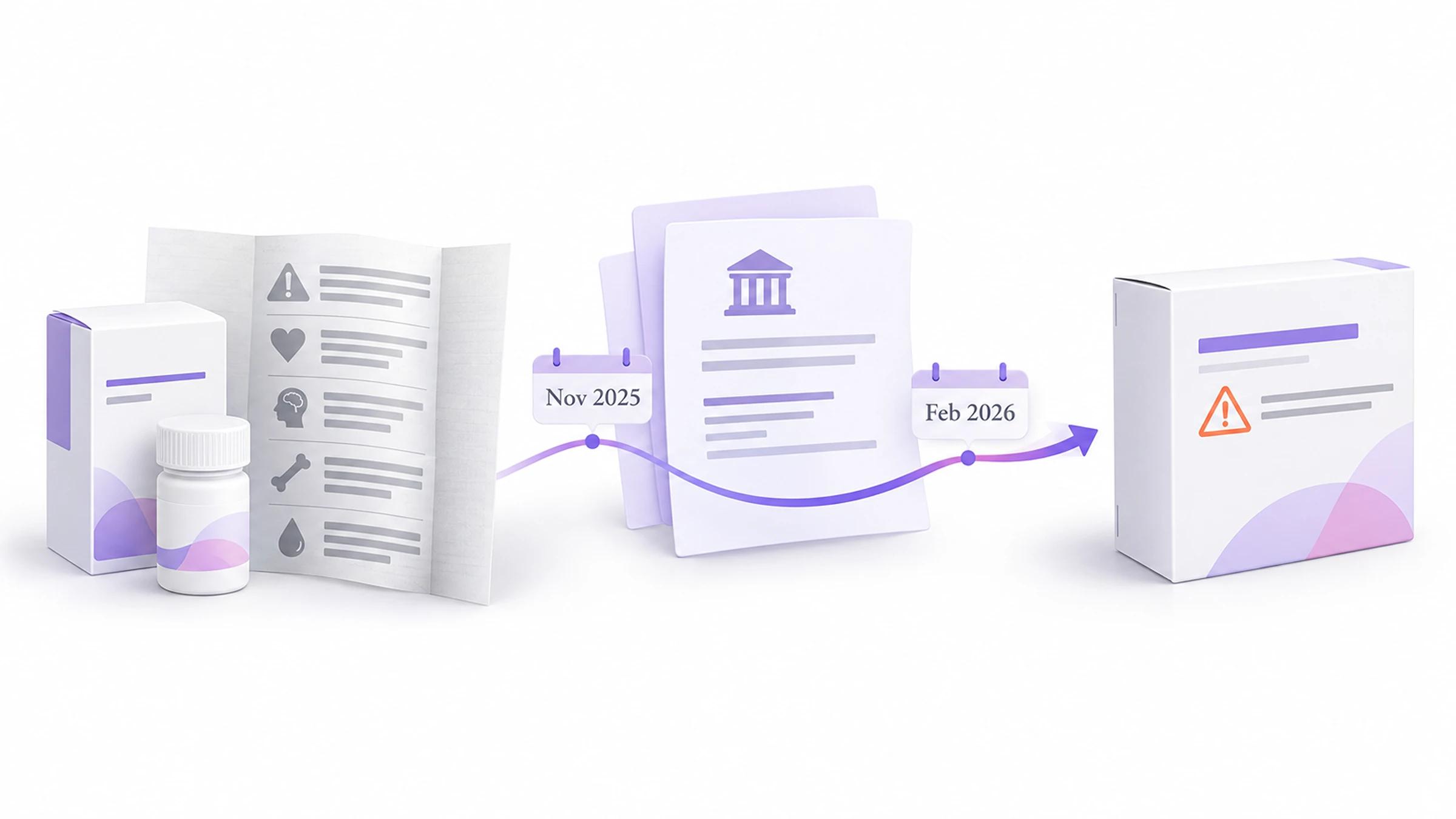
The first is regulatory. On November 10, 2025, HHS and the FDA announced they'd remove the boxed warnings on menopausal hormone therapy that referenced cardiovascular disease, breast cancer, and probable dementia (FDA). The labeling changes were approved in February 2026 (CancerNetwork). The boxed warning for endometrial cancer stays on systemic estrogen-alone products, and the new labels say systemic HRT should be started within 10 years of menopause onset or before age 60, with timing and duration left to the prescriber and patient.
Key insight: The boxed warnings traced back to a Women's Health Initiative study whose participants averaged 63 years old, more than a decade past the typical age of menopause, and who were given a hormone formulation that's no longer in common use (FDA).
The second change is the size of the untreated group. The FDA's February 2026 announcement noted that, as of 2020, there were 41 million U.S. women aged 45 to 64 and roughly 2 million of them were on hormone therapy (CancerNetwork). That's about one in twenty.
Perimenopause telehealth closes the geography part of that gap. A provider licensed in the patient's state can review an intake from anywhere, and asynchronous review means the patient doesn't have to schedule a video call around her workday.
Who this use case is for
This use case fits operators who already have trust with women in their 40s and 50s and want to turn that trust into a structured care program. In practice, that's usually one of these groups:
- Women's health and wellness brands, including coaches, communities, and supplement companies, that want a prescription program without becoming a medical practice.
- Med spas and hormone clinics that already see perimenopausal patients locally and want to reach people outside their zip code.
- GLP-1 and weight management operators whose customers overlap heavily with this age group and who want a hormone line on the same storefront.
- Nurse practitioners and physicians going independent who want to prescribe in their licensed states while the backend is handled for them.
How a menopause telehealth program runs step by step
A menopause telehealth program has five moving parts. Your customer only sees the first one. The other four run behind your brand, and each has a clear owner. (For the wider category view, see how to launch a hormone therapy program online in weeks.)
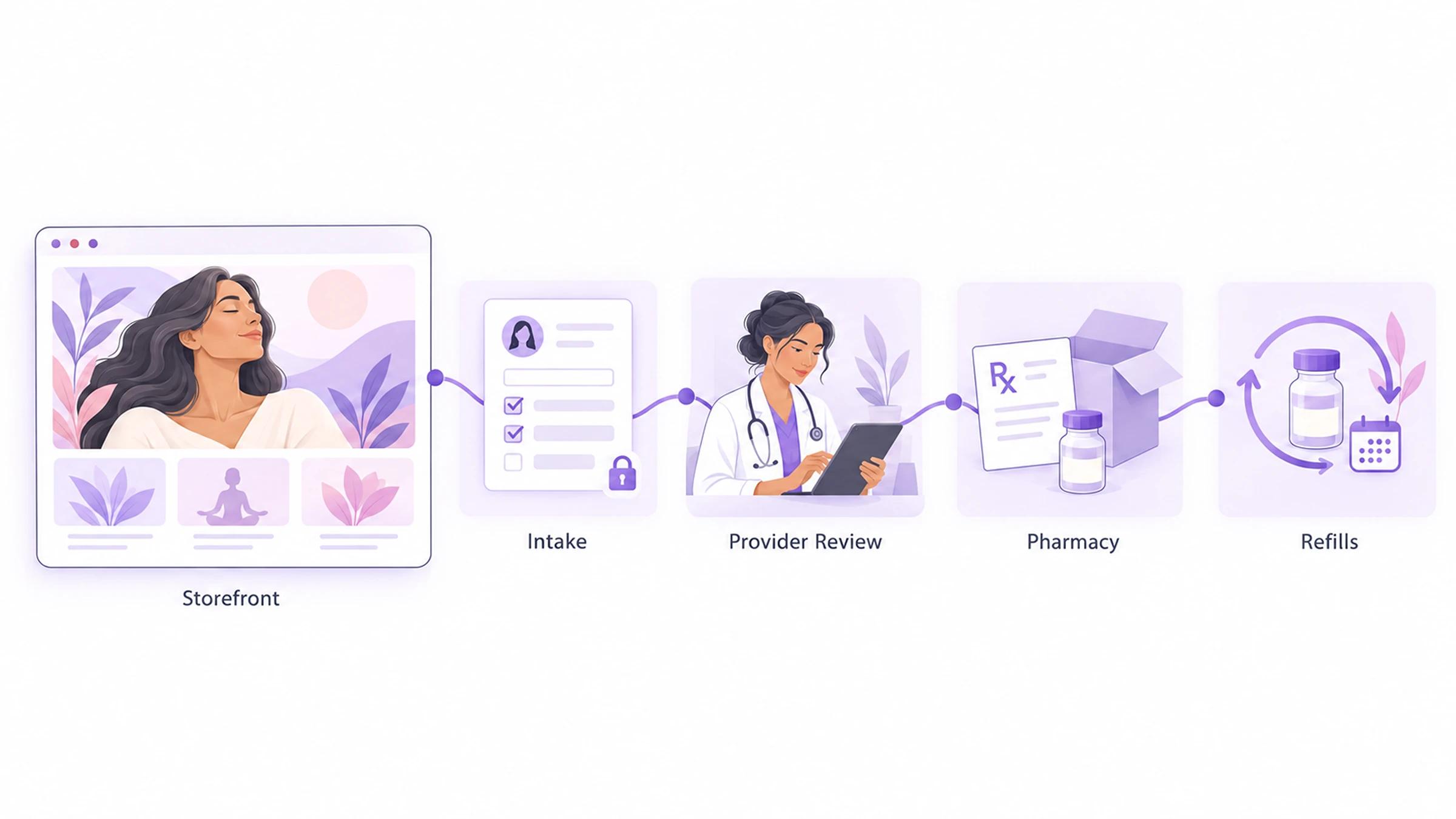
- Step 1: The storefront and program design
Your brand owns the domain, program page, pricing, and checkout. This is where you define the perimenopause telehealth offer and how you'll describe it. Keep the first launch to one program, because every extra program brings its own intake, review criteria, pharmacy setup, and refill schedule.
- Step 2: Intake and eligibility screening
The intake collects what a licensed provider needs to decide: health history, current medications, symptoms, and state of residence, in the same format every time. Since this is protected health information, it has to run on HIPAA-compliant technology, so a generic form builder won't cut it.
- Step 3: Licensed provider review
A provider licensed in the patient's state reviews the intake, asynchronously or over video, and decides whether a prescription is appropriate. They can also order labs, ask for more information, or decline. Your support team can handle shipping and billing questions, but eligibility and treatment decisions always stay with the clinician.
- Step 4: Prescribing and pharmacy routing
Once a provider approves a prescription, it goes electronically to a pharmacy that holds dispensing authority for that patient's state. Hormone programs add a wrinkle here. Estrogen and progesterone products follow standard prescription rules, but testosterone is a controlled substance, so any program that includes it needs a pharmacy with the right DEA registration.
- Step 5: Follow-up, refills, and ongoing review
Hormone therapy is ongoing care, so the refill cycle is where recurring revenue lives. Refills should queue automatically, with any required clinical check-in done before the order reaches the pharmacy, and payments need retry logic for failed cards.
What fails and what works in online HRT programs
When an online HRT launch stalls, the cause is almost always operational, and it tends to surface right when volume arrives. We've written about the broader pattern in where telehealth launches break at scale, and hormone programs follow it closely.
| Where it breaks | What tends to fail | What works |
|---|---|---|
| Intake | A general form that misses the history a provider needs, so cases bounce back for more information | A program-specific intake that collects everything required for review in one pass |
| Provider capacity | One or two contracted clinicians who can't absorb a spike after a marketing push | Routing across a provider network by state license and queue availability |
| Pharmacy | Pharmacy contracts started after the build, which can add months before the first shipment | Pharmacy routing configured and tested before launch, including DEA-registered dispensing if testosterone is offered |
| Messaging | Landing pages promising symptom relief or outcomes | Copy that describes the program and the review process, and leaves clinical claims to the provider |
| Refills | Manual reminders and one-off payments | Automatic refill queues with clinical check-ins and payment retries built in |
The common thread is timing. Each of these fixes is cheap to set up before launch and expensive to retrofit once patients are in the system.
The compliance layer behind hormone therapy telehealth
Hormone therapy telehealth sits under several overlapping rules, and your storefront copy is where most operators get exposed first. Here's what the compliance layer covers, and our guide to telehealth compliance without the legal rabbit hole maps who owns each piece.
Labeling and marketing claims
The boxed warnings changed, but the labels still carry risk information and the endometrial cancer warning remains on systemic estrogen-alone products. Your marketing shouldn't describe hormone therapy as risk-free or promise results. The FDA's approved indications are tied to menopause, so whether a given perimenopausal patient is a candidate is a clinical decision for the licensed provider, and your copy should say that plainly.
Compounded hormones
Some hormone programs use compounded preparations. The FDA states that compounded drugs aren't FDA-approved, so the agency doesn't verify their safety, effectiveness, or quality, and that telehealth promotion of prescription drugs, compounded ones included, must be truthful and non-misleading (FDA). Describe any compounded options accurately and never present them as equivalent to approved products.
Controlled substances and state licensure
Testosterone is a Schedule III controlled substance. Under the DEA's current telemedicine flexibilities, DEA-registered practitioners can prescribe Schedule II through V medications over audio-video telemedicine without a prior in-person visit, through December 31, 2026 (DEA). Permanent rules aren't final yet, so design the testosterone piece to adapt. Every prescription also depends on a provider licensed in the patient's state and a pharmacy allowed to dispense there.
Key insight: Estrogen and progesterone programs aren't affected by the DEA deadline at all. Only the testosterone line of a hormone program carries that dependency, so you have the option of launching estrogen and progesterone first and adding testosterone once the rules settle.
How FUSE Health supports a perimenopause telehealth program
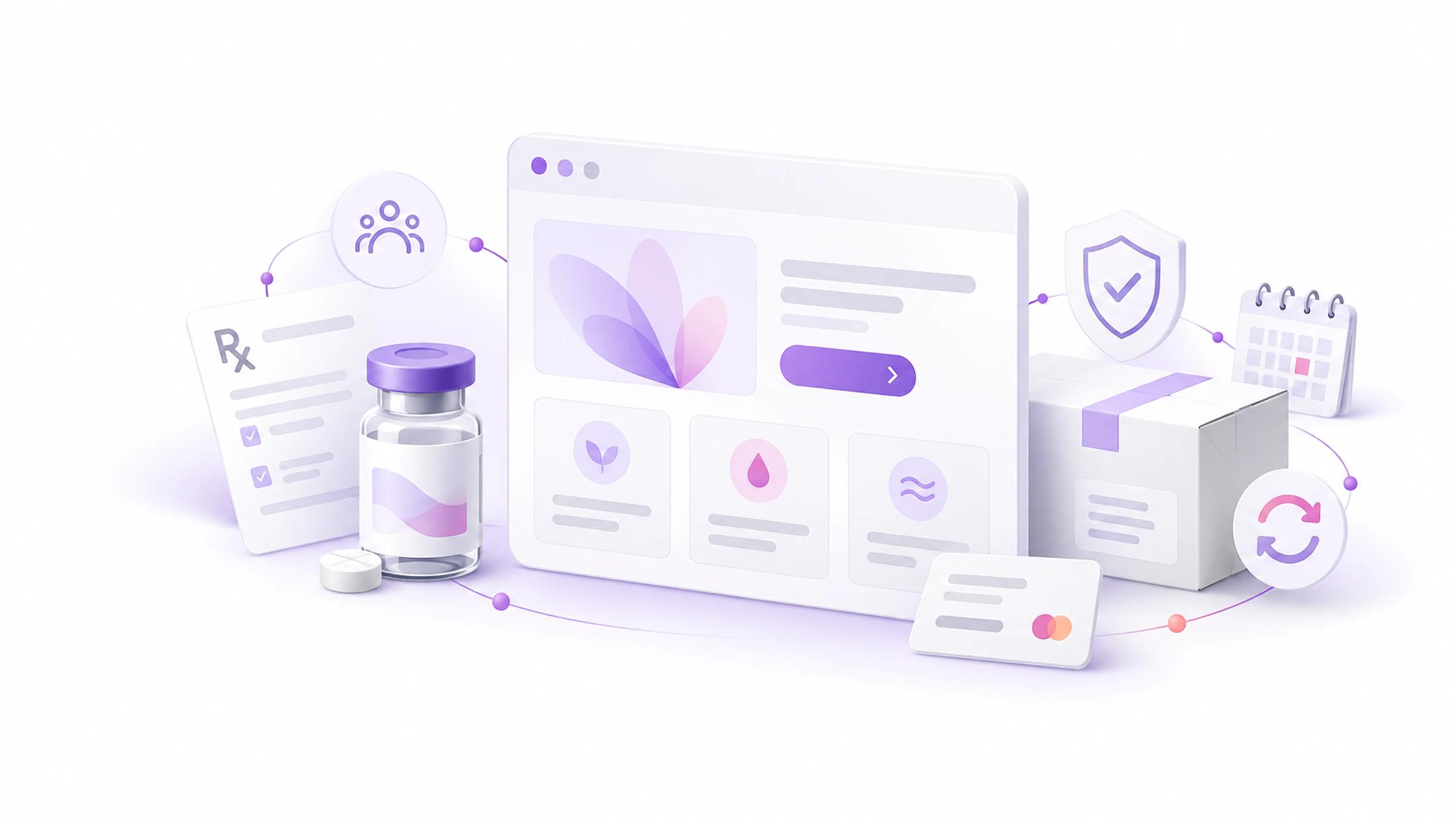
FUSE Health is built for the operator who has the audience and wants the program, without hiring clinicians, negotiating pharmacy contracts, or writing software. You sell the program under your own brand. The clinical and operational layer runs behind it, in the same five-step order described above.
Here's what that covers for a hormone therapy telehealth launch:
- A white-label storefront on your domain, so the patient relationship and the marketing stay yours.
- Program-specific intake on HIPAA-compliant infrastructure, feeding a licensed provider network that routes cases by state license, credentials, and queue availability, with async and video review built in.
- Pharmacy partners already configured for hormone replacement and testosterone, including DEA-registered controlled-substance dispensing. Our pharmacy integration use case explains the routing.
- Refill logic that queues required clinical review before the pharmacy order, plus payments and a dashboard for enrollments, approvals, declines, and refills.
- LegitScript certification, SOC 2 Type II, and HIPAA compliance at the platform level.
The clearest proof is a hormone program that's already live. A regional diagnostics brand with five locations and more than 18,000 annual customers launched a hormone optimization program on FUSE Health in six weeks. It started with one program instead of the three leadership originally wanted, configured refills before the first enrollment, and tracked telehealth revenue separately from lab revenue. Most of its first-90-day enrollments came from customers it already had (FUSE Health case study).
Conclusion
The demand behind perimenopause telehealth is documented: a label change that removed the broad boxed warnings, about one in twenty U.S. women aged 45 to 64 on hormone therapy as of 2020, and fewer than a third of surveyed ob-gyn residency programs teaching a menopause curriculum. Whether your program holds up comes down to the parts your customer never sees.
Put intake, licensed review, pharmacy routing, and refills in place before your first enrollment and you can launch one program, learn from real data, and add the next without rebuilding.
Your next step is simple. Book a walkthrough and we'll map your perimenopause telehealth program onto live infrastructure, so you can see how quickly your brand could be taking its first enrollments.
Disclaimer: This article is for informational purposes only and doesn't constitute medical or legal advice. Treatment decisions are made by licensed providers based on each patient's individual history. Operators should confirm current federal and state requirements with qualified legal counsel before launching.
References
- FDA: HHS Advances Women's Health, Removes Misleading FDA Warnings on Hormone Replacement Therapy (November 10, 2025)
- CancerNetwork: FDA Removes Black Box Warning for Breast Cancer and Other Indications on HRT Products (February 16, 2026)
- Mayo Clinic News Network: Mayo Clinic study puts price tag on cost of menopause symptoms for women in the workplace (April 26, 2023)
- Healio: Most OB/GYN residency programs in US lack dedicated menopause curriculum (August 10, 2023)
- DEA: DEA Extends Telemedicine Flexibilities to Ensure Continued Access to Care (December 31, 2025)
- FDA: Compounding and the FDA, Questions and Answers
- FUSE Health: How a Lab Brand Launched White Label Telemedicine Fast

Daniel is a two-time founder who has scaled service businesses across major U.S. markets. A Y Combinator competition winner, he focuses on removing operational and regulatory barriers so operators can build and scale modern healthcare businesses.
- Background
- Startup Operations & Service Systems
- Experience
- 2x Founder, Multi-Market U.S. Scaling
- Qualifications
- Healthtech Market Expertise & Operational Scaling
- Key Achievement
- Scaled Premier Staff & Eventstaff across major U.S. markets