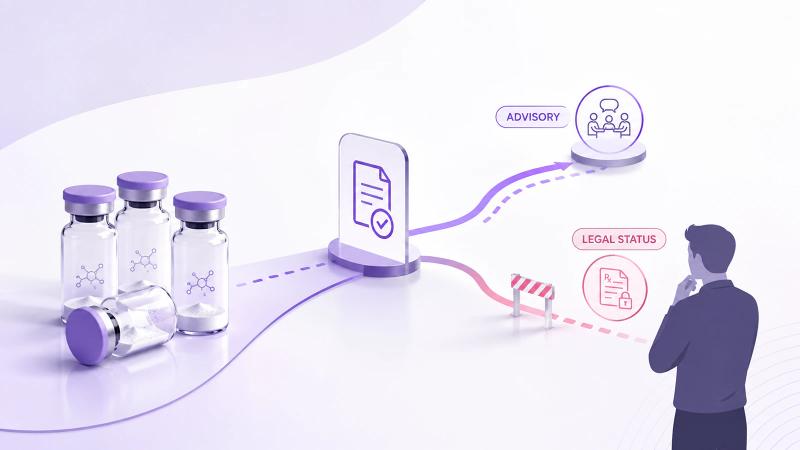

The FDA peptide ban list is not a document the FDA publishes. It is the Category 2 list, and in April 2026 twelve peptides came off it. Removal did not make them legal to compound. It moved them into a gap that most operators are misreading as a green light.
The FDA peptide ban list is the most cited document in this industry that does not exist. Ask ten operators to send it to you, and you get ten different screenshots, most of them wrong, several of them a year stale.
In April 2026, the FDA removed twelve peptides from the list people mean when they say ban list. Within a week, catalogs were updated, ads were written, and a fair number of brands started selling substances they still cannot lawfully source. The regulatory language for what happened was precise and boring. The industry translation of it was neither.
Here is what actually came off, what is still on, and what the gap between those two facts costs you.
There is no ban list. There is a Category 2 list
The FDA maintains no list of banned peptides. It maintains a list of bulk drug substances that "may present significant safety risks," known as Category 2 under the agency's interim compounding policy. A substance on it is one the FDA has said it may take enforcement action over if a pharmacy compounds with it.

Three things follow, and all three are routinely missed. The list governs compounding from bulk substances only. It is short, and it is not mostly peptides, holding fourteen substances, of which five are peptides. And coming off it is not the same as being allowed, because the list for allowed is a different list entirely.
What came off in April 2026
On April 15, 2026, the FDA announced it would remove twelve peptide bulk drug substances from Category 2 within seven days, effective on or about April 22. This is the action behind every "peptides unbanned" headline since.
The twelve peptides removed from FDA Category 2 in April 2026, and where each stands after the July 2026 advisory committee vote.
| Peptide | Status | PCAC action, July 2026 |
|---|---|---|
| BPC-157 | In the gap | Recommended for the 503A Bulks List |
| TB-500 (Thymosin Beta-4 fragment) | In the gap | Recommended for the 503A Bulks List |
| KPV | In the gap | Recommended for the 503A Bulks List |
| MOTS-c | In the gap | Recommended for the 503A Bulks List |
| Semax (heptapeptide) | In the gap | Recommended for the 503A Bulks List |
| Epitalon | In the gap | Recommended for the 503A Bulks List |
| Emideltide (DSIP) | In the gap | Voted down |
| Melanotan II | In the gap | Not reviewed in July |
| Cathelicidin LL-37 | In the gap | Not reviewed in July |
| PEG-MGF | In the gap | Not reviewed in July |
| GHK-Cu (injectable routes) | In the gap | Not reviewed in July |
| Dihexa acetate | In the gap | Not reviewed in July |
Read the middle column twice. All twelve came off the restricted list and landed nowhere. Removal "does not, by itself, place these substances on the 503A bulks list or into Category 1." Compounding them still carries enforcement exposure.
What is still on the list

The remaining peptide entries are worth knowing by name, because several are still marketed as though the April action covered them. It did not.
Peptide substances remaining on the FDA Category 2 list, with the compounding pathway each restriction applies to.
| Substance | Applies to | Listed since |
|---|---|---|
| Ipamorelin acetate | 503B outsourcing facilities | September 29, 2023 |
| GHRP-2 (injectable and nasal) | 503B outsourcing facilities | September 29, 2023 |
| GHRP-6 | 503B outsourcing facilities | September 29, 2023 |
| Ibutamoren mesylate | 503A and 503B | December 2022 and September 2023 |
| Kisspeptin-10 | 503A pharmacies | September 29, 2023 |
Ipamorelin is the one that catches people. It was named in early coverage of the announcement, is widely assumed to have been part of the April release, and is still on the list. A growth hormone secretagogue line built on a headline rather than on the list itself is a real exposure.
The gap nobody is pricing in
The FDA runs three interim buckets. Category 1 is where the agency has said it does not intend to act against compounders that meet the guidance conditions. Category 2 is the risk list. Category 3 is for substances nominated without enough information to evaluate.
The twelve did not move to Category 1. They left Category 2 and joined none of the others. That difference is everything, because enforcement discretion attaches to Category 1 and nothing else. A pharmacy compounding a removed peptide today is not protected by the removal.
This is why the "rfk peptide list" circulating in operator groups is misleading rather than simply wrong. The February 2026 announcement described roughly fourteen of nineteen peptides moving to Category 1. What the agency executed two months later was a removal of twelve into no category at all, and the two name lists do not match.
Operator translation. Do not build a product line on an announcement. Build it on the published list, and re-check the published list before every catalog change. The two have diverged twice this year.
What the July vote did, and what it did not
On July 23 and 24, 2026, the Pharmacy Compounding Advisory Committee reviewed seven of the removed peptides and voted in favor of six for inclusion on the 503A Bulks List. Emideltide was voted down. A further review of the remaining peptides is expected before February 2027.
A committee vote is advised. The FDA is not bound by it, and nothing joins the 503A Bulks List until formal rulemaking is complete. Until then, the practical status of BPC-157 and TB-500 is unchanged, whatever your supplier's landing page says. The realistic planning horizon is 2027, not this quarter.
What you can still prescribe
Strip the noise out and the prescribable set is stable, which is the part the coverage never mentions.

Approved peptide drugs
Peptides holding FDA approval are prescribable and dispensable through normal licensed channels. That includes the GLP-1 class and a long tail of approved peptide therapeutics across metabolic and hormone care. No list-watching required.
Substances that qualify for 503A compounding
A 503A pharmacy can compound for an individual patient using a bulk substance that has a USP monograph, is a component of an approved drug, or appears on the 503A Bulks List, so long as the result is not essentially a copy of an available commercial product. That test does not care about Category 2 at all, which is why several peptide programs run cleanly without ever touching the contested names.
What stays off the table
Research-chemical sourcing, structure or function claims made outside a prescription pathway, and any of the twelve removed peptides compounded from bulk while rulemaking is pending. Disclaimers on a label do not change how the FDA reads a funnel.
Running a catalog through a moving list
Operators who handle this well are not the ones with the best legal intuition. They are the ones whose catalog is structured so a list change is a lookup rather than an investigation. Every SKU is tagged to a named pathway, not just a pharmacy partner. Sourcing is separated from the storefront, so swapping a partner does not mean rebuilding your funnel. Clinical review, documentation, and payments sit underneath the brand rather than inside it.
That separation is what FUSE Health was built to provide. Operators own the brand, the offer, and the customer. The regulated machinery underneath is structured, documented, and swappable, which is the only version of this business that survives a list that changes twice a year.
What FUSE takes off your plate
The reason a list change hurts is almost never the list. It is that most peptide operators are quietly running four regulated functions they never set out to run: pharmacy sourcing, prescriber licensing, clinical documentation, and payment underwriting. Each one is somebody's full-time job. When a category moves, all four move at once, and a two-person marketing team is suddenly doing regulatory triage instead of selling.

FUSE exists so that layer is already built. Operators bring the brand, the offer, and the audience. Everything underneath is standing infrastructure, documented and swappable, which is what turns a list change from a fire drill into a config update.
What an operator keeps, what FUSE runs underneath, and what each layer does when the FDA moves a substance between categories.
| Layer | Who runs it | What happens when a list moves |
|---|---|---|
| Brand, offer, pricing, customer relationship | You | Nothing. Your funnel, your list, and your margin structure are untouched |
| Pharmacy sourcing and supply documentation | FUSE network | Partner swapped behind the storefront, or the SKU pauses cleanly, without a rebuild |
| Prescriber coverage and license tracking | FUSE | Coverage map updates. No rehiring, no state-by-state scramble |
| Clinical review and per-patient records | FUSE workflow | The audit trail for affected orders already exists and can be produced |
| Payments and category underwriting | FUSE | A category change does not trigger a processor review you did not see coming |
That is the breakthrough, and it is a boring one. Not a shortcut around the rules, and not a promise that regulatory risk disappears, because in this category it does not. What changes is who carries it and whether it is visible. A non-clinical operator can launch a compliant program without first becoming a healthcare company, and can go live in weeks rather than quarters, because the slow part was never the website. It was the four functions above.
Selling peptides stops being a legal project and becomes a catalog decision. You still make that decision with the list open in front of you. You just stop making it alone.
The decision in front of you
The list did get shorter in 2026. It did not get replaced with a permission list, and the difference between those two sentences is where the enforcement risk lives right now.
You have two options. Wait for rulemaking and hope your current sourcing holds, or build a program where the list is an input rather than a dependency. The first is a bet on a Federal Register notice. The second is a business.
Regulatory note. This article is written for operators and business decision-makers. It is general information about the regulatory landscape, not legal advice and not medical advice, and it does not recommend any peptide for any person or condition. FDA lists referenced here change without notice, and state pharmacy and telehealth rules add requirements beyond the federal picture described. Confirm current status directly with the FDA and with qualified regulatory counsel before making product decisions. Prescribing and dispensing decisions belong to licensed clinicians and pharmacies.
References
- FDA, Certain Bulk Drug Substances for Use in Compounding That May Present Significant Safety Risks (Category 2 list)
- FDA, Bulk Drug Substances Used in Compounding Under Section 503A of the FD&C Act
- FDA, July 23-24, 2026 Meeting of the Pharmacy Compounding Advisory Committee
- Orrick, FDA Announces Removal of 12 Peptides from Category 2 and Schedules PCAC Meetings
- Frier Levitt, FDA to Remove 12 Popular Peptides from the Category 2 Do Not Compound List
- Buchanan Ingersoll & Rooney PC, FDA PCAC Recommends Six Peptides for the 503A Bulks List
- Pharmacy Times, A Pharmacist's Take on What RFK Jr's Announcement Actually Means

Daniel is a two-time founder who has scaled service businesses across major U.S. markets. A Y Combinator competition winner, he focuses on removing operational and regulatory barriers so operators can build and scale modern healthcare businesses.
- Background
- Startup Operations & Service Systems
- Experience
- 2x Founder, Multi-Market U.S. Scaling
- Qualifications
- Healthtech Market Expertise & Operational Scaling
- Key Achievement
- Scaled Premier Staff & Eventstaff across major U.S. markets