

Is it illegal to sell peptides online? It depends entirely on how your program is structured. Without a licensed clinical layer, the answer leans toward yes. With one, operators can build compliant programs that scale. Here is what separates the two.
The Question Every Operator Searches but Rarely Gets a Straight Answer To
Is it illegal to sell peptides online? Most operators who type this into a search bar walk away more confused than when they started. One source says peptides are unregulated research chemicals. Another says they are controlled drug substances. A third points to compounding pharmacy loopholes that may or may not still exist.
The confusion is real, but it is not because the rules are unclear. It is because most sources do not separate the legal model from the illegal one. That distinction is exactly what this article covers.
That answer turns on one question: is a licensed provider making the clinical determination, or is the operator bypassing that step entirely? The answer determines whether your program is defensible or not.
What the FDA Actually Says About Selling Peptides Online
In September 2023, the FDA placed a group of popular peptides, including BPC-157 and TB-500, in Category 2 of its interim compounding policy, the list of bulk substances it says may present significant safety risks. That put compounding pharmacies on notice that FDA may take enforcement action if they compounded with them.
For any operator asking whether it is illegal to sell peptides online, that listing was the starting point, and 2026 has moved it twice. In April, FDA removed twelve of those peptides from Category 2 without moving them to any category that allows compounding.
Since October 28, 2026, HHS's draft enforcement discretion policy says it won't take action against 503A pharmacies that compound BPC-157, TB-500, KPV, MOTS-c, Semax or Epitalon when ten conditions are met. None of the six is FDA approved or on the 503A Bulks List, and the policy doesn't cover 503B facilities or research-use-only sellers. Our legality guide walks through all ten conditions.
Where the most-asked peptides stand today:
- BPC-157, TB-500, KPV, MOTS-c, Semax and Epitalon: conditional 503A route under HHS's October 2026 draft policy, single ingredient and set routes only
- GHK-Cu (injectable): removed from Category 2 in April 2026, with no compounding route yet and a committee review expected before the end of February 2027
- Selank: nomination withdrawn, so there's no compounding route
Semaglutide and tirzepatide sit in a separate lane because they're FDA-approved drugs. Their shortages have been declared resolved, which ended the shortage-based compounding allowance, and in April 2026 FDA proposed excluding them from the 503B bulks list. Patient-specific 503A compounding with documented clinical need is what's left.
When operators ask whether it is illegal to sell peptides online, the FDA's framework offers a clear starting point: does the compound have an approved drug, a USP monograph, or a place on the bulks list for compounding? If none of those apply, selling it for human use is federally prohibited, regardless of labeling. The six peptides in HHS's October 2026 policy are the current exception, and only through a 503A pharmacy that meets every condition.
Where 'Is It Illegal to Sell Peptides Online' Gets Complicated
The phrase 'research use only' is the most misused label among operators who ask whether it is illegal to sell peptides online and then look for a shortcut. That shield does not exist.
The FDA applies a totality-of-circumstances standard when evaluating whether an online sale constitutes drug distribution. If your site includes before-and-after photos, dosing protocols, and customer testimonials describing health outcomes, the research-use label is irrelevant. Enforcement follows intent, not labels.
Three online business models and their legal risk:
- Direct-to-consumer peptide sales without clinical oversight: High risk. No defensible compliance position under the FDCA.
- Research chemical sales with implied human use: High risk. FDA has pursued enforcement action against sellers using this framing.
- Telehealth-integrated programs with licensed provider review: Defensible. Peptide legality is structurally maintained through the clinical layer.
The third model is the only one that holds up under regulatory scrutiny. It is also the model FUSE Health was built to power.
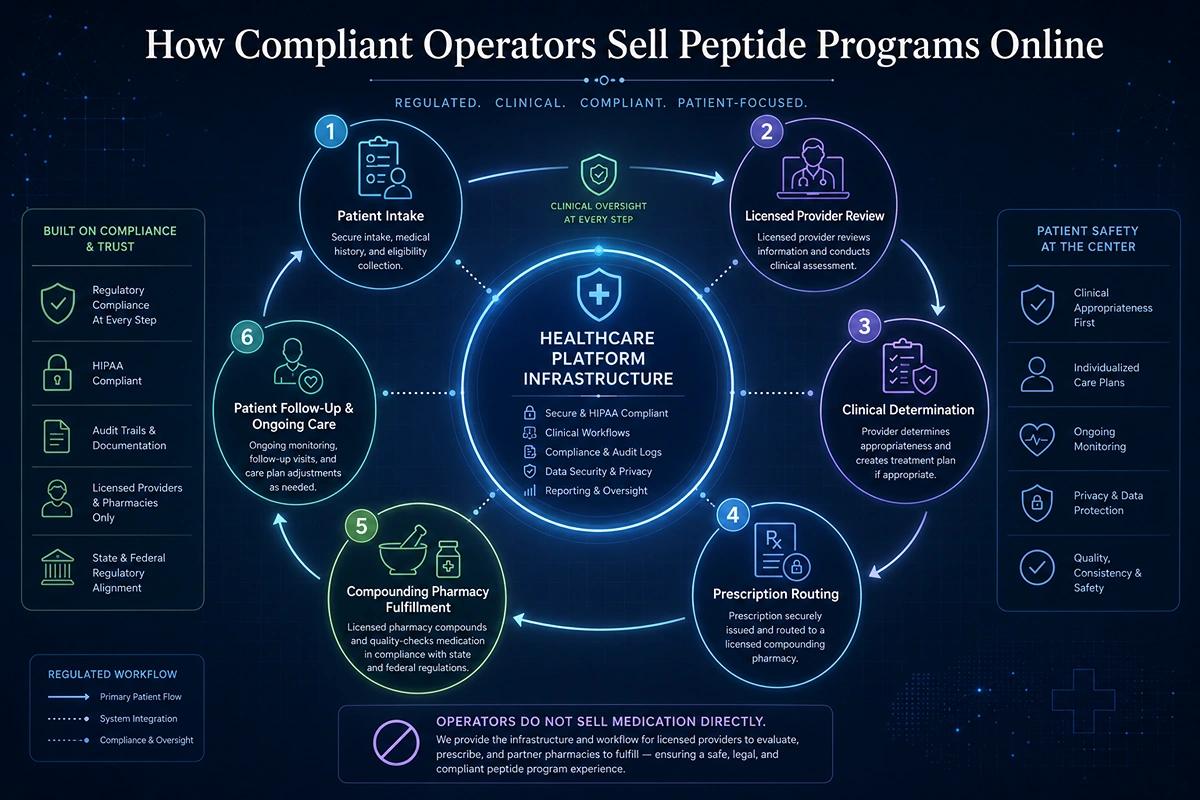
How Compliant Operators Sell Peptide Programs Online
A compliant operator asking whether it is illegal to sell peptides online quickly realizes the answer hinges on structure. They do not sell peptides directly. They offer a health program. The clinical determination, the prescription, and the fulfillment all run through a regulated workflow that the operator triggers and tracks but does not control.
This distinction matters for anyone still asking whether it is illegal to sell peptides online. The answer changes based entirely on where the clinical decision sits.
The FUSE Health workflow in four steps (no DEA registration required):
- Patient intake is collected through your branded storefront.
- A licensed provider reviews the intake and makes the clinical determination.
- If clinically appropriate, a prescription is routed to an FDA-registered compounding pharmacy.
- Fulfillment and follow-up run on FUSE Health's infrastructure, not yours.
You run the program. The clinical decisions belong to licensed providers. That structure is what makes selling peptide programs online legally sustainable at scale.
What Happens When Operators Get the Online Peptide Model Wrong
Enforcement in this space is not theoretical. Operators who never asked whether it is illegal to sell peptides online, and assumed they were safe, are the primary enforcement targets. Skipping the clinical oversight layer is the most common mistake. The FDA has issued warning letters to dozens of online peptide suppliers since 2023. State pharmacy boards have taken action against compounding pharmacies operating outside USP 797 and 503B standards. Payment processors are actively flagging peptide-related merchants as elevated compliance risk.
The risks and long-term consequences of building without a compliant foundation:
- Payment processing accounts frozen or terminated without notice
- State medical board complaints when clinical oversight is absent or improvised
- Federal FDCA misbranding or adulteration charges if products are mislabeled
- Platform bans from major ad networks for peptide-related promotional content
None of these outcomes is inevitable for operators who build on compliant infrastructure from the start. All of them are realistic for operators who do not.
Why FUSE Health Is the Infrastructure Operators Trust:
Operators enquiring whether it is illegal to sell peptides online need more than a pharmacy connection to get a defensible answer. FUSE Health provides the full clinical and operational foundation:
- Licensed provider network management and cross-state licensure verification
- Prescription routing exclusively to FDA-registered compounding pharmacies
- HIPAA-compliant data infrastructure for patient intake, records, and follow-up
- Payment processing optimized for telehealth and compounding verticals
- Operator certification and training resources for regulated market entry
Is it illegal to sell peptides online without a compliant clinical structure? For most models, yes. FUSE Health is built to carry that structure for you.
Conclusion
Is it illegal to sell peptides online? Without a compliant clinical structure, yes, for most business models. Operators who build without a licensed clinical layer face real enforcement exposure. Those who do not ask whether it is illegal to sell peptides online before launching often find out the hard way. With the right infrastructure, it is a program operators can run, defend, and grow.
FUSE Health was built to solve this exact problem. The platform makes the compliant model the operationally simple model, so operators do not have to choose between growth and legal stability.
The operators scaling sustainable peptide programs in 2026 are not finding workarounds. They are building on infrastructure that makes compliance the starting point, not a retrofit.
DISCLAIMER: This content is produced by FUSE Health for educational and informational purposes only. It does not constitute legal advice. For compliance guidance specific to your business, consult a licensed healthcare attorney.
References
- FDA 503A Bulk Drug Substances List
- FDA 503B Registered Outsourcing Facilities
- FDA, Compounding Laws and Policies
- Federal Food, Drug, and Cosmetic Act (FDCA)
- U.S. Department of Health and Human Services, Enforcement Discretion Policy Regarding 503A Compounding Using Certain Peptide Bulk Drug Substances, with Appendices A and B, October 2026.
- Federal Register, Vol. 91, No. 209, p. 68526, doc. 2026-22192, published October 30, 2026, docket HHS-OASH-2026-0496.

Daniel is a two-time founder who has scaled service businesses across major U.S. markets. A Y Combinator competition winner, he focuses on removing operational and regulatory barriers so operators can build and scale modern healthcare businesses.
- Background
- Startup Operations & Service Systems
- Experience
- 2x Founder, Multi-Market U.S. Scaling
- Qualifications
- Healthtech Market Expertise & Operational Scaling
- Key Achievement
- Scaled Premier Staff & Eventstaff across major U.S. markets