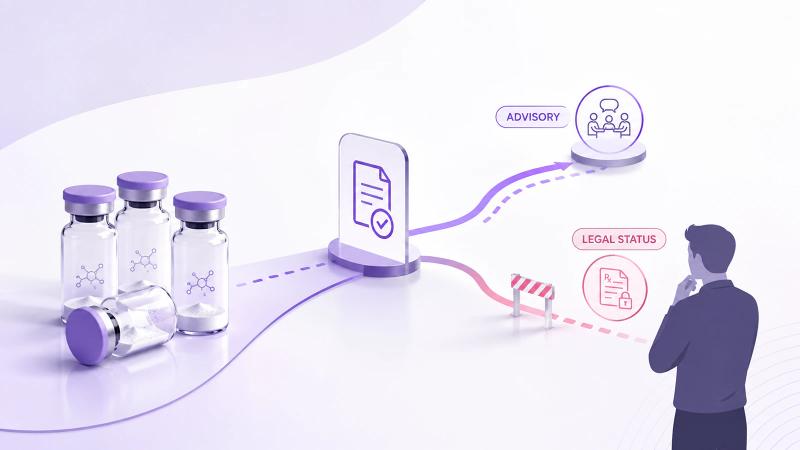

What peptides are FDA approved comes to roughly 80 drugs worldwide, and almost none of them are the names circulating in the wellness market. Approval status decides your pharmacy lane, your prescriber workflow, and your ad copy. Get the mapping right and a storefront launches in days.
What peptides are FDA approved is a much shorter list than most storefronts assume. Roughly 80 peptide drugs have been approved worldwide since insulin arrived in the 1920s, according to a 2022 review in Nature's Signal Transduction and Targeted Therapy. Semaglutide is on that list. Tirzepatide is on that list. BPC-157, ipamorelin, and the rest of the names that fill Instagram comment sections are not.
That gap is where peptide businesses either scale or get a warning letter.
The operators who launch fast are not the ones who memorized the approval list. They are the ones who mapped each molecule to a pathway: approved drug, compounded preparation, or off the table entirely. Once that mapping exists, the rest of the build is plumbing. Prescriber network, pharmacy routing, patient portal, payment rails.
This piece gives you the list, then gives you the part the list does not tell you.
The approved peptides list, sorted the way operators think
Most versions of the FDA approved peptides list you will find online are organized by drug class, which is useless if you are building a catalog. Below is the practical version. It skips the hospital-only molecules nobody sells through a storefront and keeps the ones that show up in real program planning.

Metabolic and weight programs
| Molecule | Brand | First US approval |
|---|---|---|
| Exenatide | Byetta | 2005 |
| Liraglutide | Victoza, Saxenda | 2010, 2014 |
| Dulaglutide | Trulicity | 2014 |
| Semaglutide | Ozempic, Rybelsus, Wegovy | 2017, 2019, 2021 |
| Tirzepatide | Mounjaro, Zepbound | 2022, 2023 |
This is the category everyone wants. It is also the category with the tightest rules right now, which we get to below.
Hormone and growth axis
| Molecule | Brand | Status and use |
|---|---|---|
| Teriparatide | Forteo | 2002, osteoporosis |
| Tesamorelin | Egrifta | 2010, HIV-associated lipodystrophy |
| Abaloparatide | Tymlos | 2017, osteoporosis |
| Sermorelin | Geref | Approved, then pulled from sale in 2008 |
| Leuprolide | Lupron | Prostate cancer, endometriosis, central precocious puberty |
| Octreotide | Sandostatin | Acromegaly, carcinoid |
Sermorelin deserves a footnote because operators get this one wrong constantly. Geref was an approved drug. Sanofi stopped selling it, and in 2013 the FDA formally determined it was not withdrawn for reasons of safety or effectiveness. That determination is what allows generic and compounded pathways to be discussed at all. It does not mean sermorelin is currently an approved commercial product you can put in a cart.
Sexual health, skin, and appetite signaling
| Molecule | Brand | Approval and population |
|---|---|---|
| Bremelanotide | Vyleesi | 2019, HSDD in premenopausal women |
| Afamelanotide | Scenesse | 2019, erythropoietic protoporphyria |
| Setmelanotide | Imcivree | 2020, specific genetic obesity |
Note what these three have in common. Every one is approved for a narrow, defined population. Melanotan II, the molecule the tanning market talks about, is not here and never has been.
The rest of the working list
Vosoritide (Voxzogo, 2021), linaclotide (Linzess, 2012), plecanatide (Trulance, 2017), icatibant (Firazyr, 2011), enfuvirtide (Fuzeon, 2003), desmopressin, vasopressin, calcitonin salmon, lanreotide, degarelix, cetrorelix, difelikefalin, and lutetium Lu 177 dotatate.
Add insulin and glucagon and you are near a hundred molecules across every route and indication. That is the honest answer to "how many approved peptides are there," and it is why any article promising a tidy round number is guessing.
Where the "14 peptides FDA-approved" number came from
Search for a list of FDA-approved peptides, and you will hit a lot of pages claiming fourteen. Some claim seven. Some claim over a hundred.
They are all counting different things. Fourteen usually means peptides marketed in wellness and anti-aging clinics that happen to have an approved parent drug. A hundred-plus counts every peptide and peptide-adjacent biologic ever cleared. Neither number is wrong so much as unlabeled.
For an operator, the count is irrelevant. Knowing which peptides are FDA-approved only helps if you know what each answer forces you to do next. What matters is a two-column question you can answer per SKU: is there an approved drug for this molecule, and does my patient qualify for it under a prescriber's judgment? Everything downstream follows from those two answers. Our operator guide to peptide legality works through the same logic SKU by SKU.
The peptides that are not approved, and what actually changed in 2026
Here is the part that moved this year.
The FDA maintains a Category 2 list of bulk drug substances that may present significant safety risks in compounding. As of the April 2026 update, the peptides sitting there are GHRP-2, GHRP-6, ipamorelin acetate, and kisspeptin-10, alongside non-peptide entries like ibutamoren mesylate and cesium chloride. The agency's stated concern with peptides is immunogenicity from aggregation and peptide-related impurities.
Then July happened.

On July 23 and 24, 2026, the Pharmacy Compounding Advisory Committee reviewed seven peptides for the 503A bulks list. BPC-157, KPV, and TB-500 cleared 8 to 6 with one abstention. MOTS-c cleared 7 to 5 with two abstentions. Semax and epitalon passed on similarly thin margins. Emideltide, the delta sleep-inducing peptide, was voted down 7 to 6.
The panel overrode FDA's own scientists, who had recommended against all seven. That is unusual, and it produced a lot of press.
It also produced a lot of operators who read the headline and started drafting product pages. Do not be one of them.
PCAC votes are advisory. They are not rulemaking. Nothing is legally compoundable because a committee said it should be, and none of these seven molecules is an FDA-approved drug. The distance between a favorable advisory vote and a lawful storefront SKU is measured in years of rulemaking, and it is a distance the agency is not obligated to close. We broke down exactly what shifted and what did not in our FDA Category 2 list breakdown for peptide brands.
Meanwhile, the pressure runs the other direction on the drugs everyone actually sells. On April 30, 2026, the FDA proposed excluding semaglutide, tirzepatide, and liraglutide from the 503B bulks list, on the grounds that there is no clinical need for outsourcing facilities to compound them when approved versions are available. Commissioner Marty Makary put it plainly: when FDA-approved drugs are available, outsourcing facilities cannot lawfully compound using bulk drug substances absent a clear clinical need.
So the market has two simultaneous stories. Wellness peptides inched toward a possible future pathway. GLP-1 compounding narrowed hard. A storefront built on last year's assumptions is now standing on the wrong side of both.
What approval status actually changes in your workflow
This is the section the listicles skip, and it is the only one that affects your P&L. Approval status is not a marketing label. It is a routing instruction, and it determines four things in sequence.
Your pharmacy lane
An approved drug routes to a standard dispensing pharmacy. A compounded preparation routes to a 503A pharmacy for patient-specific prescriptions or a 503B outsourcing facility for office stock. Choosing wrong is not a paperwork error, it is a licensing problem. We laid out the decision tree in 503A vs 503B for your program.
Your prescriber requirement
Every molecule on the approved list above is prescription-only. That means a licensed prescriber in the patient's state, an actual clinical evaluation, and documentation that survives a board review. It also means your program's geography is bounded by your prescriber network, not by your ad spend. State-by-state constraints and the asynchronous rules are covered in telehealth prescribing in 2026.
Your claim set
This is where most operators lose. The FDA's June 2026 guidance for telehealth companies promoting compounded drugs is specific about what you cannot say. You cannot imply a compounded drug is FDA-approved. You cannot call it a generic version of an approved drug. You cannot claim it produces identical results. You cannot say it came from an FDA-approved or FDA-licensed pharmacy, because the agency does not approve or license facilities.
Your brand presentation
The same guidance flags a subtler trap. If you put your own trademark on a compounded product in a way that implies you are the compounder, that is a misleading claim on its own, independent of anything you said about efficacy.
That fourth one is what caught 30 telehealth companies on March 3, 2026, when the FDA issued warning letters over compounded GLP-1 marketing. The letters cited two practices: implying equivalence to approved medications, and obscuring the product's source behind house branding. Both are copy decisions. Neither requires a bad actor. A marketing team writing what felt like ordinary DTC copy is enough.
That enforcement wave was not an anomaly either. The agency has sent more advertising warning letters since September 2025 than in the preceding decade combined.
What a resilient peptide program actually looks like

Strip away the regulatory vocabulary, and the operating model is four moving parts. You own the front. Everything clinical happens behind it.
- The storefront. Your brand, your domain, your pricing, your customer relationship. The patient buys a program, not a molecule.
- Intake and eligibility. A structured questionnaire that collects what a prescriber actually needs. Not a checkbox. The intake is your first compliance artifact, and it is the document that gets pulled if a board asks how a prescription happened.
- Clinical review. A licensed prescriber in the patient's state reviews, approves, denies, or requests more information. Denials matter. A program with a zero percent denial rate is not a clinical program, and it reads that way to a regulator.
- Fulfillment and refills. The prescription routes to the pharmacy matched to that molecule's pathway. Refills run on a schedule tied to the prescription, not to a subscription billing cycle. This is where the margin lives, and it is also where most homegrown builds crack under volume, as we covered in how compounded semaglutide programs run through telehealth.
The reason this structure holds under scale is that no single step is improvised. Payments run through processors that already understand telehealth risk. Patient data sits in a HIPAA-aligned system rather than a marketing CRM. Prescriber credentialing is tracked and renewed. When a state rule shifts or a molecule moves category, you change a routing rule, not your whole business.
That is the difference between a storefront and a stack of vendors that happen to be pointed at each other.
What FUSE does with the list
FUSE Health runs the clinical and fulfillment side of peptide and GLP-1 programs so operators can sell under their own brand. Licensed prescribers across all 50 states, pharmacy fulfillment, a white-labeled patient portal, and a compliance layer that keeps your product catalog and your ad copy on the same side of the line.

Practically, that means when the July 2026 PCAC vote landed, our operators did not have to guess. The catalog rules did not change, because the rules were never keyed to press coverage. They were keyed to approval status and pharmacy pathway, which is the only mapping that holds when the news cycle moves.
We also tell operators no. Regularly. If a molecule cannot be routed cleanly, it does not go in the catalog. That is a worse pitch than "sell anything you want," and it is the reason our operators are still selling.
The decision in front of you
The approved peptide list is public and it is not going to be your competitive advantage. Everyone can read it.
What separates a peptide business that compounds revenue from one that compounds legal exposure is the workflow underneath. Which pharmacy for which molecule. Which prescriber in which state. What the landing page is allowed to say. How refills fire without a human touching them.
Building that yourself runs the better part of a year and a legal budget most operators underestimate by half, which we walked through in peptide business margins and what peptide therapy actually costs. Or you plug into infrastructure that already carries the prescriber network, the pharmacy relationships, and the claim review, and you go live in under seven days.
The list tells you what exists. The workflow tells you what you can sell.
References
- FDA. Certain Bulk Drug Substances for Use in Compounding that May Present Significant Safety Risks. Updated April 22, 2026.
- FDA. July 23-24, 2026: Meeting of the Pharmacy Compounding Advisory Committee.
- AJMC. FDA Panel Backs 6 Peptides for Compounding. July 2026.
- FDA. FDA Proposes to Exclude Semaglutide, Tirzepatide, and Liraglutide on 503B Bulks List. April 30, 2026.
- FDA. FDA to Telehealth Companies: What to Know When Promoting Compounded Drugs. June 15, 2026.
- FDA. FDA Warns 30 Telehealth Companies Against Illegal Marketing of Compounded GLP-1s. March 3, 2026.
- Federal Register. Determination That GEREF (Sermorelin Acetate) Injection Was Not Withdrawn From Sale for Reasons of Safety or Effectiveness. March 4, 2013.
- Wang L, et al. Therapeutic peptides: current applications and future directions. Signal Transduction and Targeted Therapy. 2022.

Daniel is a two-time founder who has scaled service businesses across major U.S. markets. A Y Combinator competition winner, he focuses on removing operational and regulatory barriers so operators can build and scale modern healthcare businesses.
- Background
- Startup Operations & Service Systems
- Experience
- 2x Founder, Multi-Market U.S. Scaling
- Qualifications
- Healthtech Market Expertise & Operational Scaling
- Key Achievement
- Scaled Premier Staff & Eventstaff across major U.S. markets