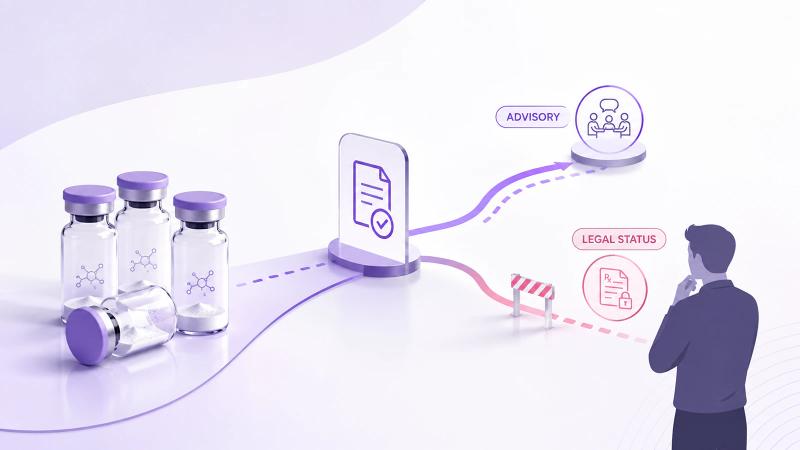

White label peptide sellers got a rule change most missed. FDA pulled 12 peptides off Category 2 on April 22, 2026, and an advisory panel backed six for the 503A list in July. Removal is not permission. Here is the current list and the workflow that keeps operators clean.
The short version for operators
White label peptides operators spent early 2026 reading headlines claiming the FDA "approved" BPC-157 and TB-500. It did not. The real story is narrower and easier to build around: the FDA cleaned up its Category 2 list, sent seven substances to an advisory committee, and left everything else where it was.
If you sell peptides online, the takeaway is simple. Category 2 tells you what the FDA has flagged as a safety risk. It does not tell you what you are allowed to sell. That answer comes from your pharmacy partner, your prescriber network, and the paperwork behind both. Get that layer right and a white label peptides brand launches in weeks instead of quarters. Get it wrong and you are one warning letter from a dead merchant account.
See the workflow before you commit. Book a walkthrough with FUSE and we will show you the exact intake, review, and fulfillment path a compliant peptide storefront runs on.
What Category 2 actually means
Under Section 503A of the Federal Food, Drug, and Cosmetic Act, compounders can use bulk drug substances that appear on the FDA's 503A bulks list. While the agency works through that list, it sorts nominations into buckets. Category 1 gets interim enforcement discretion during review. Category 2 holds substances the FDA has identified as presenting significant safety risks.

Two details matter for anyone running a peptide clinic or peptide pharmacy relationship.
First, Category 2 is a warning list, not a ban list. It signals where the FDA has documented concerns such as immunogenicity, impurity profiles, or reported adverse events.
Second, entries are scoped. Some apply to 503A pharmacies, some to 503B outsourcing facilities, some to specific routes. Ipamorelin acetate, for example, is listed under 503B, not 503A. Read it as one flat blocklist and you will either overbuild or take risks you did not intend.
The current FDA Category 2 peptide list
As of the FDA's page update dated April 22, 2026, these are the peptides still sitting in Category 2:
| Substance | Scope | Cited concern | Added |
|---|---|---|---|
| GHRP-2 | 503B, injectable and nasal | Immunogenicity, serious adverse events | Sept 29, 2023 |
| GHRP-6 | 503B | Immunogenicity | Sept 29, 2023 |
| Ibutamoren mesylate | 503A and 503B | Congestive heart failure risk | 2022 / 2023 |
| Ipamorelin acetate | 503B | Immunogenicity, adverse event reports | Sept 29, 2023 |
| Kisspeptin-10 | 503A | Immunogenicity, insufficient safety data | Sept 29, 2023 |
Category 2 also carries non-peptide entries such as cesium chloride, domperidone, and quinacrine hydrochloride. They rarely touch a peptide telehealth storefront, but they show how the agency thinks. This is a risk register, not a product catalog. For how legality gets decided at the program level, see our operator guide on which peptides are legal.
The 12 peptides FDA removed in April 2026
Effective April 22, 2026, the FDA removed twelve peptide bulk drug substances from Category 2:
BPC-157, Cathelicidin LL-37, Dihexa acetate, Emideltide (DSIP), Epitalon, GHK-Cu (injectable routes), KPV, Pegylated Mechano Growth Factor, Melanotan II, MOTS-c, Semax, and Thymosin Beta-4 Fragment (TB-500).
Seven went to the Pharmacy Compounding Advisory Committee in July 2026. The remaining five, LL-37, Dihexa, GHK-Cu, PEG-MGF, and Melanotan II, are scheduled for review before the end of February 2027.
What the July 2026 PCAC vote changed
The committee met on July 23 and 24, 2026 and voted on seven substances. Six drew favorable recommendations: BPC-157 (8-6-1), KPV (8-6-1), TB-500 (8-6-1), MOTS-c (7-5-2), Epitalon (7-4-1), and Semax (8-5-1). Emideltide did not (6-7-1).
Read those margins. A one-vote spread is not consensus. The FDA is not bound by the committee, and formal inclusion still requires notice-and-comment rulemaking expected to run into 2027.
The peptides that quietly disappeared
CJC-1295, AOD-9604, thymosin alpha-1, and selank acetate now sit in the FDA's "nominated but withdrawn" table. Not in Category 2, not on the bulks list. If a supplier tells you a withdrawn nomination means clearance, end the conversation.
Why removal is not a green light
This is where peptide business opportunities turn into liability. Removal from Category 2 did not move these substances to Category 1, the bucket that carries interim enforcement discretion. They are unclassified while review continues.
Meanwhile enforcement has been busy. On March 3, 2026, the FDA issued 30 warning letters to telehealth companies over compounded GLP-1 marketing, citing claims that implied equivalence to approved drugs and branding that obscured who actually compounded the product. That followed more than 50 warning letters in September 2025 and Import Alert 66-80 targeting ingredient quality.

Notice what got cited. Not the molecule. The marketing, the labeling, the disclosure. Those are storefront decisions, and storefront decisions are the ones operators control.
What fails: buying "research use only" material, borrowing a pharmacy's compliance posture, publishing dosing guidance on a product page, and running payments through a processor that never underwrote the category. More on what operators get wrong.
What works: clinical decisions owned by a licensed prescriber, a pharmacy that documents its sourcing, marketing that describes a program rather than a molecule, and a payment stack approved for this vertical before order one.
The storefront-first model, in plain steps
The operators scaling right now are not practicing medicine. They own the brand, the audience, and the offer. Everything clinical runs behind the storefront in a fixed sequence, which is the core of the operator storefront playbook. Med spas run it without opening a clinic.
How the workflow runs
- Storefront. The customer lands on your branded site, your domain, your pricing. Checkout is built for a prescription category, not a supplement one.
- Intake. Asynchronous telehealth collects history, medications, contraindications, and consent through a HIPAA compliant patient intake form. No video call required in most states for eligible programs.
- Clinical review. A licensed provider in the patient's state reviews the file and prescribes, requests more information, or declines. FUSE partners average under 24 hours.
- Pharmacy routing. Approved orders route to a 503A or 503B partner pharmacy matched to the product and the state. The pharmacy owns sourcing, testing documentation, and labeling, which is why choosing the right pharmacy partner matters more than checkout design.
- Fulfillment. The patient gets your branding on the experience and the pharmacy's required disclosures on the medication itself.
- Refills. Refill logic runs on the prescription terms, not the cart. This is where retention comes from. FUSE storefronts hold 94% refill retention.
That sequence is the whole answer to "how to sell peptides online" without holding a license. You sell the program. Licensed people make the clinical calls. The same handoff is mapped on how FUSE works.
Ready to see it live? Book a demo and walk the intake, provider queue, and pharmacy handoff with your own product list on screen.
Building a system that survives volume
White label peptides storefronts rarely fail on day one. They fail at month six, when volume exposes whatever was improvised. The break points are predictable: where telehealth launches break at scale.
Payments. Storefronts get frozen when a processor discovers the category after the fact. FUSE runs on Stripe with the category underwritten up front, so a good month does not trigger a hold.
Data. Intake answers become protected health information the moment a provider touches them. HIPAA compliant telemedicine infrastructure and SOC 2 Type II controls are the floor, not a differentiator, and a standard ecommerce build does not clear it. See Shopify HIPAA compliance for peptide sellers.
Certification. LegitScript certification is what ad platforms and processors check before they let a healthcare storefront run. Getting it after a rejection costs weeks. See telehealth compliance for the sequence.
Provider capacity. A 50-state network means you launch nationally instead of state by state, and a traffic spike gets absorbed instead of queued.
Regulatory drift. The list changed in April. The committee voted in July. Rulemaking may land in 2027. Your catalog logic has to update when the list does, without a rebuild.
Across 1,200+ programs launched on FUSE, that layer separates operators who scale from operators who spend the year rebuilding.
The decision in front of you
The peptide market is not waiting for 2027. Demand is here, the regulatory picture is clearer than it has been in three years, and the constraint on most operators is infrastructure, not interest.

You can spend nine months assembling prescribers, pharmacies, compliance review, payments, and a certified storefront. Or put your brand on top of telehealth infrastructure that already carries LegitScript certification, SOC 2 Type II, HIPAA controls, a 50-state provider network, and 503A and 503B pharmacy partners, starting at $699 per month.
The list will keep moving. The workflow underneath it should not have to.
Next step: Book a walkthrough with FUSE and get a clear answer on which peptide programs you can launch, in which states, and how fast.
This article is written for business operators and covers regulatory and operational topics only. It is not medical advice, and it is not legal advice. It does not recommend, endorse, or provide dosing guidance for any peptide or compounded medication. Regulatory status changes; confirm current requirements with the FDA, your state board of pharmacy, and qualified counsel before launching or modifying any program.
References
- FDA. Certain Bulk Drug Substances for Use in Compounding that May Present Significant Safety Risks. Updated April 22, 2026.
- FDA. Bulk Drug Substances Used in Compounding Under Section 503A of the FD&C Act. Updated May 14, 2026.
- FDA. FDA Warns 30 Telehealth Companies Against Illegal Marketing of Compounded GLP-1s. March 3, 2026.
- McDermott Will & Schulte. Bulk-list bound? PCAC backs majority of peptides in two-day public meeting. July 27, 2026.
- Buchanan Ingersoll & Rooney. FDA PCAC Recommends Six Peptides for the 503A Bulks List. August 4, 2026.
- Frier Levitt. FDA to Remove 12 Popular Peptides from the Category 2 Do Not Compound List. April 16, 2026.
- Orrick. FDA Announces Removal of 12 Peptides from Category 2 and Schedules PCAC Meetings. April 16, 2026.
- The National Law Review. Tiny Chains, Big Changes? What FDA's Latest Actions Mean for Peptide Compounding. April 22, 2026.

Daniel is a two-time founder who has scaled service businesses across major U.S. markets. A Y Combinator competition winner, he focuses on removing operational and regulatory barriers so operators can build and scale modern healthcare businesses.
- Background
- Startup Operations & Service Systems
- Experience
- 2x Founder, Multi-Market U.S. Scaling
- Qualifications
- Healthtech Market Expertise & Operational Scaling
- Key Achievement
- Scaled Premier Staff & Eventstaff across major U.S. markets