
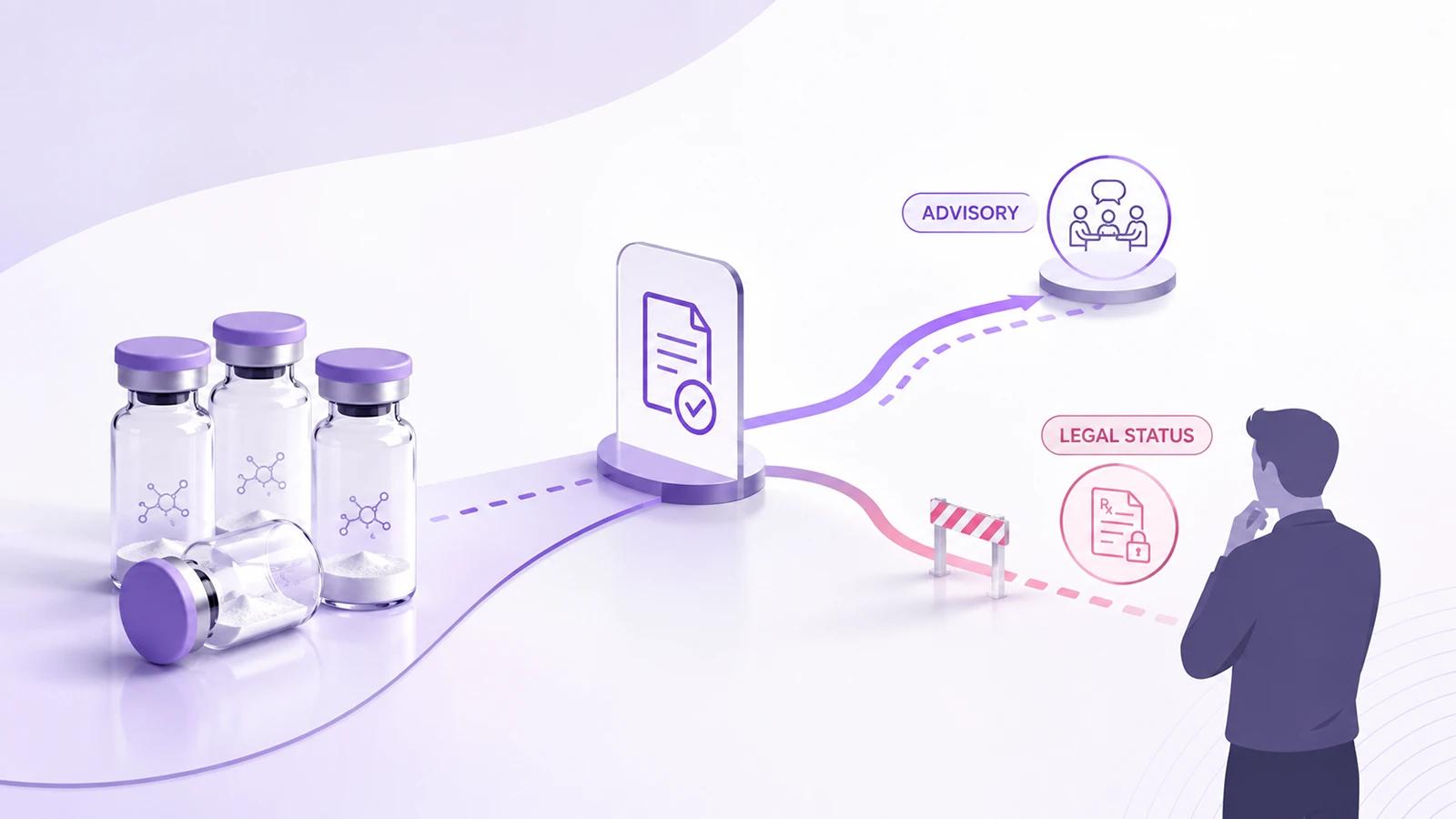
Which peptides are legal depends on your structure, not the molecule. Six peptides got an FDA advisory nod in July 2026 and none of them became legal to compound. Here is what your business can offer, dispense and advertise today, with the date it was last checked.
Which peptides are legal? Fewer than your supplier's catalogue suggests, and far fewer than the internet decided in July.
On 23 and 24 July 2026, an FDA advisory committee voted to recommend six peptides for the 503A Bulks List. BPC-157 cleared 8 to 6 with one abstention. TB-500 and KPV, the same margin. MOTS-c went 7 to 5, Semax 8 to 5, Epitalon 7 to 4. One substance, emideltide, was voted down 7 against to 6 for. Within about a week, half the market had decided peptides were legal again.
They aren't. As of 6 August 2026, not one of those six can be lawfully compounded, and no peptide has ever been added to the 503A Bulks List by rule. FDA's own scientific reviewers recommended against all seven before the committee overruled them.
That gap, between what operators believe and what's actually true, is where peptide programs die. Not at launch. Three months in, when a pharmacy refuses the order, a processor freezes the account, or an ad platform pulls certification, and the whole funnel stops at once.
So this page does something the other results for this question don't. It answers it from your side of the desk: what can my business legally offer, dispense and advertise, today, with a date on it.
The three questions hiding inside "are peptides legal"
Most operators ask one question and get three answers, which is why the internet looks contradictory.
The first question is whether the FDA has approved the peptide as a drug. For almost every peptide people want to sell, the answer is no. The second is whether you can sell it without a prescription. Almost always no, and the exceptions are narrower than the research-use-only peptide market pretends. The third is the one that actually decides your business: if a prescription is required, is there a pharmacy that can legally fill it?
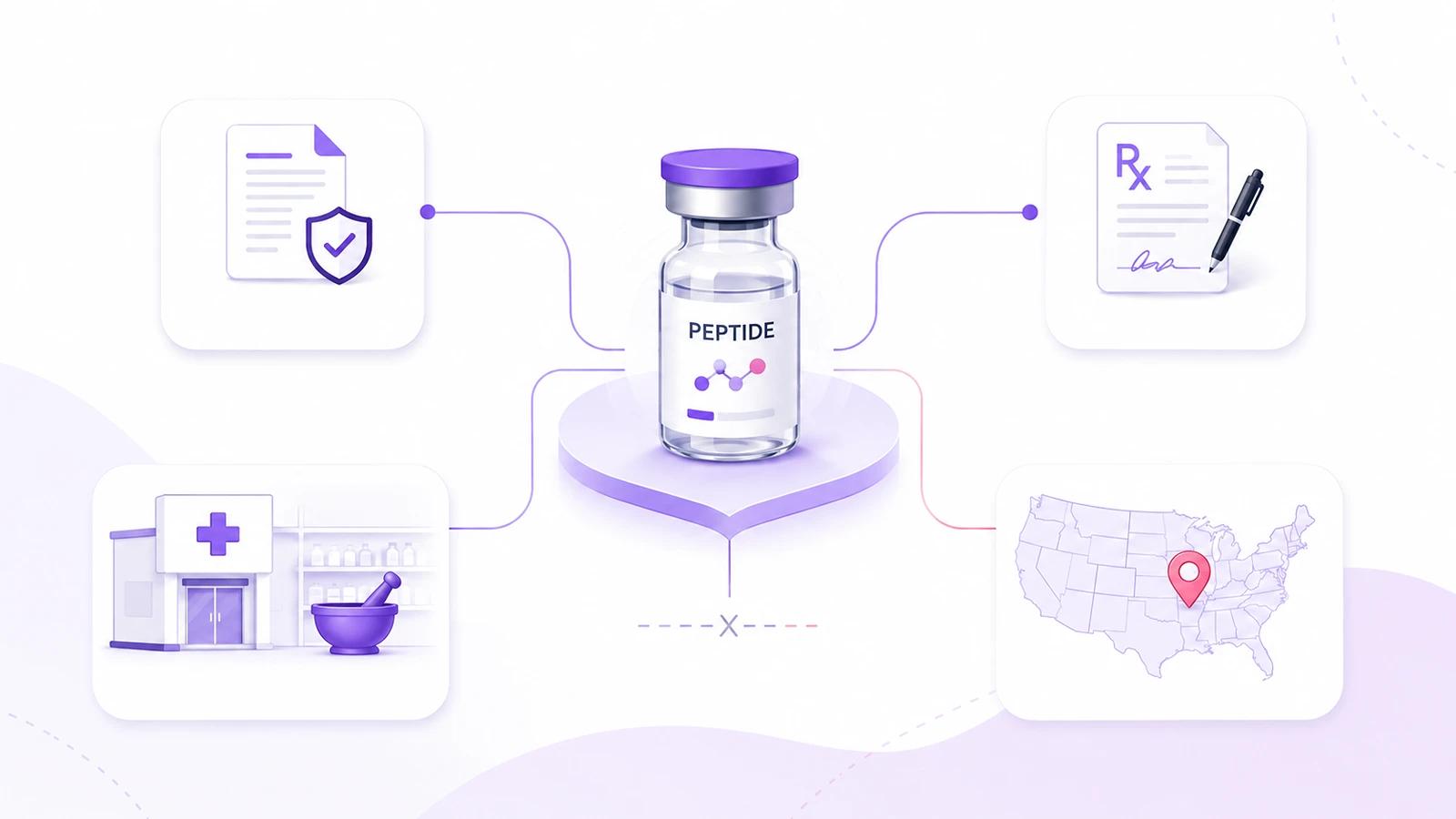
That third question is where the money is, and it's the one nobody answers. A peptide can be prescribable in theory and unfillable in practice, because no pharmacy has a lawful route to compound it. BPC-157 sits exactly there right now. A prescriber can write it. No 503A pharmacy can lawfully make it. The prescription is a piece of paper.
So which peptides are legal is really four questions stacked: the peptide's federal compounding status, the licence of whoever prescribes, the type of pharmacy that dispenses, and the state your customer is standing in. Change any one of those four and the answer changes. That's not a loophole, and it isn't a technicality. It's the actual structure of the rule.
The Operator Legality Ledger: which peptides are legal today
Below is every peptide operators ask us about most, with where it stands on 6 August 2026. Read it by column, not by row. The peptide name tells you almost nothing on its own. "Who can supply it" is the column that decides whether you have a business.
One column that no other guide includes: what you're allowed to say in advertising. A peptide can be lawful to dispense and still get your ad account and your LegitScript certification pulled if you name it in a campaign. Those are two different regimes and operators conflate them constantly.
Group 1 · FDA-approved products
| Substance | Status today | Who can supply it | What ads may say | Sport (WADA 2026) | Verified |
|---|---|---|---|---|---|
| Semaglutide (Ozempic, Wegovy, Rybelsus) | Approved. Compounding contested. | Retail or 503A, patient-specific only, with documented clinical justification | May name the branded product. Do not advertise a compounded copy. | Not listed | 6 Aug 2026 |
| Tirzepatide (Mounjaro, Zepbound) | Approved. Compounding contested. | Same as above | Same as above | Not listed | 6 Aug 2026 |
| Liraglutide (Victoza, Saxenda) | Approved. Still on the FDA shortage list. | Retail or 503A; shortage pathway remains live while the shortage stands | Same as above | Not listed | 6 Aug 2026 |
| Tesamorelin (Egrifta SV / WR) | Approved. Compoundable as a component of an approved drug. | 503A or retail, subject to the copy rules | May name the branded product | Prohibited, S2.2.4 | 6 Aug 2026 |
| Bremelanotide / PT-141 (Vyleesi) | Approved. Compoundable as a component of an approved drug. | 503A or retail, subject to the copy rules | May name the branded product | Not prohibited | 6 Aug 2026 |
Group 2 · Compoundable today
| Substance | Status today | Who can supply it | What ads may say | Sport (WADA 2026) | Verified |
|---|---|---|---|---|---|
| Sermorelin | Category 1 on the 503B list, flagged as a component of an approved drug | 503B | Describe the program, not the molecule | Prohibited, S2.2.4 | 6 Aug 2026 |
| GHK-Cu (non-injectable only) | Category 1 on the 503A list, except injectable routes | 503A, topical and other non-injectable routes | Describe the program, not the molecule | Not named | 6 Aug 2026 |
| NAD+ | Category 1 on the 503A list | 503A | Describe the program, not the molecule | Not listed | 6 Aug 2026 |
| Glutathione | Category 1 on the 503A list | 503A or 503B | Describe the program, not the molecule | Not listed | 6 Aug 2026 |
| Enclomiphene citrate | Category 1 on the 503A list | 503A | Describe the program, not the molecule | Prohibited as a clomifene component, S4.2 | 6 Aug 2026 |
| Oxytocin | USP monograph exists | 503A or 503B | Describe the program, not the molecule | Not listed | 6 Aug 2026 |
| HCG | USP monograph; also approved as Pregnyl and Novarel | 503A, 503B or retail | May name the branded product | Prohibited in males, S2.2.1 | 6 Aug 2026 |
Category 1 means FDA has said it does not intend to act against compounders using the substance while it finishes evaluating. It is not the Bulks List and it is not permanent. Treat it as permission that can be withdrawn, and build your catalogue so that losing one substance does not take the program down.
Group 3 · Recommended by the July 2026 committee, still not lawful to compound
| Substance | Status today | Who can supply it | What ads may say | Sport (WADA 2026) | Verified |
|---|---|---|---|---|---|
| BPC-157 | Recommended 8-6-1. Not compoundable. No monograph, not a component of an approved drug, not on the Bulks List. | Nobody | Do not name in any ad | Prohibited, named in S0 | 6 Aug 2026 |
| TB-500 / Thymosin beta-4 | Recommended 8-6-1. Not compoundable. | Nobody | Do not name in any ad | Prohibited, named in S2.3 | 6 Aug 2026 |
| KPV | Recommended 8-6-1. Not compoundable. | Nobody | Do not name in any ad | Not named | 6 Aug 2026 |
| MOTS-c | Recommended 7-5-2. Not compoundable. | Nobody | Do not name in any ad | Prohibited, named in S4.4.1 | 6 Aug 2026 |
| Semax | Recommended 8-5-1. Not compoundable. | Nobody | Do not name in any ad | Not named | 6 Aug 2026 |
| Epitalon | Recommended 7-4-1. Not compoundable. | Nobody | Do not name in any ad | Not named | 6 Aug 2026 |
This is the group the market believes changed in July. It did not. A committee recommendation is advice to the FDA. Adding a substance to the 503A Bulks List takes notice-and-comment rulemaking, and as of 6 August 2026 no proposed rule has been published.
Group 4 · Withdrawn, rejected, or restricted
| Substance | Status today | Who can supply it | What ads may say | Sport (WADA 2026) | Verified |
|---|---|---|---|---|---|
| Emideltide / DSIP | Voted down 7 against to 6 for, 24 July 2026 | Nobody | Do not name | Not named | 6 Aug 2026 |
| CJC-1295 | Nomination withdrawn by the nominator. Off the 503A list entirely, in no category. | Nobody | Do not name | Prohibited, S2.2.4 | 6 Aug 2026 |
| AOD-9604 | Nomination withdrawn. Off the 503A list entirely. | Nobody | Do not name | Prohibited, named in S2.2.3 | 6 Aug 2026 |
| Selank acetate | Nomination withdrawn. Off the 503A list entirely. | Nobody | Do not name | Not named | 6 Aug 2026 |
| Thymosin alpha-1 | Withdrawn from 503A. Category 3 on the 503B list. | Nobody | Do not name | Not named | 6 Aug 2026 |
| Ipamorelin acetate | Withdrawn from 503A. Category 2 on the 503B list. | Nobody | Do not name | Prohibited, S2.2.4 | 6 Aug 2026 |
| Kisspeptin-10 | Category 2 on the 503A list. | Nobody | Do not name | Prohibited, S2.2.1 | 6 Aug 2026 |
| GHRP-2 | Category 2 for injectable and nasal routes on the 503B list | Limited: 503B, non-injectable and non-nasal routes only | Do not name | Prohibited, S2.2.4 | 6 Aug 2026 |
| GHRP-6 | Category 2 on the 503B list | Nobody | Do not name | Prohibited, S2.2.4 | 6 Aug 2026 |
| Ibutamoren mesylate (MK-677) | Category 2 on both lists. The most restricted substance on the page. Not a peptide, but routinely bundled with them. | Nobody | Do not name | Prohibited, S2.2.4 | 6 Aug 2026 |
| Melanotan II, LL-37, dihexa acetate, PEG-MGF | Removed from Category 2 in April 2026, never placed in Category 1. Queued for a committee meeting before the end of February 2027. | Nobody | Do not name | Not named | 6 Aug 2026 |
What the July 2026 peptide vote actually changed
Procedurally, almost nothing. That's not cynicism; it's just how the machinery works, and understanding it is worth more to you than any headline.
The Pharmacy Compounding Advisory Committee advises. It doesn't legislate, and it doesn't issue rules. For a peptide to become compoundable under 503A, FDA has to put it on the Bulks List, and that takes notice-and-comment rulemaking: a proposed rule in the Federal Register, a comment window, a review of what came back, then a final rule. FDA isn't bound by the committee either. This time, its own reviewers argued the other way on all seven peptides.
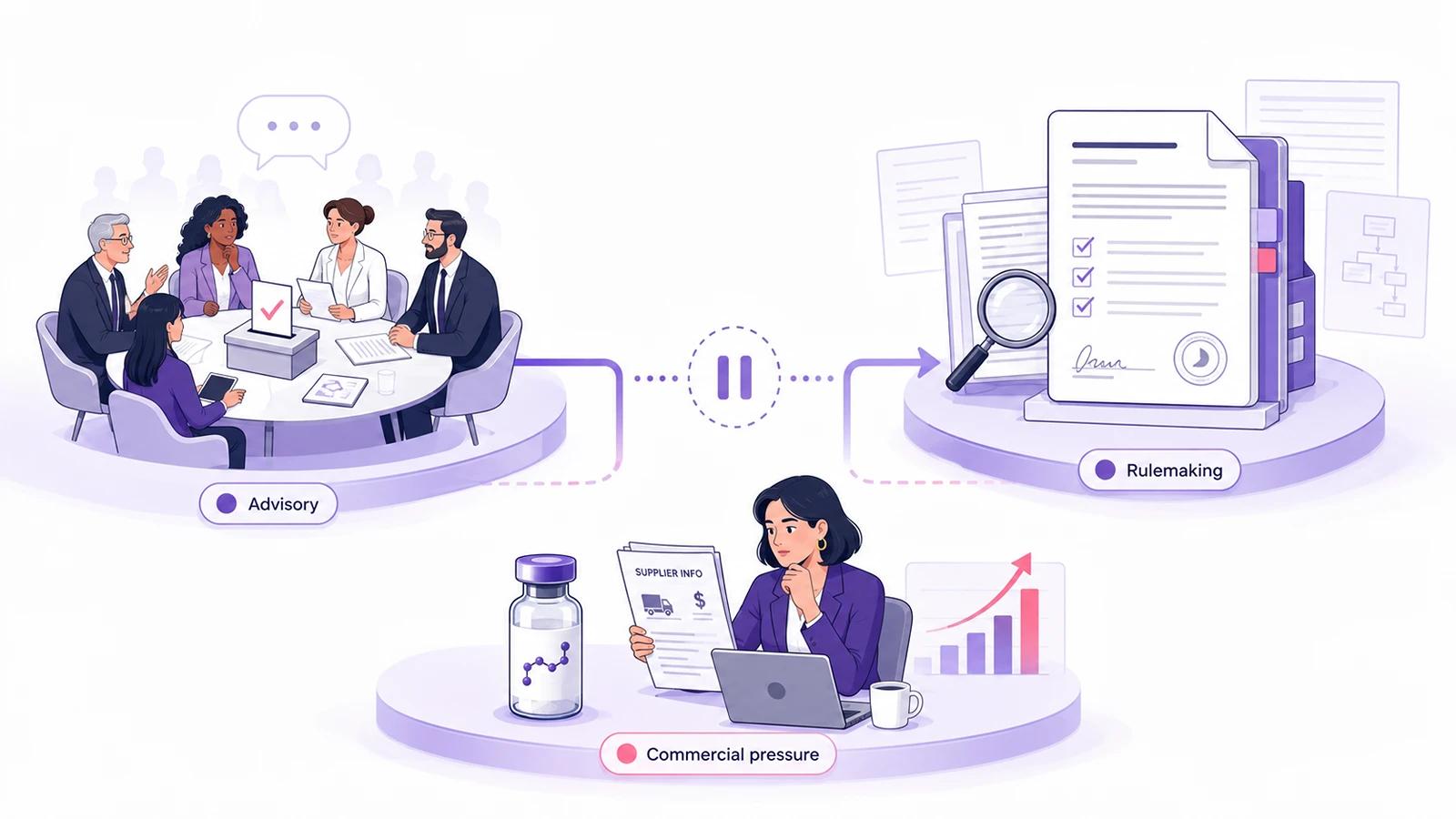
We checked on 6 August 2026. No proposed rule has been published, nothing sits on the Federal Register public inspection list, and neither nomination list has moved since 14 May. The most recent proposed rule touching the 503A Bulks List still dates from September 2019.
What did change is commercial pressure. Your customers read the same headlines. Suppliers have started quoting BPC-157 as though July settled something. If you sell peptides, you are about to spend the next two quarters explaining to people why you won't sell them the thing a Forbes headline said was becoming legal. Build the explanation now, and it becomes a trust asset. Improvise it later, and it reads like an excuse.
One honest caveat, because it cuts against us. FDA has a second option: it could extend enforcement discretion through guidance rather than waiting on a rule, which would move much faster than rulemaking. It hasn't. If it does, the group-three rows above change quickly, and the changelog at the foot of this page is where you'll see it.
Who can prescribe, who can dispense, and where you actually sit
Four roles, and most operators only own one of them.
The prescriber is a licensed clinician acting inside their state scope with a real patient relationship. The pharmacy is either a state-licensed 503A or a registered 503B outsourcing facility, and which one you need depends entirely on the substance. The platform carries the intake, the clinical review, the routing and the records. The marketer is you: brand, storefront, customer relationship, growth.
Here is the part that trips people up. If you're a coach, an influencer, a supplement brand, or a med spa without a prescriber on staff, you cannot dispense anything. Not with a disclaimer, not through a partner who ships on your behalf, not by calling it research material. What you can do is own the storefront and the customer while a licensed prescriber and a licensed pharmacy sit behind it in a defined workflow. That distinction is the entire business model, and it's legal specifically because the roles stay separate.
503A and 503B, in one screen
A 503A pharmacy compounds for a named patient against a prescription. It can only use a bulk substance if that peptide has a USP or NF monograph, is a component of an FDA-approved drug, or appears on the 503A Bulks List. Three routes, and every peptide has to clear one of them.
A 503B outsourcing facility can make batches without patient-specific prescriptions, but only from substances on its own clinical-need list or from drugs currently in shortage. FDA has finalised five substances on that clinical-need list. Not one is a peptide.
That's why the "who can supply it" column reads "nobody" so often. It isn't that the peptide is banned. It's that neither statutory door opens for it.
The research-use-only trap in peptide sales
Search for how to sell peptides online and the top answers will walk you through research-use-only peptide labelling, high-risk payment processors and how to keep a Google Merchant account alive. It's practical advice for a model that doesn't survive contact with a regulator.
Research-use-only is a statement about intended use. It holds when the peptide genuinely goes to research and the marketing matches. It stops holding the moment anything on your site, in your email flow, in a creator's caption, or in a customer service reply suggests a person should put it in their body. Dosing charts break it. Reconstitution guides break it. Before-and-after photos break it. A testimonial breaks it. The label on the vial doesn't decide intended use. Your marketing does.
FDA sent more than 55 warning letters to online sellers in this space on 16 September 2025, and misleading direct-to-consumer marketing was the through-line. The enforcement risk is real, but it usually isn't what ends the business first. What ends it first is infrastructure. Processors classify you as high risk and hold your funds. Ad platforms deny certification. Then a supplier disappears, and you find out your COAs came from a lab you never verified.
The prescription pathway is slower to set up and considerably harder to knock over. That's the whole trade.
How to sell peptides online legally: the five layers
This is the part operators want and rarely get in one place. Five layers, in this order, because each one depends on the one before it.

- Layer one: entity and licensure
Decide what your company is before you decide what it sells. A brand that owns a storefront and routes to independent clinicians is a different regulated animal from a company that employs prescribers. Several states now register med spas directly. Indiana starts requiring registration with its Medical Licensing Board on 1 January 2027, under an act signed on 5 March 2026. Get this wrong, and every layer above it inherits the problem.
- Layer two: the prescriber network
You need clinicians licensed in every state you sell into, not a single physician with a broad-sounding title. Coverage gaps show up as silent order failures: the customer pays, the order sits, nobody can tell them why. Async review works in most states for most of these categories. Some require synchronous contact or an in-person exam for particular drug classes, and those rules move.
- Layer three: pharmacy routing
One pharmacy relationship is a single point of failure, and it will fail, usually at the worst time. Capacity fills. A pharmacy decides to stop compounding a peptide. A licence lapses in a state that happens to be 20 percent of your volume. Route across more than one, and know which type each is, because a 503B cannot fill a 503A-only peptide and no amount of goodwill changes that.
- Layer four: state verification before approval
Every order needs a check of peptide against state before anyone approves it. At ten customers you can do this in a spreadsheet. At a hundred you can't, and at a thousand the spreadsheet is a liability with a filename. This has to be automated, and it has to run before approval rather than as a reconciliation afterwards. Interstate shipping adds its own layer: nearly every state requires a non-resident pharmacy licence before a pharmacy can ship in, so a 50-state footprint means roughly 50 licences and renewals sitting behind your checkout.
- Layer five: advertising compliance
Build this last, and it will invalidate the four layers beneath it. Google and Microsoft both require LegitScript certification for pharmacy and telemedicine advertisers. LegitScript reviews the whole site, not the ad. Name a Category 2 substance anywhere on your storefront, and the certification fails regardless of how careful the ad copy is.
If you want the storefront side of this in more detail, our guide to HIPAA-compliant storefront setup covers the technical layer, and the pharmacy comparison guide covers how to evaluate a partner.
What you can and cannot say
Advertising is governed separately from dispensing, and the line is not where most operators assume.
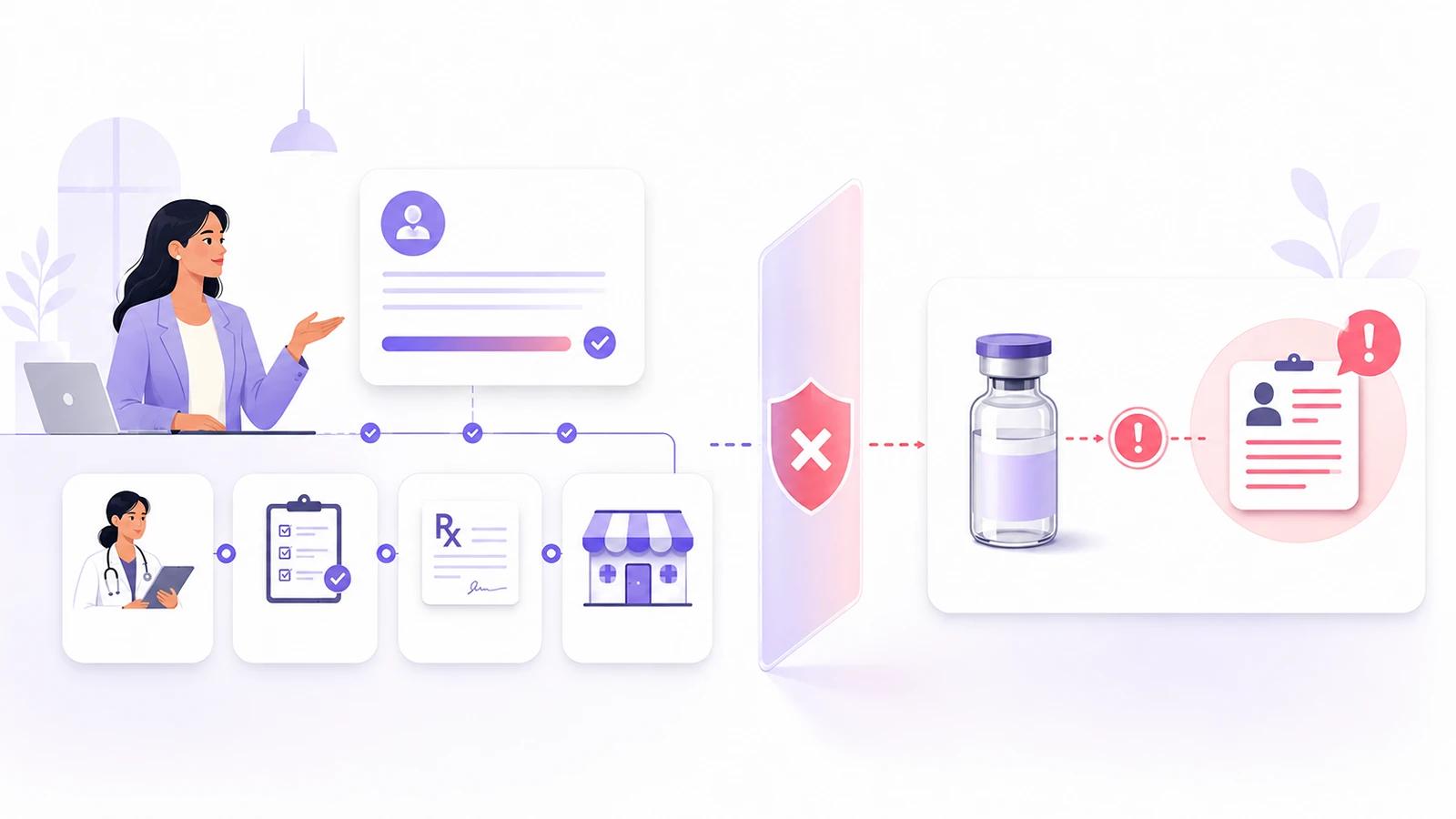
You are allowed to say that you offer a clinical program, that a licensed clinician evaluates eligibility, and that medications, if prescribed, are dispensed by a licensed pharmacy. Compounding pharmacies have been permitted to advertise since the Supreme Court struck down the original restriction in Thompson v. Western States Medical Center in 2002, and Congress removed it from the statute in 2013.
What you cannot do is make disease or treatment claims for a peptide FDA has not approved. The FTC standard is competent and reliable scientific evidence, which for a health benefit claim means randomised controlled human trials. Animal data doesn't clear it. Mechanism doesn't clear it. Testimonials need the same underlying substantiation as the claim they imply, which is why creator content is the most common place a compliant peptide program springs a leak.
The practical rule we give operators: advertise the program, not the molecule. It is a smaller promise, and it is the one you can keep.
The state layer: where the federal peptide answer stops being enough
Federal status is the floor. Which peptides are legal in practice also depends on the state your customer is in, and four states have moved recently enough to matter.
California rewrote its "essentially a copy" rules, operative 1 October 2025. A compounded preparation now needs a documented clinically significant difference for the individual patient, and the pharmacist has an affirmative duty to verify it. If any part of your program touches compounded GLP-1s, this is the rule that governs your economics.
Indiana enacted Senate Enrolled Act 282 on 5 March 2026. From 1 July 2026, any bulk substance used in compounding must come from an FDA-registered facility with a valid certificate of analysis. From 1 January 2027, med spas register with the Medical Licensing Board.
Louisiana went the other way. Senate Bill 30 lifted the state's prohibition on treating obesity via telehealth, which had blocked a category of program outright.
Florida is the useful counter-example. Two bills, SB 860 and HB 877, would have restricted compounded weight-loss drugs. Both died in committee on 13 March 2026. Florida law is unchanged, and if a vendor tells you otherwise, they are working from a headline rather than the bill tracker.
We don't publish a 50-state grid, and the reason is boring: we couldn't keep one accurate. A state gets a row here when someone has verified it against the board or the statute. Silence in the table means unverified, not permitted.
Where peptide programs actually break
Five failure patterns, in rough order of how often we see them.
Reading a committee recommendation as a rule change is the newest and currently the most common. An operator sees the July headlines, decides BPC-157 is one of the legal peptides now, adds it to the catalogue, takes orders, and discovers at the pharmacy that there was never a route to fill them.
Building on one pharmacy is the oldest. Concentration risk in a supply chain where a single partner can decide unilaterally to stop compounding a whole category of peptides.
Launching in a home state and assuming it generalises. The peptide catalogue is built and marketed before anyone checks the states where the audience actually lives, and a meaningful slice of demand turns out to be unservable.
Treating advertising as a marketing problem rather than an infrastructure one. The program is compliant, the storefront names a restricted substance, LegitScript declines, and paid acquisition is dead before it starts.
And manual compliance that works until it doesn't. Checking substance against state by hand is survivable at ten orders and impossible at a thousand. The failure is not gradual. One order goes to the wrong state, the pharmacy flags it, and everything downstream stops at once.
What to do with this in the next 30 days
Take your current or planned peptide catalogue and run every item against the "who can supply it" column above. Anything that reads "nobody" comes out today, including from the pages nobody visits, because LegitScript reads the whole site.

Then check your prescriber coverage against the states your traffic actually comes from rather than the states you meant to launch in. Those two lists are rarely the same, and the difference is usually the reason orders are stalling.
The operators who come through the next twelve months intact won't be the ones who guessed right about which peptides are legal next. They'll be the ones whose structure absorbs the change without anyone touching the storefront. FUSE Health is built for exactly that: peptide status and state rules mapped in advance, verification that runs before approval instead of after, multiple pharmacy routes, and payments and certification configured before the first order rather than after the first problem.
You own the brand and the customer. The rules underneath stay current whether or not you're watching them.
Disclaimer
This page is general information for businesses about regulatory status. It isn't legal or medical advice, it isn't guidance on the use of any substance, and it doesn't recommend any treatment. Regulatory status changes. Check the "last verified" date on the row you're relying on and confirm with your own counsel and your pharmacy partner before acting.
Changelog
| Date | Change |
|---|---|
| 6 Aug 2026 | Page rebuilt. Ledger created with 30 substances. Added the outcome of the 23-24 July 2026 committee meeting with vote counts. Corrected the status of CJC-1295, AOD-9604, selank acetate, thymosin alpha-1, and ipamorelin acetate to reflect that their nominations were withdrawn. Corrected liraglutide: still on the FDA shortage list. Confirmed no FDA rulemaking published as of this date. |
References
- U.S. Food and Drug Administration, Certain Bulk Drug Substances for Use in Compounding That May Present Significant Safety Risks, content current 22 April 2026.
- U.S. Food and Drug Administration, Bulk Drug Substances Nominated for Use in Compounding Under Section 503A, updated 14 May 2026.
- U.S. Food and Drug Administration, Bulk Drug Substances Nominated for Use in Compounding Under Section 503B, updated 21 March 2025.
- U.S. Food and Drug Administration, 503B Bulk Drug Substances List.
- U.S. Food and Drug Administration, July 23-24, 2026: Meeting of the Pharmacy Compounding Advisory Committee.
- Federal Register, doc. 2026-07361, Pharmacy Compounding Advisory Committee; Notice of Meeting, 16 April 2026, docket FDA-2025-N-6895.
- U.S. Food and Drug Administration, Interim Policy on Compounding Using Bulk Drug Substances Under Section 503A of the Federal Food, Drug, and Cosmetic Act, revised January 2025.
- Holland & Knight, FDA Advisory Committee Endorses Compounding of Certain Peptides, 4 August 2026.
- Buchanan Ingersoll & Rooney, FDA PCAC Recommends Six Peptides for the 503A Bulks List, 4 August 2026.
- McDermott Will & Schulte, Bulk List Bound: PCAC Backs Majority of Peptides in Two-Day Public Meeting, 27 July 2026.
- Bass, Berry & Sims, FDA Advisory Committee Recommends Six Peptides for Compounding, 31 July 2026.
- Mintz, FDA's Advisory Committee Votes on Peptides: What It Does and Doesn't Do, 29 July 2026.
- openFDA Drug Shortages database, liraglutide, records current to 13 July 2026.
- California State Board of Pharmacy, Compounded Drug Preparations, regulatory action 2025-0507-02, filed with the Secretary of State 19 June 2025, effective 1 October 2025.
- Indiana Senate Enrolled Act 282 (2026), Public Law 136-2026, signed 5 March 2026.
- Florida Senate, SB 860 (2026) and HB 877 (2026), both died in committee 13 March 2026.
- Federal Trade Commission, Health Products Compliance Guidance, 20 December 2022.
- Federal Trade Commission, Health Breach Notification Rule, effective 29 July 2024.
- Thompson v. Western States Medical Center, 535 U.S. 357 (2002).
- World Anti-Doping Agency, The 2026 Prohibited List, in force 1 January 2026.

Daniel is a two-time founder who has scaled service businesses across major U.S. markets. A Y Combinator competition winner, he focuses on removing operational and regulatory barriers so operators can build and scale modern healthcare businesses.
- Background
- Startup Operations & Service Systems
- Experience
- 2x Founder, Multi-Market U.S. Scaling
- Qualifications
- Healthtech Market Expertise & Operational Scaling
- Key Achievement
- Scaled Premier Staff & Eventstaff across major U.S. markets