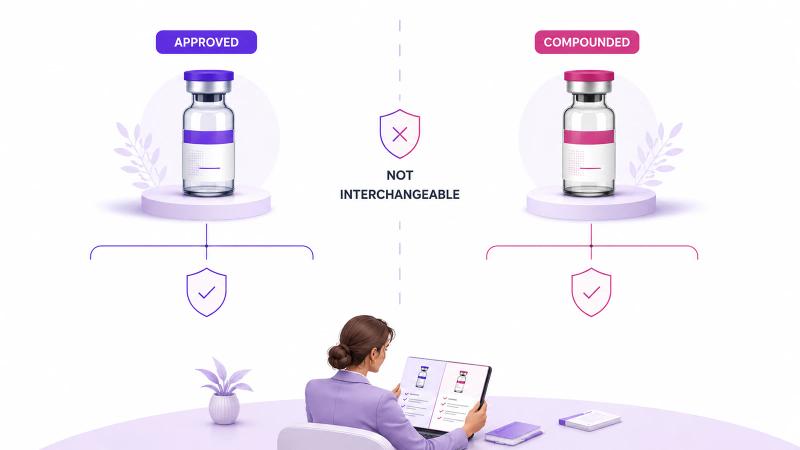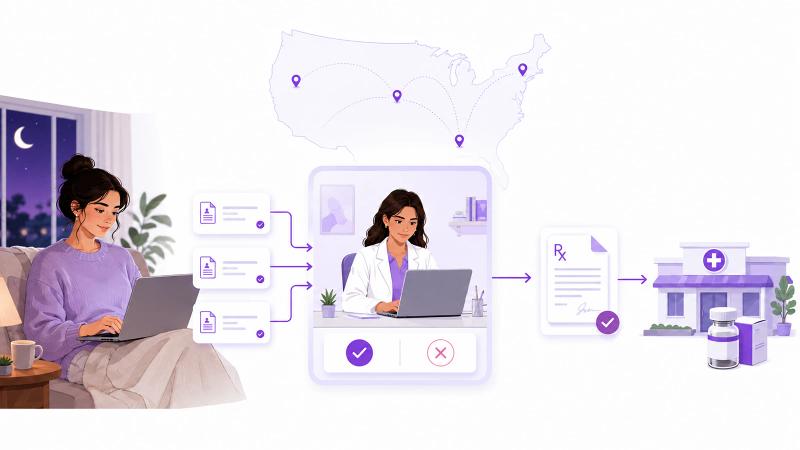
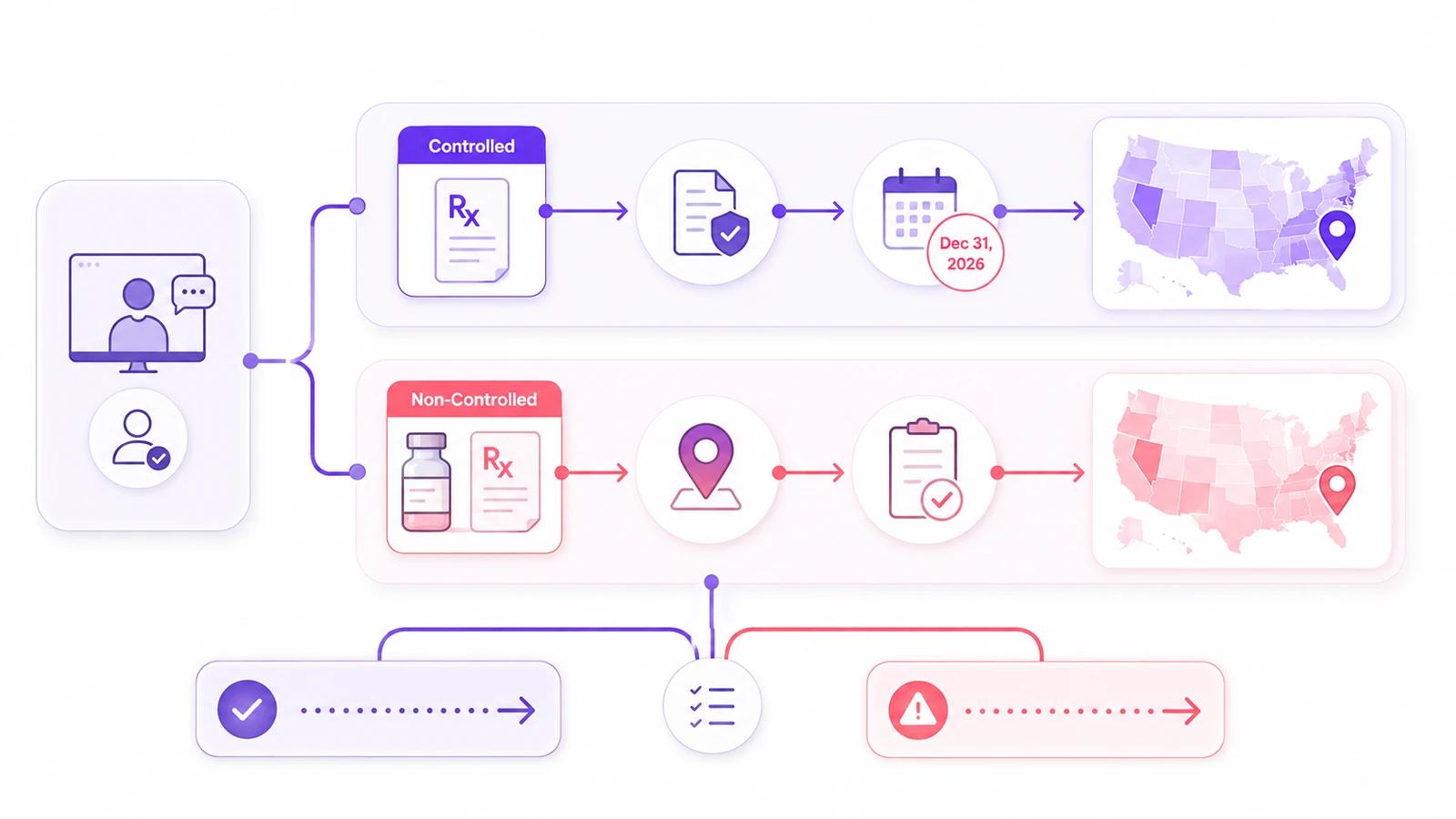
Telehealth prescribing in 2026 splits into two lanes: controlled substances under a DEA extension expiring December 31, 2026, and everything else, including GLP-1s and peptides, under state law and standard of care. Your program lives or dies on which lane it sits in and how the workflow proves it.
Telehealth prescribing decides whether your program launches in three weeks or sits in legal review for six months. You do not need a law degree to get this right. You need to know which bucket your product falls into, which states you can legally reach on day one, and what your workflow must capture every time a patient checks out. That answer is scattered across DEA notices, state board rules, and law firm alerts. Here it is in one place.
See how prescribing rules get enforced inside a real workflow. Book a walkthrough of the FUSE platform and watch intake, provider review, and pharmacy routing run end to end.
What telehealth prescribing means in 2026
Telehealth prescribing is issuing a prescription after a clinical evaluation conducted remotely, by video, phone, or structured questionnaire, instead of an in-person visit. Legality depends on three things in this order: the drug schedule, the state the patient sits in, and whether the evaluation met that state's definition of a valid patient relationship. Federal rules govern only the first. States govern the rest, and they do not agree with each other.
The two lanes: controlled versus non-controlled
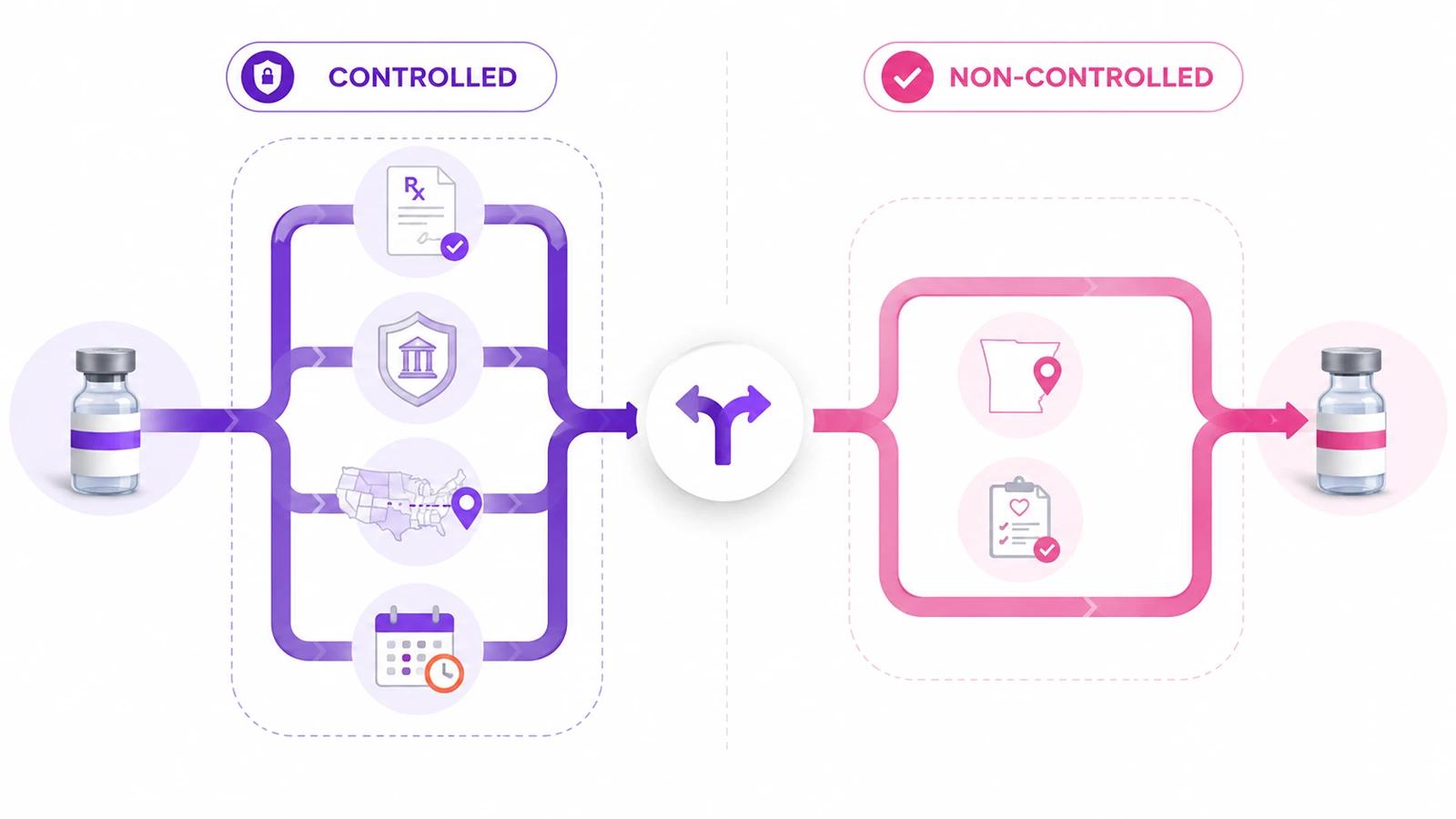
Almost every operator question collapses into one distinction. Get it wrong and nothing downstream matters.
| Controlled substances | Non-controlled substances | |
|---|---|---|
| Examples | Testosterone (Schedule III), ketamine (III), phentermine (IV), buprenorphine (III) | Semaglutide, tirzepatide, most peptides, oral finasteride, sildenafil |
| Federal layer | Ryan Haight Act, plus the current DEA telemedicine extension | No DEA involvement |
| In-person exam required federally? | Not while the extension holds | Never |
| Expiry risk | Yes, dated | No |
| Main constraint | Federal plus state | State law and standard of care |
Controlled substances: a dated permission, not a permanent one
The DEA and HHS extended the pandemic-era telemedicine flexibilities a fourth time in a rule published December 31, 2025 and effective January 1, 2026. Practitioners may prescribe Schedule II through V controlled substances via telemedicine without a prior in-person exam, provided the prescription serves a legitimate medical purpose and meets all other federal and state requirements. That authority runs through December 31, 2026 and adds no new registration, documentation, or technology requirements.
Read the date twice. Any TRT, ketamine, or stimulant program built in 2026 sits on a permission with an expiration stamp. That is not a reason to avoid the category. It is a reason to build a workflow that absorbs a rule change without a rebuild, which is what we cover in how to start a TRT clinic with compliant systems.
Non-controlled: GLP-1s are not a DEA question
Semaglutide and tirzepatide are not controlled substances. The DEA extension does not touch them, and no federal rule requires an in-person exam before prescribing them.
What applies is state law, standard of care, and sourcing. The FDA declared the semaglutide injection shortage resolved in February 2025, with enforcement discretion ending April 22, 2025 for 503A pharmacies and May 22, 2025 for 503B outsourcing facilities. Tirzepatide followed the same pattern earlier. That changed what a GLP-1 program can source and dispense, which is why how compounded semaglutide programs work through telehealth matters more than the prescribing question for most weight loss operators.
Where you can prescribe: licensure sets your map
A prescription is legal where the patient is located, not where the provider sits. That rule decides your addressable market on launch day.
The Interstate Medical Licensure Compact now covers 44 states plus Washington, D.C. and Guam, speeding multi-state licensing for physicians who qualify. It is an expedited pathway, not a national license. Nurse practitioners and physician assistants run on separate compacts with separate maps.
The practical version is simple. You do not need a provider licensed in all 50 states. You need routing logic that refuses to send a patient in State X to a provider who is not licensed there. Programs that skip this ship prescriptions into states they cannot serve and find out during an audit.
Sync versus async, and where states draw the line
Asynchronous telehealth, where a patient completes a structured intake and a licensed provider reviews it without a live call, is legal in most states for non-controlled medications and is how most high-volume programs run.
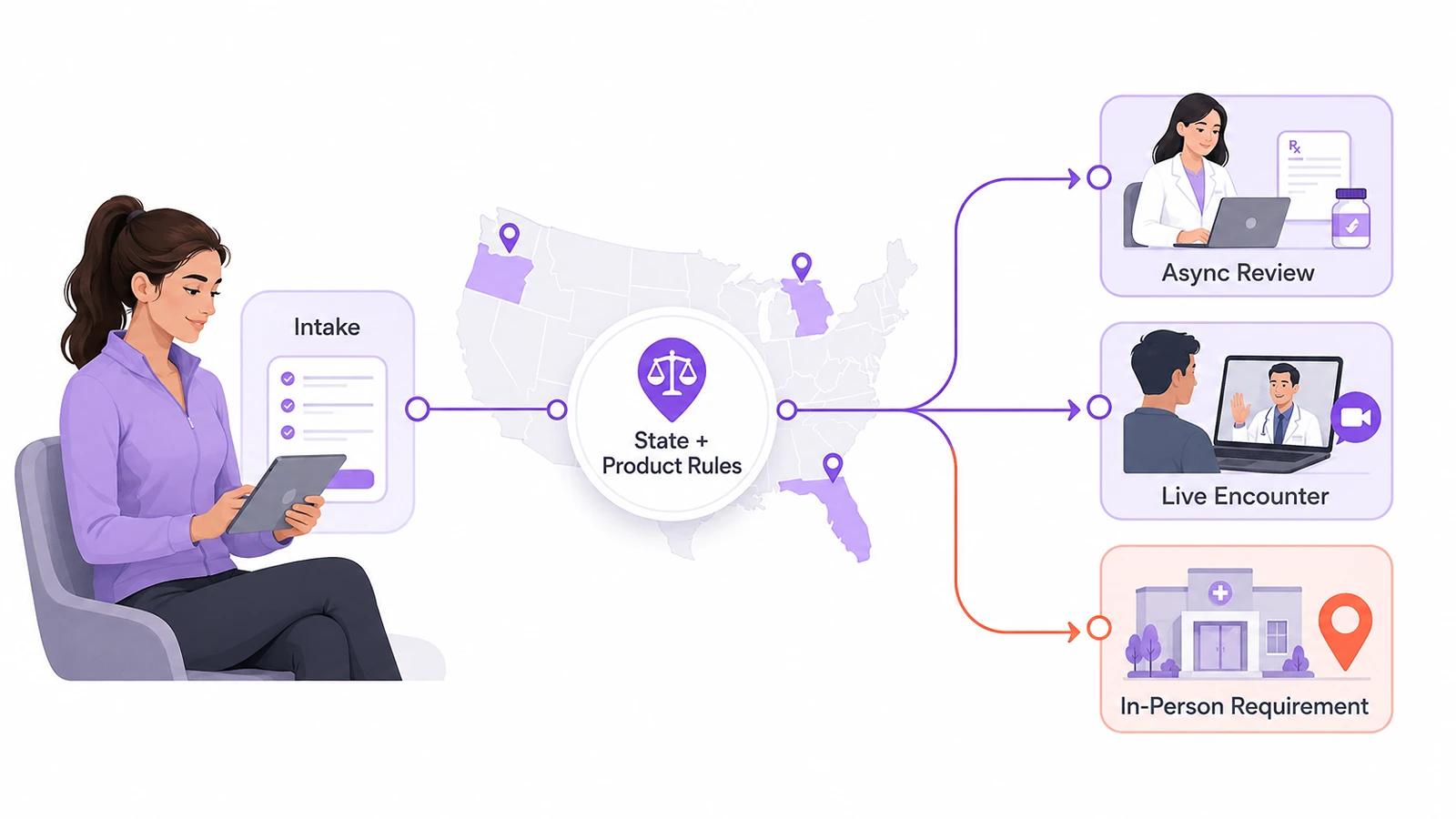
The limits are specific:
- Questionnaire-only prescribing is prohibited outright in several states. Alaska and Arkansas, among others, explicitly bar establishing a relationship through an internet questionnaire alone.
- Some states require live audio and video for the initial encounter. Arkansas requires real-time audio and visual technology or a prior in-person exam.
- Some states require a prior in-person encounter within a set window for controlled substances. Alabama requires one within the previous 12 months.
- Rules keep moving. New Jersey signed A4852 on July 8, 2026, adding Schedule II telehealth exemptions for cancer, hospice, long-term care, and substance use disorder patients, plus an adult stimulant pathway requiring an in-person visit within 30 days. The default in-person requirement stayed for everyone else.
The lesson is not to memorize 50 rulebooks. It is that intake has to branch by state and product, and those branches have to update without an engineering sprint.
Watch the state logic run live. Book a demo and unlock FUSE pricing to see how state rules, provider licensure, and product eligibility gate a single patient checkout.
The storefront-first model, and why it became the default
Here is the shift that made this category work. Operators stopped trying to become clinics.
In a storefront-first structure, you own the brand, the offer, the pricing, and the customer. Clinical review, licensure, prescribing, and fulfillment run behind the storefront inside a governed workflow you do not build or staff.
The sequence:
- Patient selects a program on your branded storefront.
- Structured intake captures identity, location, eligibility, and medical history, with questions that change by state and product.
- The system routes the case to a provider licensed in that patient's state.
- The provider decides, and the approval, denial, or escalation is documented with a timestamp.
- Approved prescriptions route to a pharmacy matched to state, license, and medication type.
- Refills follow defined triggers instead of manual chasing.
Every step above is a compliance artifact as much as an operational one. Compliance stops being a document someone wrote once and becomes a record the system produces automatically. Full stack breakdown: what a white label telehealth platform actually provides.
What actually breaks at scale
Prescribing rules rarely kill a program on day one. Volume does. The patterns repeat:
- Undefined refill logic. Refills become the bulk of your volume by month four. Without defined triggers and documentation, teams improvise, and improvised clinical decisions are the ones that show up in complaints.
- Provider capacity behind ad spend. Paid acquisition scales in a day. Licensed review capacity does not.
- Pharmacy routing as an afterthought. Build routing before marketing.
- Ad platform gating. Google and Meta require LegitScript certification for regulated health categories. Most operators discover this after building the funnel.
The full failure map is in where telehealth launches break at scale, and the workflow controls in telehealth compliance without the legal rabbit hole.
The compliance layer, stated plainly
A defensible telehealth prescribing program needs five things running at all times: verified patient identity and location, version-controlled consent, documented provider decisions, licensure-aware routing, and HIPAA-compliant communication kept separate from marketing. Each of these is covered in compliance tools every GLP-1 platform should include. Pharmacy relationships need to be documented, and the 503A versus 503B question needs an answer before your first order. 503A vs 503B: which pharmacy for your program covers that decision.
None of this is exotic. It is bookkeeping applied to clinical operations. It feels hard because most operators assemble it from five vendors and a spreadsheet.
Why operators build this on FUSE
FUSE exists because the gap between "I have a brand and an audience" and "I have a compliant prescribing operation" was swallowing good businesses. We run the layer underneath the storefront: state-aware intake, provider routing across all 50 states, documented clinical review, direct pharmacy integrations, and HIPAA infrastructure, with async and synchronous video both supported. Operators keep the brand, the margin, and the customer.
That is the difference between a program that launches in weeks and one that never clears legal.
The bottom line
Telehealth prescribing in 2026 is not ambiguous. It is conditional. Controlled substances run on a federal permission dated December 31, 2026. Non-controlled programs, including GLP-1s and peptides, run on state law and standard of care with no federal exam requirement. Your market is set by licensure, not ambition. Your defensibility is set by whether the workflow produces a record every time, or only when someone remembers to write one.
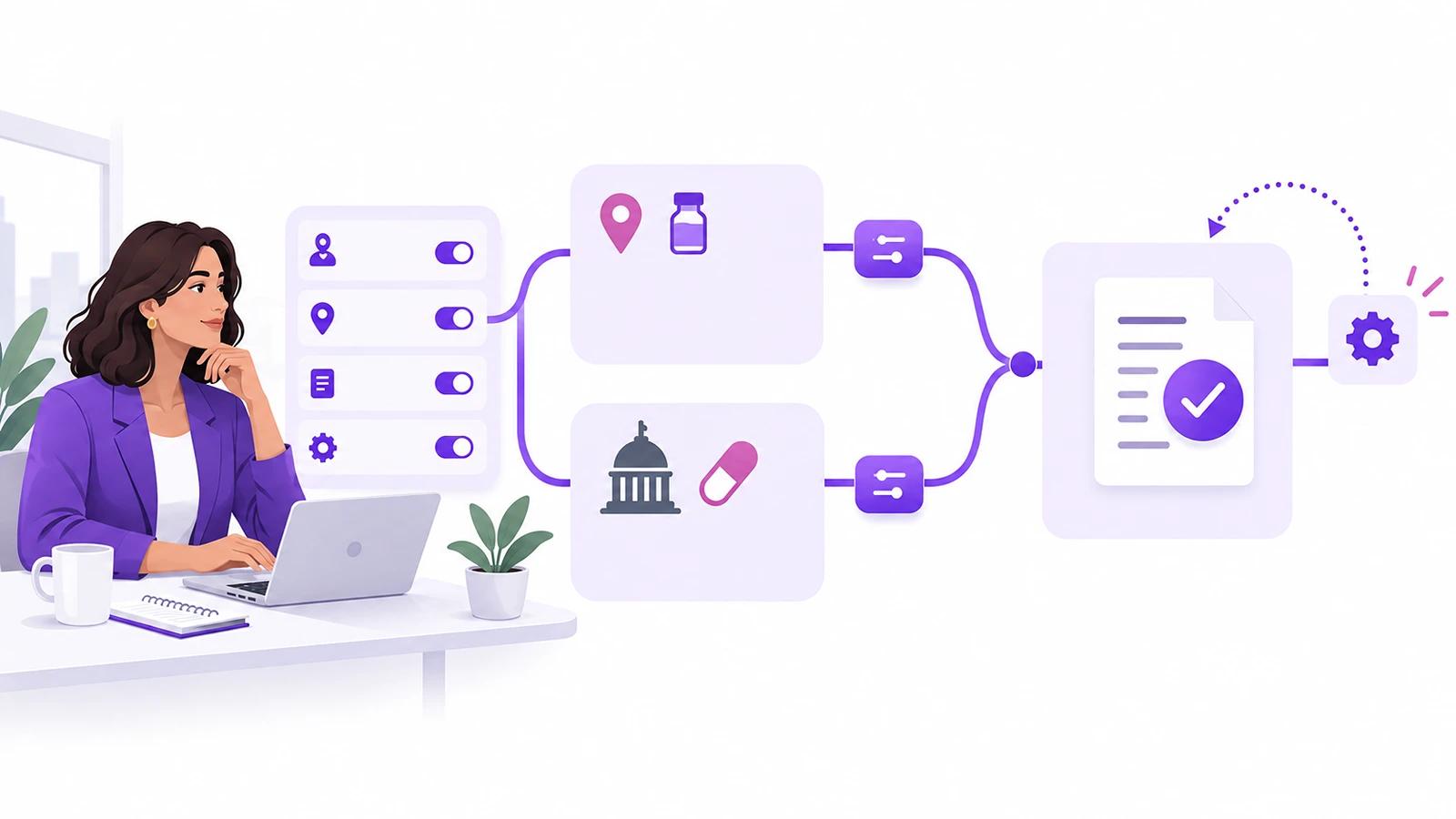
Operators who treat this as a legal research project stall. Operators who treat it as a workflow problem launch, then absorb rule changes as configuration instead of crisis.
Pick the second path. Book a consultation with the FUSE team and get a launch plan mapped to your product, your states, and your volume.
This article is for informational purposes and is not legal or medical advice. Regulations change frequently. Verify current federal and state requirements with qualified counsel before launching or modifying a telehealth program. Last reviewed August 19, 2026.
References
- DEA. Fourth Temporary Extension of COVID-19 Telemedicine Flexibilities for Prescription of Controlled Medications. Federal Register, December 31, 2025.
- Interstate Medical Licensure Compact. Member states. Data as of 2026.
- FDA. Declaratory Order: Resolution of Shortages of Semaglutide Injection Products. February 2025.
- New Jersey Assembly Bill No. 4852, signed July 8, 2026. Telemedicine prescribing of Schedule II controlled dangerous substances.
- Center for Connected Health Policy. State telehealth policies: online prescribing.
- DEA. Ryan Haight Online Pharmacy Consumer Protection Act of 2008.