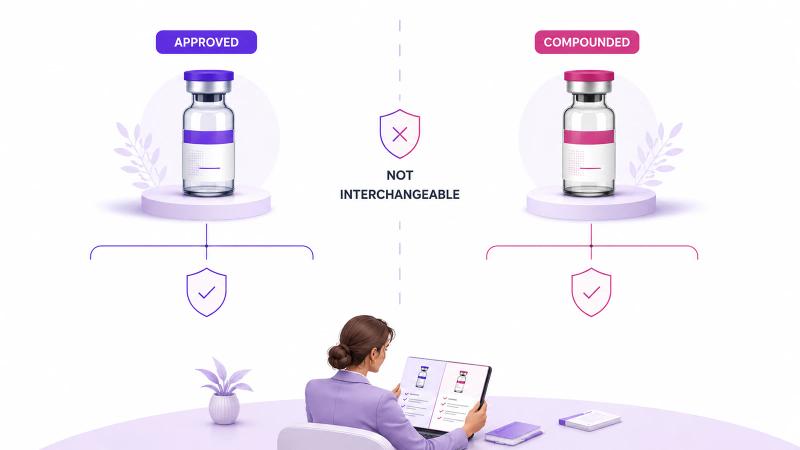

503A vs 503B comes down to one question: does your program need patient-specific prescriptions or office stock at volume? 503A pharmacies compound per patient under state boards. 503B facilities register with FDA, run CGMP, and supply multi-state programs.
503A vs 503B is the first infrastructure decision that actually caps your growth, and most operators treat it as paperwork. It is not. The designation your pharmacy partner holds decides whether you can serve 12 states or 50, whether product can sit as stock before an order exists, and how much runway you get when a federal rule moves.
Both are legal. Both compound. They answer to different regulators, and that difference shows up in your launch timeline and your catalog.
See the pharmacy layer before you commit. Book a walkthrough with FUSE and we will show you how program routing works across 503A and 503B partners.
What a 503A pharmacy actually does
A 503A pharmacy is a traditional compounding pharmacy operating under Section 503A of the Federal Food, Drug, and Cosmetic Act. It is licensed by a state board of pharmacy, supervised by a licensed pharmacist, and it compounds against a prescription written for an identified patient.

That last part is the constraint. A 503A pharmacy compounds after a prescriber writes for a named person. It does not build inventory in advance for a clinic to hold on a shelf.
503A pharmacies are not required to follow current good manufacturing practice. They work to USP compounding standards and whatever the state board layers on top. FDA can inspect them, but they do not sit on a routine risk-based inspection schedule the way outsourcing facilities do.
For a single-state clinic with a defined patient panel, this model is clean. For a telehealth brand serving patients in 30 states, it means 30 sets of non-resident pharmacy rules to satisfy before you can advertise.
What a 503B outsourcing facility actually does
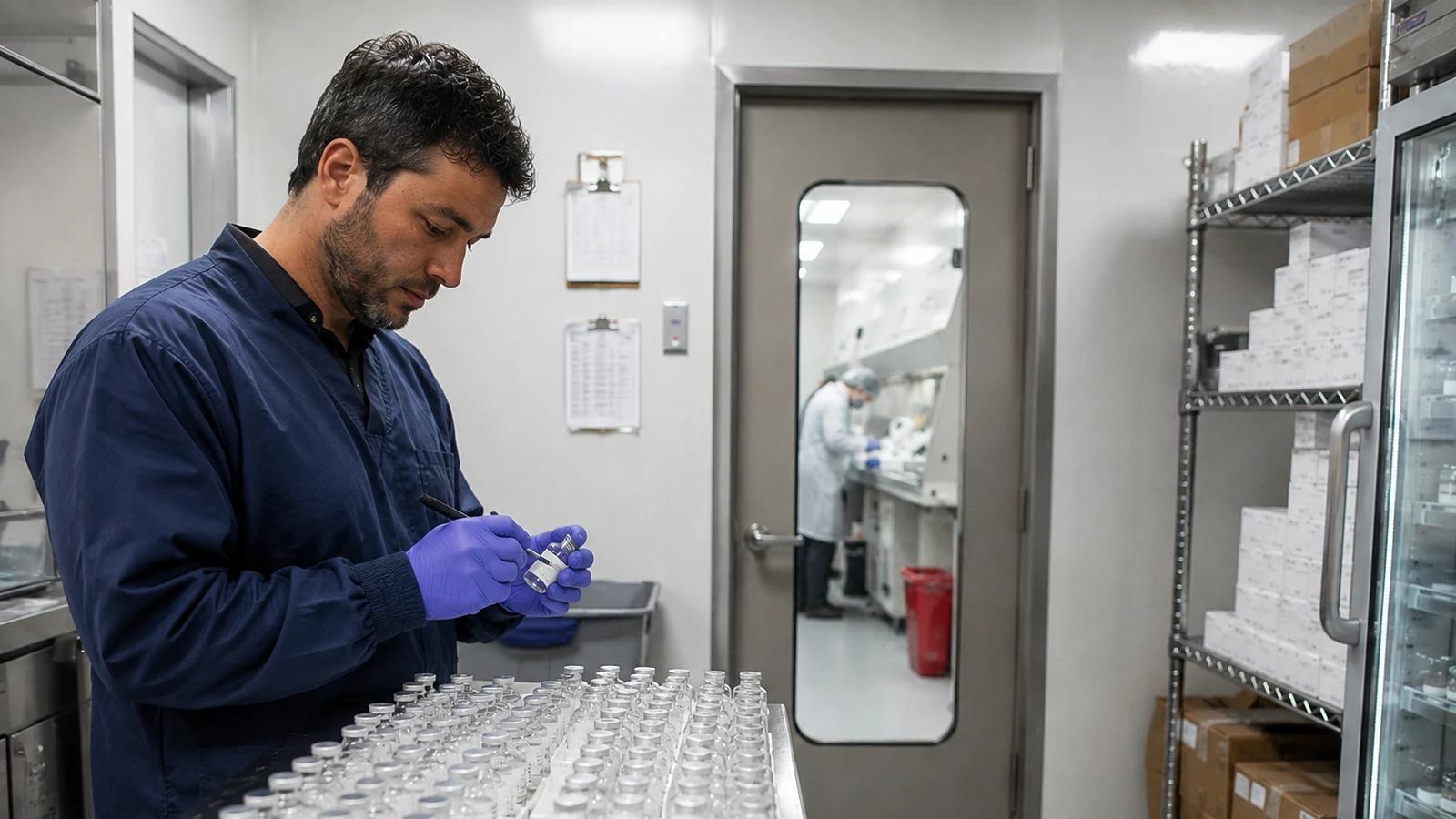
A 503B outsourcing facility registers with FDA under Section 503B. That registration changes three things operators feel directly.
- No patient-specific prescription required. Product can be compounded in batches and shipped as office stock. This is the mechanism that makes multi-state volume possible at all.
- CGMP applies. That is the manufacturing standard, not the pharmacy standard. It covers environmental controls, testing, stability data, and batch records.
- FDA inspects on a risk-based schedule. Facilities also report adverse events and submit product reports to FDA twice a year, so there is a paper trail you can actually check before you sign.
The cost of that overhead is real and it shows up in unit economics. The return is that one facility can supply a national program without you standing up a pharmacy footprint in every state you sell into.
503A vs 503B at a glance
| Factor | 503A pharmacy | 503B outsourcing facility |
|---|---|---|
| Primary regulator | State board of pharmacy | FDA, plus state licensure |
| Prescription required | Yes, patient-specific | No, office stock permitted |
| Production standard | USP compounding standards | Current good manufacturing practice |
| FDA inspection | Not routinely scheduled | Risk-based schedule |
| Output model | Per prescription | Batch production |
| FDA reporting | Limited | Adverse events plus twice-yearly product reports |
| Fits | Single-state clinics, defined panels | Multi-state programs, office stock, volume |
The GLP-1 wind-down that showed operators the difference
If you want a concrete example of why the designation matters, look at what happened when the GLP-1 shortages ended.
FDA declared the tirzepatide shortage resolved on December 19, 2024. Semaglutide followed on February 21, 2025. Because compounding of those molecules had depended on shortage-list status, resolution pulled the ground out from under a large number of programs.
FDA then gave compounders a wind-down window, and the window was not the same length for both designations.
- Tirzepatide: 503A pharmacies had 60 days, ending February 18, 2025. 503B facilities had 90 days, ending March 19, 2025.
- Semaglutide: 503A pharmacies had until April 22, 2025. 503B facilities had until May 22, 2025.
Thirty days is not a rounding error when a single molecule carries your catalog. Operators on 503A-only supply had a shorter runway to reformulate, renegotiate, or move the program somewhere else.
That is the practical lesson. The designation is not a compliance checkbox. It sets how much time you get when federal policy moves. If you are building a GLP-1 program, assume the rules will move again and pick supply that leaves you room to react.
Which pharmacy fits your program
One state, defined patient panel
503A works. Your prescriber writes, the pharmacy compounds for that patient, and you stay inside one board's rules. Adding states means adding non-resident licensure, so map that before you spend on marketing outside your footprint.
Multi-state telehealth brand
503B. Office stock and batch production are what let one supply chain serve all 50 states. This is the model sitting behind most white label telehealth platforms, and it is why the pharmacy layer, not the storefront, is the real bottleneck at launch.
Med spa adding peptides or weight loss
Depends on your map. One location in one state, 503A is workable. Multi-location or a franchise rollout, and you want 503B routing behind it. Med spas selling peptides online hit this the moment they cross a state line, which is also how one med spa added telehealth revenue in 30 days without opening a second clinic.
Ecommerce, creator, or coaching brand
503B, and it is not close. Consumer brands sell into whatever state the traffic comes from, and patient-specific compounding does not scale to that. Look at how D2C brands launch white label telehealth before you commit to a supply model.
What operators get wrong
Treating the designation as the pharmacy's problem. It is your problem. Your catalog, your state coverage, and your refill logic all inherit whatever your partner is licensed to do, which is why choosing the right pharmacy partner outranks almost every other launch decision.
Assuming 503B means anything is available. It does not. A 503B facility still cannot compound something that is essentially a copy of a commercially available FDA-approved product outside narrow exceptions. Coming off a restriction list is not the same as authorization to sell, and the same logic governs which peptides are legal to put in your catalog.
Signing one pharmacy with no fallback. When a molecule changes category or a facility draws an inspection finding, single-source operators stall. Multi-pharmacy routing is the difference between a bad week and a dead brand.
Not sure which side your program lands on? Book a consultation and we will map your states, your catalog, and the pharmacy routing that supports both.
The decision in one line

If your program is patient-specific and lives inside one state, 503A is the honest answer. If you are selling a program to patients across state lines, you need 503B in the stack, and you need routing that does not depend on one facility staying open.
The operators who scale are not the ones who picked the perfect pharmacy on day one. They are the ones who built supply that survives a rule change. That is an infrastructure decision, and you make it before launch or you make it under pressure.
FUSE runs that layer for operators who do not want to build it: licensed providers across all 50 states, 503A and 503B partners routed by product and jurisdiction, and compliance handled as infrastructure instead of a project. See how it works.
References
- FDA. FDA clarifies policies for compounders as national GLP-1 supply begins to stabilize.
- FDA. Compounding and the FDA: Questions and Answers.
- FDA. Registered Outsourcing Facilities under Section 503B of the FD&C Act.
- FDA. Aligning Federal and State Regulation of Compounders.
- The FDA Group. 503A vs. 503B: A Quick Guide to Compounding Pharmacy Designations and Regulations.
- Frier Levitt. Thinking About Starting a 503B Outsourcing Facility? Here's What You Need to Know.
- Food and Drug Law Institute. State-by-State Patchwork Creates Onerous Burdens for 503B Outsourcing Facilities.
- Pharmacy Times. FDA Affirms Decision on Tirzepatide Shortage Resolved, Sets Transition Period for Compounding.

Daniel is a two-time founder who has scaled service businesses across major U.S. markets. A Y Combinator competition winner, he focuses on removing operational and regulatory barriers so operators can build and scale modern healthcare businesses.
- Background
- Startup Operations & Service Systems
- Experience
- 2x Founder, Multi-Market U.S. Scaling
- Qualifications
- Healthtech Market Expertise & Operational Scaling
- Key Achievement
- Scaled Premier Staff & Eventstaff across major U.S. markets