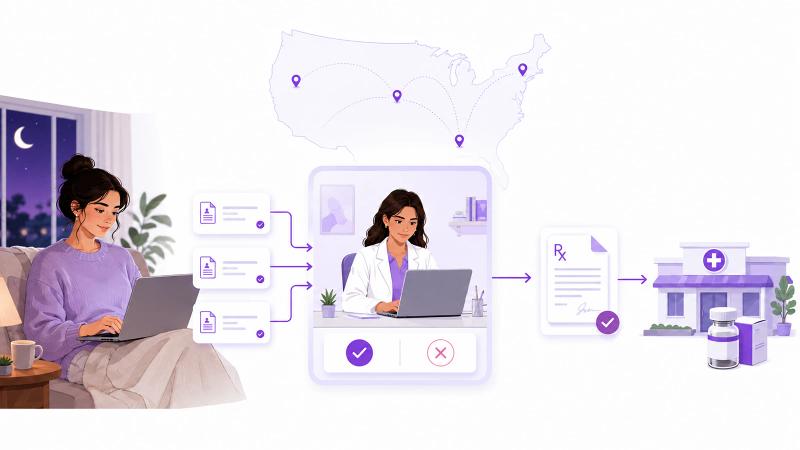

Every state allows telehealth across state lines. What differs is how a provider earns the right to treat there: full licensure, an interstate compact, or a telehealth-only registration. Most operators underestimate the assembly cost. This map shows all three paths, state by state.
Which states allow telehealth across state lines? All fifty, plus DC. That answer surprises people, and it is the reason so many launches stall at month four.
The state is not the gatekeeper. The provider's license is. A state does not grant your brand permission to sell into it. It determines which credential the clinician reviewing that intake must hold before treating someone within its borders. Get that wrong, and the exposure is unlicensed practice, with a named individual attached to it.
So the operator question is really: what does it cost, in dollars and in weeks, to have a licensed provider available in every state you sell to, and who carries that cost? If you sell the program rather than review it, that credential can sit with someone else, which is why non-licensed operators can run a branded program at all.
See the workflow before you build it. FUSE Health routes intakes to providers licensed in the patient's state, so coverage is a routing problem instead of a hiring problem. Book a walkthrough, and we will map your state footprint in about ten minutes.
The three mechanisms most reference pages blur together
Almost every reference page on this topic mixes these three into one list. They are not interchangeable. They differ in cost, in speed, and in what they let a provider actually do.
1. Full state licensure
The default. A physician applies to the state board, gets verified, pays the fee, and holds an unrestricted license. It permits everything, including in-person care.
It is also the slow path. The IMLC's fee schedule shows state license fees from $35 for a Pennsylvania MD to $895 in Texas, and that is only the fee line. Board processing is where the calendar goes.
2. Interstate compacts
Compacts do not create a national license. They create an expedited route to a real license in each member state, or a privilege to practice recognized by members.
As of July 31, 2026, the Interstate Medical Licensure Compact (IMLC) covers 44 member states plus DC and Guam, for 46 member jurisdictions across 59 licensing boards. Alaska finalized its legislation in June 2026 and became the 44th. Six states remain outside: California, Massachusetts, New York, Oregon, South Carolina, and Virginia. The application fee is $700 plus the cost of each state license requested. In its FY2025 annual report, the IMLC states that 52% of physicians obtain their Letter of Qualification in 30 days or less, and 51% receive all requested licenses in 7 days or less.
The Nurse Licensure Compact (NLC) covers 43 jurisdictions and works differently: one multistate license, issued by the nurse's home state, valid in every other member state. Nine states remain outside, including California, New York, and Illinois.
PSYPACT covers psychologists in 42 jurisdictions and requires an ASPPB E.Passport: $440 to obtain including the processing fee, $140 to renew.
3. Telehealth registration and special-purpose licenses
The least understood of the three, and the one that quietly saves the most time. Around twenty states let an out-of-state provider register or hold a telehealth-only credential instead of a full license. Florida charges no fee. Arizona charges $500. Minnesota runs $100 up front plus $75 a year.
The tradeoff is written into the statute. These credentials almost always prohibit opening an office or seeing patients in person in that state. For an async storefront that costs nothing. For a hybrid clinic it is a wall.
The 50-state map
Read this by column. A state that closes one door usually leaves another open.
| State | IMLC (physicians) | NLC (nurses) | PSYPACT (psychologists) | Telehealth-only path for out-of-state physicians |
|---|---|---|---|---|
| Alabama | Member | Member | Participating | Exception only (fewer than 10 days or 10 patients/yr) |
| Alaska | Member, implementing (44th, June 2026) | Not a member | No legislation | Prior in-person visit or referral required |
| Arizona | Member | Member | Participating | Registration, $500 |
| Arkansas | Member, implementing | Member | Participating | Episodic consultation exception |
| California | Not a member | Not a member | No legislation | Immediately life-threatening condition exception |
| Colorado | Member | Member | Participating | Registration, effective 1/1/26 |
| Connecticut | Member | Member (full 10/1/25) | Participating | Behavioral health registration expired 6/30/25 |
| Delaware | Member | Member | Participating | Registration |
| District of Columbia | Member | Not a member | Participating | MD/VA/DC proximal reciprocity |
| Florida | Member | Member | Participating | Registration, no fee |
| Georgia | Member | Member | Participating | Telemedicine license, $500 |
| Hawaii | Partial (issuing only) | Not a member | Legislation introduced | Consultation with HI-licensed physician |
| Idaho | Member | Member | Participating | Registration, behavioral health only |
| Illinois | Member | Not a member | Participating | Temporary telemedicine permit, $75 |
| Indiana | Member | Member | Participating | Registry terminated 7/1/24, full license required |
| Iowa | Member | Member | Legislation introduced | Consultation exception |
| Kansas | Member | Member | Participating | Telemedicine waiver, $100 + $100/yr |
| Kentucky | Member | Member | Participating | Infrequent consultation exception |
| Louisiana | Member | Member | No legislation | Telemedicine permit, $300 |
| Maine | Member | Member | Participating | Registration, consultation only, $500 |
| Maryland | Member | Member | Participating | MD/VA/DC proximal reciprocity |
| Massachusetts | Not a member | Member, pending | Legislation introduced | No permanent pathway |
| Michigan | Member | Not a member | Participating | Narrow circumstantial exceptions |
| Minnesota | Member | Not a member | Participating | Registration, $100 + $75/yr |
| Mississippi | Member | Member | Participating | Consultation at MS physician's request |
| Missouri | Member | Member | Participating | Informal or episodic consultation |
| Montana | Member | Member | Enacted, effective TBD | Occasional case practice exception |
| Nebraska | Member | Member | Participating | Incidental consultation exception |
| Nevada | Member | Not a member | Participating | Telemedicine license, $1,225 |
| New Hampshire | Member | Member | Participating | Consultation exception |
| New Jersey | Member | Member | Participating | Non-directive consultation only |
| New Mexico | Member, implementing | Member | No legislation | Telemedicine license, $400 |
| New York | Not a member | Not a member | Legislation introduced | Consultation exception only |
| North Carolina | Member | Member | Participating | Neighboring-state reciprocity |
| North Dakota | Member | Member | Participating | Specific scenario exceptions |
| Ohio | Member | Member | Participating | Consultation and follow-up exceptions |
| Oklahoma | Member | Member | Participating | Osteopathic telemedicine license eliminated (SB 929, 2025) |
| Oregon | Not a member | Not a member | No legislation | Telemedicine license, $253 |
| Pennsylvania | Member | Member (full 7/7/25) | Participating | Extraterritorial license, $30, adjoining states |
| Rhode Island | Member, implementing | Member | Participating | Time-limited consultation exceptions |
| South Carolina | Not a member | Member | Participating | Registration, behavioral health only, $10 |
| South Dakota | Member | Member | Participating | Consultation exception |
| Tennessee | Member | Member | Participating | Telemedicine license, $400 initial / $300 renewal |
| Texas | Member | Member | Participating | Telemedicine license phased out 12/31/25 |
| Utah | Member | Member | Participating | Limited registration, behavioral health only |
| Vermont | Partial (issuing only) | Member | Participating | Registration (10 patients / 120 days) or telemedicine license (20 patients / 2 yrs) |
| Virginia | Not a member | Member | Participating | MD/VA/DC proximal reciprocity |
| Washington | Member | Member | Participating | Practitioner-to-practitioner consultation |
| West Virginia | Member | Member | Participating | Registration, $175 |
| Wisconsin | Member | Member | Participating | Consultation and data-review exception |
| Wyoming | Member | Member | Participating | Consultation, 12 days per 52-week period |
Sources: IMLC (July 2026), NCSBN (2025-26), PSYPACT map (content dated April 23, 2025), FSMB comparison of permanent interstate telemedicine pathways. PSYPACT is the stalest of the four, so verify psychology coverage directly before relying on it.
What 50-state coverage actually costs
Nobody publishes this number, so here is the arithmetic. Treat it as a model with visible inputs, not a benchmark. It sits on top of the other telemedicine startup costs you are already budgeting for.

Take one physician you want licensed everywhere. The IMLC covers 45 of the 51 state-and-DC jurisdictions: $700 for the Letter of Qualification, plus a license fee in each state. The published spread runs $35 to $895, so a $465 midpoint puts state fees near $21,000. The six non-compact states are applied for individually, at their own fees and their own pace. Call it $22,000 to $26,000 in hard fees for one clinician, before a single intake is reviewed.
Then the calendar. About half of IMLC applicants clear in a month. The other half do not, and the non-compact states are where the tail lives. Realistic first-pass assembly runs 6 to 12 months for one physician. And you need more than one, because a single clinician cannot carry national volume or take a vacation.
Renewals then arrive on 51 separate cycles, in perpetuity. The compact expedites issuance. It does not consolidate renewal.
Where multi-state coverage breaks
Three failure patterns show up again and again, and none of them are about the initial paperwork. They sit alongside the other bottlenecks that break launches at scale: predictable and cheapest to fix before you sell anything.

Enacted is not the same as operating. The Counseling Compact is enacted in 38 states plus DC. As of its July 30, 2026 update, it is live in seven. The PA Licensure Compact has members and adopted rules, but its commission stated in July 2026 that no state is issuing privileges yet, with onboarding projected for early 2027. The APRN Compact sits below its seven-state activation threshold. Building a launch plan on a compact that passed but is not issuing is the most expensive mistake here.
Pathways disappear. Indiana terminated its telemedicine registry on July 1, 2024. Texas phased out its telemedicine license on December 31, 2025. Oklahoma eliminated the osteopathic telemedicine license in 2025. Connecticut's behavioral health registration lapsed June 30, 2025. A map built in 2023 has holes in it today.
Licensure is only one layer. A license does not settle modality rules, prescribing rules, or the DEA. The DEA's telemedicine flexibilities for controlled substances were extended a fourth time by a rule published in the Federal Register on December 31, 2025. They expire December 31, 2026. If your program touches scheduled medications, that date belongs on your roadmap.
Resiliency notes for operators
- Async review with in-state license matching, plus a fallback network so a state gap does not turn into a refund.
- Your brand owns the storefront and the customer relationship. The license sits with the reviewing clinician, not your LLC. The rest of that boundary is mapped in our telehealth compliance breakdown.
- Payments authorize at checkout and capture after clinical approval, so a declined intake never becomes a chargeback.
- LegitScript readiness gates ad approvals on Meta and Google. It is a separate track from licensure, and it has its own queue.
How telehealth companies operate in all 50 states
They rarely license one doctor everywhere. They build a routing layer.
- The customer buys a program on the operator's storefront and completes structured intake.
- The system reads the shipping and residence state.
- The intake routes to a clinician holding the right credential there: a full license, an IMLC-issued license, or a telehealth registration.
- The provider reviews asynchronously and prescribes if appropriate.
- Fulfillment routes to a pharmacy partner configured for that program, and refills run on defined rules.
The operator sells. The network carries the licensure. That is the whole difference between a brand that launches nationally in weeks and one still assembling licenses in month nine.
FUSE Health was built on that model: providers in all 50 states, routing that pairs each patient with a clinician licensed where they live, and a fallback network for out-of-state requests so geography never forces you to turn a customer away. Around 1,200 programs have launched on it, with average provider review under 24 hours. One franchise network used it to standardize telehealth across 45 locations in 10 weeks, with new sites onboarded in about a week.
Map your state footprint against a real workflow. Tell us which states you sell into and which programs you want live, and we will show you exactly where routing covers you. Book a consultation.
The decision this actually comes down to
The question of which states allow telehealth across state lines has a short answer. The useful one is about ownership: you are choosing who assembles and maintains the licensure layer.

Do it yourself and you own a fee line north of $22,000 per physician, a 6 to 12 month runway, 51 renewal cycles, and a map that shifts every legislative session. Route through infrastructure that already holds coverage and the same launch measures in days, with the workflow structured before your first sale instead of after your first complaint.
If customers are already asking for a program, demand is not your constraint. Licensure assembly is. That is a solved problem, and solving it means starting from existing infrastructure rather than building a clinic.
This article is for informational purposes for business operators. It is not legal advice and does not address clinical care. Licensure requirements change by legislative session. Confirm current requirements with the relevant state board or qualified counsel before launching in any state.
References
- Interstate Medical Licensure Compact. Member states, licensing boards and fees. Data as of July 31, 2026.
- Interstate Medical Licensure Compact. What does it cost? Per-state license fee schedule.
- Interstate Medical Licensure Compact. FY2025 Annual Report. Letter of Qualification and license issuance statistics.
- National Council of State Boards of Nursing. Nurse Licensure Compact member jurisdictions and implementation status.
- PSYPACT. Participating states map. Content dated April 23, 2025.
- ASPPB. E.Passport application and renewal fees.
- Federation of State Medical Boards. Comparison of States with Permanent Interstate Telemedicine Registration, Licensure and Exception Pathways.
- Counseling Compact. Status update, July 30, 2026.
- PA Licensure Compact Commission. Newsletter, July 1, 2026.
- DEA. Fourth Temporary Extension of COVID-19 Telemedicine Flexibilities for Prescription of Controlled Medications. Federal Register, December 31, 2025.

Daniel is a two-time founder who has scaled service businesses across major U.S. markets. A Y Combinator competition winner, he focuses on removing operational and regulatory barriers so operators can build and scale modern healthcare businesses.
- Background
- Startup Operations & Service Systems
- Experience
- 2x Founder, Multi-Market U.S. Scaling
- Qualifications
- Healthtech Market Expertise & Operational Scaling
- Key Achievement
- Scaled Premier Staff & Eventstaff across major U.S. markets