
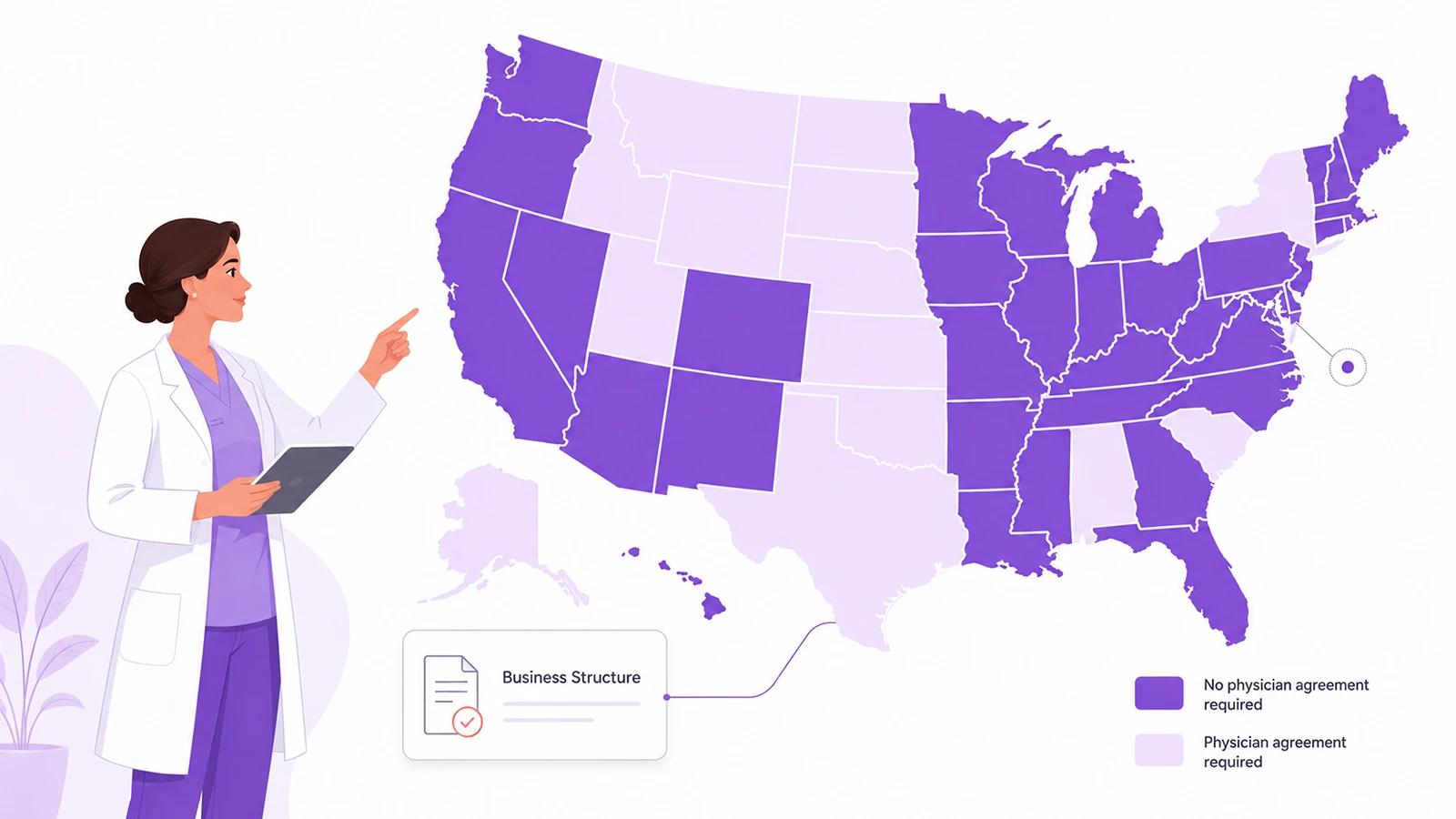
Can a nurse practitioner open their own practice? In 27 states plus Washington, D.C., yes, with no physician agreement required. In 23 states you need one, and the cost is real. The state map decides your clinical scope. Your entity structure decides whether you can own the business at all.
The Answer, Then the Part Nobody Tells You

Can a nurse practitioner open their own practice? Yes, and in most of the country you can do it without asking a physician for permission. The American Association of Nurse Practitioners classifies 27 states plus Washington, D.C. as full practice authority jurisdictions, along with Guam and the Northern Mariana Islands. Its state practice environment map was last updated in May 2026.
That is the answer to the question most people are actually asking. It is also the point where most articles stop, which is why so many nurse practitioners get halfway into a launch and discover a second rulebook they never knew existed.
Practice authority tells you what you may treat and prescribe. It says nothing about who is allowed to own the company, take the payment, hold the patient data, or keep the whole thing running when order volume climbs. Those are separate rules, and in roughly two thirds of states they cut against you. We built the independent NP infrastructure around exactly that gap.
Nurse practitioner independent practice states, grouped three ways
AANP sorts every jurisdiction into three tiers. Counts published elsewhere still disagree, often because a blog copied a number from 2019 and never revisited it. Verify against AANP directly and against your own board of nursing before you sign anything.
1. Full practice (27 states plus D.C.)
Alaska, Arizona, Colorado, Connecticut, Delaware, Hawaii, Idaho, Iowa, Kansas, Maine, Maryland, Massachusetts, Minnesota, Montana, Nebraska, Nevada, New Hampshire, New Mexico, New York, North Dakota, Oregon, Rhode Island, South Dakota, Utah, Vermont, Washington, Wyoming, and Washington, D.C.
You evaluate, diagnose, order and interpret tests, and prescribe, including controlled substances, under the exclusive licensure authority of the state board of nursing.
2. Reduced practice (12 states)
Alabama, Arkansas, Illinois, Indiana, Kentucky, Louisiana, Mississippi, New Jersey, Ohio, Pennsylvania, West Virginia, and Wisconsin.
At least one element of practice is limited, and a collaborative agreement with a physician is typically required to deliver care.
3. Restricted practice (11 states)
California, Florida, Georgia, Michigan, Missouri, North Carolina, Oklahoma, South Carolina, Tennessee, Texas, and Virginia.
Career-long supervision, delegation, or team management by a physician is required for at least one element of practice.
The hours trap inside full practice
Full practice authority is not always immediate. New York grants independent practice only after a nurse practitioner completes 3,600 hours of qualifying experience, and until then a written practice agreement and protocols apply. Florida, a restricted state, offers an autonomous practice registration that requires 3,000 clinical practice hours within the preceding five years and limits autonomous work to primary care under Fla. Stat. 464.0123.
Read your state's fine print before you read anyone's map.
What a collaborating physician actually costs
If you land in one of the 23 states that require physician involvement, this becomes a line item, not a formality.
Published operator guidance puts fair monthly collaboration fees in the range of roughly $500 per month for a small panel to $1,000 per month for a larger practice, and $1,000 to $2,000 per month for higher liability work. Rates above that exist and are commonly described in the nurse practitioner community as opportunistic rather than market.

One structural warning. Paying a collaborating physician per patient or as a percentage of collections invites federal Anti-Kickback Statute exposure. Flat stipend arrangements are the standard for a reason. This is not a place to get creative on your own.
Budget the rest honestly too: entity formation, professional liability coverage, DEA registration, credentialing time before payer money arrives, and an EHR that supports e-prescribing in every state you serve.
The ownership question that sinks more launches than scope
Here is the rule that surprises people. In roughly 33 states, corporate practice of medicine doctrines prohibit a non-clinician from owning an entity that practices medicine or employs clinicians. Nurse practitioners often clear this in full practice states, but the moment you bring in a business partner, an investor, or a physician collaborator, the ownership chart matters more than the scope of practice.
The structure that survives review separates the two halves of the business:
- A professional entity, owned by a licensed clinician, holds the clinical relationship. Diagnosis, prescribing, and chart decisions live here and nowhere else.
- A management company handles everything that is not clinical judgment: the brand, the site, pricing, marketing, support, logistics, and technology. This is the MSO-PC structure most digital health companies run on.
- A written services agreement connects them at fair market value, with no revenue share tied to clinical volume.
Enforcement is not theoretical. Regulators and courts have pursued companies whose management layer reached into clinical decisions. If your operating agreement lets a non-clinician set protocols or override a prescriber, you have a problem no disclaimer fixes. Our corporate practice of medicine 50-state guide breaks this down by enforcement tier.
The storefront-first model, and why it wins
The old assumption was that opening a practice meant a lease, a front desk, and a waiting room. That model still exists. It is also the slowest and most capital-hungry way to test whether anyone wants what you are selling.
The version that works now looks like this. You run a storefront. Patients arrive, choose a program, complete an intake, and pay. Behind that storefront, a structured clinical workflow takes over: a licensed provider reviews the intake asynchronously, approves or declines, and the prescription routes to a pharmacy that ships to the patient. You never touch a clinical decision. The provider never touches your marketing.
Broken into steps:
- Sell. Your brand, your pricing, your funnel, your customer relationship.
- Review. Intake is routed to a licensed provider in the patient's state. Approve, decline, or request more information.
- Fulfill. Approved prescriptions route to a licensed pharmacy partner and ship direct.
- Support. Refills, follow-ups, and messaging run on the same rails, with clinical questions routed back to the clinical side.
Compliance sits inside those four steps rather than on top of them, which is the difference between a workflow that holds up and a policy binder nobody reads.
The reason this model keeps winning is that it lets a nurse practitioner start earning without renting square footage, and it lets a non-clinician operator build a health brand without practicing medicine. Same infrastructure, two different owners, which is exactly what a white label platform provides.
What breaks at volume
Small practices fail on cash. Growing practices fail on plumbing. Four systems predictably crack.
Payments. Card processors classify prescription commerce as high risk. Accounts get frozen at exactly the moment volume proves the concept. Build with a processor that already understands the category.
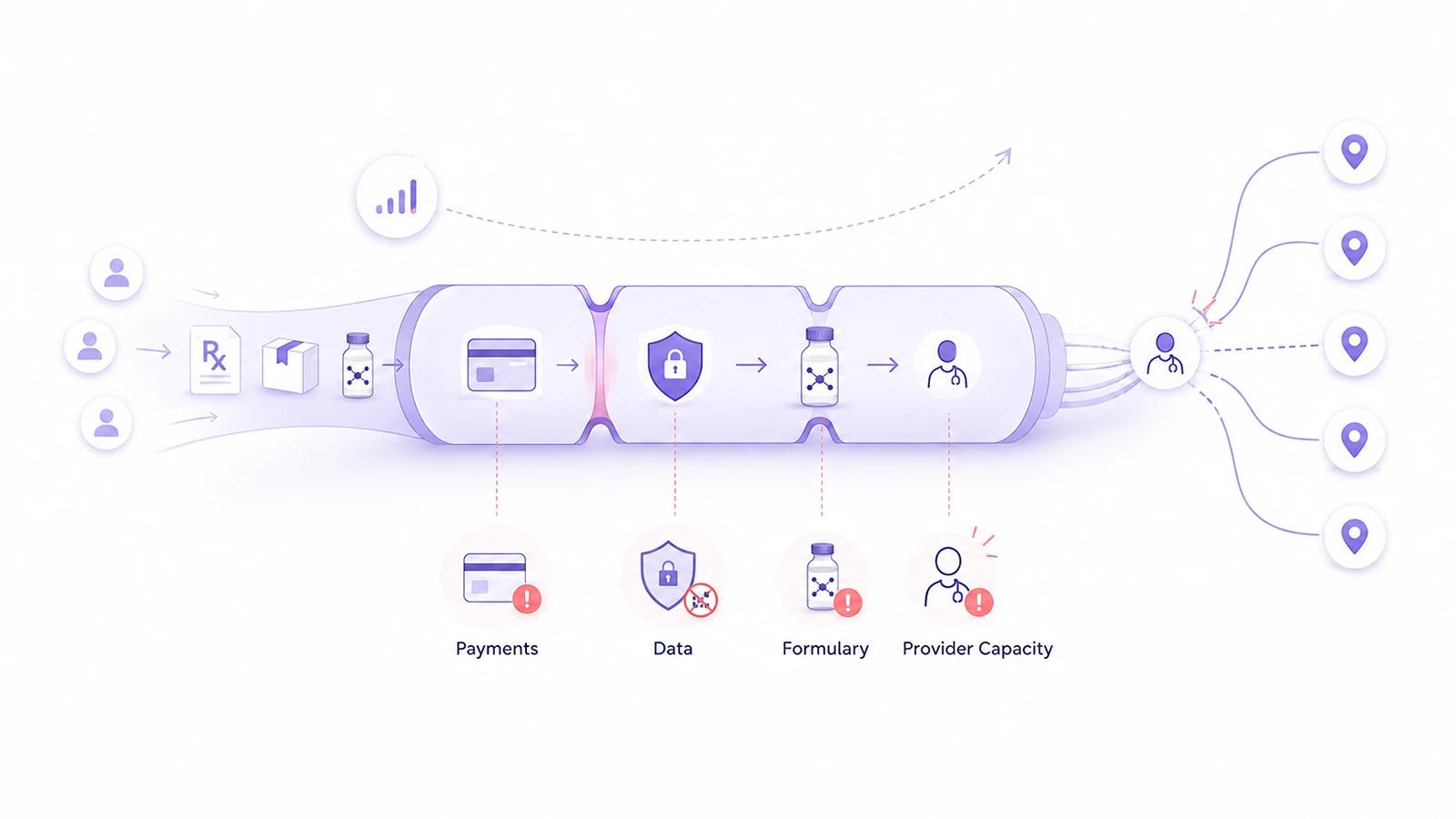
Data. HIPAA obligations attach to the clinical side, and most storefront tooling is not built for it. Marketing pixels firing on an intake page are a common and expensive mistake, and a standard Shopify setup is not HIPAA compliant on its own.
Certification and formulary. Product categories move. What is compoundable, what is on shortage, and what a pharmacy will fill changes without warning. A static product page becomes a compliance liability.
Provider capacity. One collaborating clinician covering three states does not scale to fifteen. Licensing coverage has to grow before demand does, not after.
None of these are reasons to stay small. They are reasons to pick infrastructure that already solved them.
The decision in front of you
Can a nurse practitioner open their own practice? In most of the United States, clinically, yes. The harder question is whether you want to spend your first year building infrastructure or building a patient base.
Every operator who launches on their own rebuilds the same four systems: compliant intake, provider coverage across states, pharmacy fulfillment, and payments that survive scrutiny. That work is done. FUSE runs it as infrastructure so the clinical side stays clinical and the business side stays yours. If you want the full sequence, start with our guide to starting a compliant telehealth business.
The nurse practitioners who move fastest are not the ones with the best legal memo. They are the ones who put a real storefront in front of real demand while the structure held up underneath.
This article is general business information for operators and clinicians. It is not legal advice and it is not medical advice. Practice authority, corporate ownership, and prescribing rules vary by state and change frequently. Confirm current requirements with your state board of nursing and qualified healthcare counsel before launching.
References
- American Association of Nurse Practitioners, State Practice Environment (updated May 2026)
- American Association of Nurse Practitioners, NP Fact Sheet
- New York State Education Department, Practice Requirements for Nurse Practitioners
- Florida Statutes 464.0123, Autonomous Practice by an Advanced Practice Registered Nurse
- The Elite Nurse Practitioner, How Much Should a Physician Collaborator Cost (2024)
- Zivian Health, Collaborating Physician Fees: The Ultimate Guide

Daniel is a two-time founder who has scaled service businesses across major U.S. markets. A Y Combinator competition winner, he focuses on removing operational and regulatory barriers so operators can build and scale modern healthcare businesses.
- Background
- Startup Operations & Service Systems
- Experience
- 2x Founder, Multi-Market U.S. Scaling
- Qualifications
- Healthtech Market Expertise & Operational Scaling
- Key Achievement
- Scaled Premier Staff & Eventstaff across major U.S. markets