

What is an MSO in healthcare? It's a company that runs a medical practice's business side under contract, while the licensed physicians who own the practice keep every clinical decision. Oregon and California both redrew that line in 2025, so the details matter now.
Introduction
In most states, people without a medical license can't own a medical practice. Yet private equity firms and wellness brands put money into medical businesses every day. How does that work? It usually comes down to three letters. MSO stands for management services organization, and it's the structure that lets business people fund and run a practice without touching the medicine.
Here's the short version of how it works. One company (the professional corporation, or PC) is owned by licensed physicians and delivers the care. A second company (the MSO) handles billing, staffing, leases, software, and marketing, and it gets paid a fee for that work. The two sign a management services agreement, and that contract is where the whole arrangement lives or dies.
Below, I'll walk you through what an MSO does, how money moves between the two companies, and what Oregon's and California's 2025 laws say about where the line sits. If you're the operator trying to sell clinical programs under a non-clinical brand, this is the structure to understand first. It's also the same logic behind how FUSE works.
What an MSO in healthcare means

- The MSO meaning in plain terms
In medical terms, an MSO is a business services company that contracts with a medical practice to run its non-clinical operations. It holds no medical license and has no say in how anyone gets treated. Its job is everything around the care, like sending claims, hiring front-desk staff, signing the office lease, and running the marketing.
Think of the MSO as the plumbing of a practice. Patients never see it, the physicians depend on it every day, and nobody thinks about it until something leaks.
- The professional corporation on the other side
The other half of the structure is the professional corporation, usually called a PC (or a PA or PLLC, depending on the state). A PC is a company that licensed professionals own, and in medicine that means physicians. The PC holds the provider contracts, employs or contracts the clinicians, owns the medical records, and carries the responsibility for patient care.
So when people search for "MSO vs PC," the simplest answer is that the PC practices medicine and the MSO runs the business around it. You rarely see one without the other, since the MSO has nothing to manage without a PC.
Why the MSO structure exists in the first place
The MSO model exists because of a legal rule called the corporate practice of medicine doctrine, or CPOM. Under CPOM, a business corporation can't practice medicine or control how physicians practice it. The idea is that clinical judgment shouldn't bend to whoever owns the company. According to Epstein Becker Green, the majority of states have some form of CPOM restriction, though how strict they are varies a lot from one state to the next. Our 50-state CPOM guide maps where each state sits.
Here's a detail that surprises most business owners. The Medical Board of California keeps a list of decisions it considers clinical. One of them is how many patients a physician must see in a given period, or how many hours a physician must work. That sounds like a scheduling question to most people. In California, it's treated as a medical decision, which means an MSO that sets patient quotas can cross the line without ever touching a chart.
The same page lists choosing diagnostic tests, deciding on specialist referrals, and owning the patient's overall care. That gives you a handy test for any MSO contract. If a business person is making one of those calls, the structure has a problem.
CPOM also has deep roots. Oregon's version goes back to a 1947 state Supreme Court case, State ex rel. Sisemore v. Standard Optical, which barred corporations from owning medical practices or employing physicians. The rule is almost 80 years old, and the MSO is what the business world built to work inside it.
How the MSO and the PC split the work
The cleanest way to understand an MSO arrangement is to look at who owns which decision. Here's how the split usually looks in a compliant setup.
| Area | The MSO handles | The PC and its physicians keep |
|---|---|---|
| Money | Billing, collections, payroll processing, accounting | Final billing and coding decisions in California when private equity or hedge funds are involved |
| People | Recruiting and managing non-clinical staff | Hiring, firing, and supervising clinicians |
| Care | Scheduling software, patient intake tools, IT | Diagnosis, treatment, test selection, referrals, prescribing |
| Records | Hosting and securing the systems | Owning the medical records and their contents |
| Growth | Marketing, real estate, vendor contracts | Which services the practice offers clinically |
The table looks tidy, and regulators still judge the arrangement by how the two companies behave on an ordinary Tuesday. If the contract gives physicians control of clinical staffing and an MSO manager fires a nurse practitioner over revenue targets, the paperwork won't protect anyone.
Physicians usually hold the PC's voting shares, while the MSO holds the capital, the operating team, and the technology. That's why investors like the model, because they can grow the business side while the clinical side stays under licensed control.
How money moves between an MSO and a PC
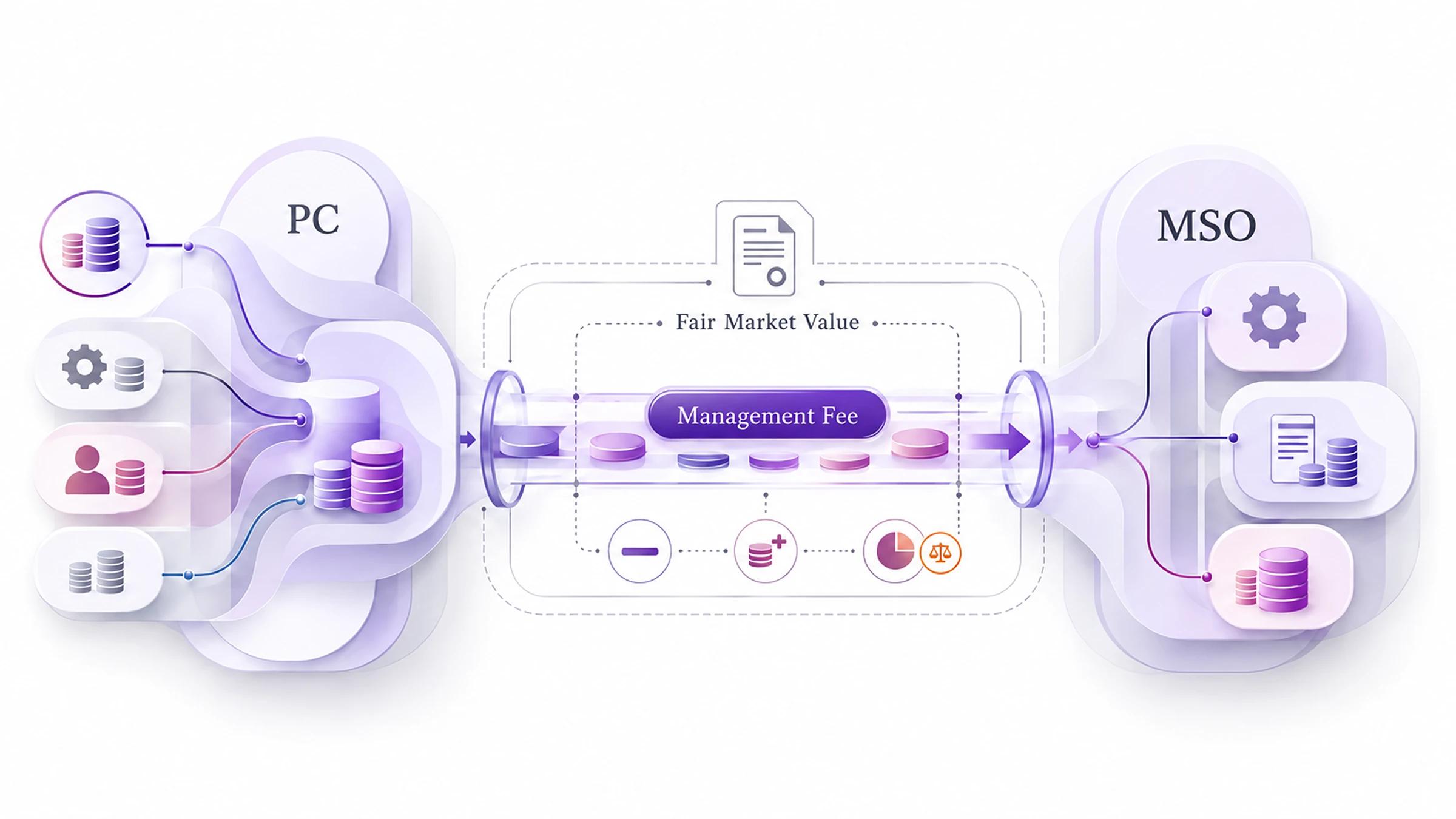
Money is the part regulators watch most closely. The PC collects the revenue for the care it provides, then pays the MSO a management fee for its services. Whatever's left after expenses and physician pay stays with the PC.
How that management fee gets calculated is where most of the legal risk sits. There are three common approaches:
- A flat fee, where the PC pays a fixed monthly amount for a defined set of services. It's the easiest to defend, since the number stays put as patient volume changes.
- Cost plus a markup, where the MSO passes through its actual costs and adds a set percentage on top. This works when the MSO's spending is easy to document.
- A percentage of revenue, where the MSO takes a share of what the practice collects. This is common, but percentage fees can raise fee-splitting questions under some state laws, so it needs a close legal review state by state.
If a practice bills Medicare or Medicaid, the federal Anti-Kickback Statute comes into play too. Its safe harbor for management contracts sits at 42 CFR 1001.952(d). It asks for a signed written agreement, a term of at least one year, and a fee method that's set in advance at fair market value and isn't tied to the volume or value of referrals. That one-year minimum stops the parties from quietly rewriting the fee every few months to reward referrals.
Fair market value is the phrase that holds the whole thing together. When an MSO charges far more than its services are worth, the fee starts to look like profit moving from the medicine to the investors, which is the exact thing CPOM is trying to prevent.
A case study in 2025: two states that redrew the MSO line
The clearest way to see MSO rules at work is to look at two states that decided existing structures had gone too far.
- Oregon SB 951
On June 9, 2025, Oregon Governor Tina Kotek signed Senate Bill 951. Law firm Davis Wright Tremaine calls its limits among the most stringent restrictions in the country on corporate involvement in medical practices. The law defines an MSO broadly, as any entity providing management services to a professional medical entity for money under a written agreement. According to Reed Smith, an MSO doesn't need private equity backing for the law to apply.
The biggest change is a ban on dual ownership. In many "friendly PC" setups, a physician tied to the MSO also owns the PC, which keeps the PC friendly to the MSO's plans. According to Kirkland & Ellis, Oregon now bars dual ownership in an MSO and a professional organization it manages. The law also limits the stock transfer agreements that let an MSO swap out the PC's owner.
According to Nixon Peabody, MSOs that existed before June 9, 2025, have until January 1, 2029, to come into compliance, while newer entities face the rules sooner.
- California SB 351
Four months later, on October 6, 2025, California Governor Gavin Newsom signed Senate Bill 351, which took effect January 1, 2026. Foley & Lardner reports that the law bars private equity groups and hedge funds from interfering with a provider's professional judgment, and it spells out decisions that only physicians can make. Those include owning and deciding the content of medical records, making employment decisions about clinicians, negotiating payer contracts, making billing and coding decisions, and approving the equipment and supplies the practice uses.
California took a narrower route. Its law targets private equity and hedge funds, and it mostly writes existing case law and Medical Board guidance into statute. It also lets the state Attorney General seek court orders and recover legal fees from investors, which puts investors themselves on the hook.
- What both cases tell an operator
Put the two laws side by side and a pattern shows up. Both states left the MSO model standing and went after the same thing, which is business control creeping into clinical decisions through contracts, ownership tricks, and fee structures. Oregon attacked the ownership mechanics, and California listed the decisions that belong to physicians.
For anyone building a health brand, the takeaway is practical. The version of the model that relies on a physician owner who signs whatever the MSO sends over is getting harder to defend. The structures that hold up give the clinical side real independence and pay the business side a fair, fixed price for real work.
How an MSO arrangement gets set up step by step
Here's the typical order for building a traditional MSO and PC. Each step needs a healthcare attorney who knows the states you'll operate in.
- Form the professional corporation. A licensed physician in each relevant state becomes the owner, and the PC registers with the state medical board where required.
- Form the MSO. This is a regular business entity, often an LLC, that the investors or the brand owner can own.
- Sign the management services agreement. The MSA lists every service the MSO provides and every decision it's barred from making.
- Set the management fee. A valuation firm often confirms the fee is consistent with fair market value, and the fee method gets locked in for at least a year.
- Sign the supporting agreements. These can include a stock transfer restriction agreement and a lease, though Oregon now limits how far those can go.
- Run the business the way the paper says. Every hiring decision, schedule rule, and pricing change gets checked against the clinical and non-clinical split.
That sixth step is where most arrangements slip, because the documents are easier to draft than to live by. Building this across many states means recruiting physician owners, licensing in each state, and paying for legal and valuation work before the first patient ever shows up. If you're going down this road, our MSO setup guide covers who signs what and how to decide whether you need one.
Where MSO arrangements usually go wrong
Most MSO problems start with growth pressure pushing the business side into decisions it isn't allowed to make. These are the failure points that keep showing up.
- Quotas dressed up as scheduling. Patient-per-hour targets count as clinical control in California.
- Fees that float with revenue. A percentage fee that swells as the practice grows can raise fee-splitting questions in some states, and it fails the federal safe harbor's volume test when federal programs are involved.
- A physician owner in name only. When the MSO can replace the PC's owner at will, it starts to look like the real owner, and Oregon's 2025 law went straight at this.
- Business staff touching clinical hiring. Clinician hiring, firing, and supervision belong to the PC, and California's SB 351 now writes that into law for private equity-backed practices.
- Marketing that promises outcomes. When the MSO runs the ads, claims about results slip in easily, and they create exposure with the FTC and state boards.
Every one of these is an ordinary shortcut a fast-growing company takes when nobody is watching the line between the two sides. The same growth pressure shows up in operations too, which we cover in where launches break. If you want a wider view of the rules around a health brand, our guide to telehealth compliance basics covers the pieces outside the MSO question.
How the MSO logic applies to a telehealth brand
The principle behind the MSO structure is simple. The business side runs the business, and licensed clinicians make every clinical decision. That same principle shapes how a compliant telehealth brand should work, whether or not it ever forms a traditional MSO.
On FUSE, the operator owns the storefront, the pricing, the marketing, and the customer relationship. When a customer clicks to buy, they complete a structured clinical intake, and a licensed provider in the FUSE provider network reviews the request, typically in under 24 hours. Approved orders go through pharmacy routing to US-based 503A or 503B licensed compounding pharmacies. The operator sees purchases and order status, and never sees clinical records, because that boundary is built into the platform itself.
The provider pay structure follows the same fair market value logic you saw in the safe harbor. Providers in the network are paid a flat consultation fee set at fair market value, and they're paid whether they approve or decline. They're never paid per prescription, because paying per approval would create an incentive to approve.
This is also why operators on FUSE don't need a medical license for the brand, since the brand never conducts a medical consultation and licensed providers do. You get the clinical plumbing already built, with licensed providers in all 50 states, so the brand doesn't have to build a clinical layer of its own. That's the core of what a white label platform should give you. Availability still varies by product and state, and the platform enforces those state rules at intake.
The business case gets stronger as the catalog grows. FUSE supports 70 visit types across 11 clinical categories, so a weight-loss customer can later become a skin-care customer without you signing a second vendor.
Conclusion

An MSO is the business company that sits next to a medical practice, and the whole structure depends on one line staying where it belongs. Business people fund and run the operation, and licensed clinicians make every medical call. When those two stay separate, the model still works, even after Oregon's and California's 2025 laws.
If you're building a health brand, you have two ways to respect that line. You can build the traditional version yourself, with physician owners, a PC in each state, and legal and valuation work in every market. Or you can launch on infrastructure where the clinical layer, the pharmacy routing, and the state rules are already in place, and put your energy into the brand, which is the path we lay out in starting a telehealth business. Either way, the first step is the same, which is mapping your catalog and your states against the rules before you spend on anything else.
A Note on Scope
This content is for informational purposes only and does not constitute legal, medical, or regulatory advice. Regulatory requirements vary by state and are subject to ongoing FDA guidance updates. Operators should consult a licensed healthcare attorney and compliance specialist before launching. All prescribing decisions on the FUSE platform are made by independent licensed clinicians based on individual patient evaluation.
Disclosure: Daniel Meursing is the CEO of FUSE Health, which provides telehealth infrastructure to operators. FUSE has a commercial interest in the topics discussed in this article.
References
- Medical Board of California, Information Pertaining to the Practice of Medicine
- eCFR, 42 CFR 1001.952 Exceptions (Anti-Kickback Statute safe harbors)
- Davis Wright Tremaine, Oregon SB 951 Restricts Corporate Medical Practice (June 2025)
- Reed Smith, Oregon Enacts Strict New Corporate Practice of Medicine Law (SB 951)
- Kirkland & Ellis, Oregon SB 951 (June 2025)
- Nixon Peabody, Oregon SB 951: Corporate Practice of Medicine Law Explained (July 2025)
- Epstein Becker Green, Oregon SB 951 Awaits Governor's Signature (2025)
- Foley & Lardner, California SB 351 Signed (October 2025)

Daniel is a two-time founder who has scaled service businesses across major U.S. markets. A Y Combinator competition winner, he focuses on removing operational and regulatory barriers so operators can build and scale modern healthcare businesses.
- Background
- Startup Operations & Service Systems
- Experience
- 2x Founder, Multi-Market U.S. Scaling
- Qualifications
- Healthtech Market Expertise & Operational Scaling
- Key Achievement
- Scaled Premier Staff & Eventstaff across major U.S. markets