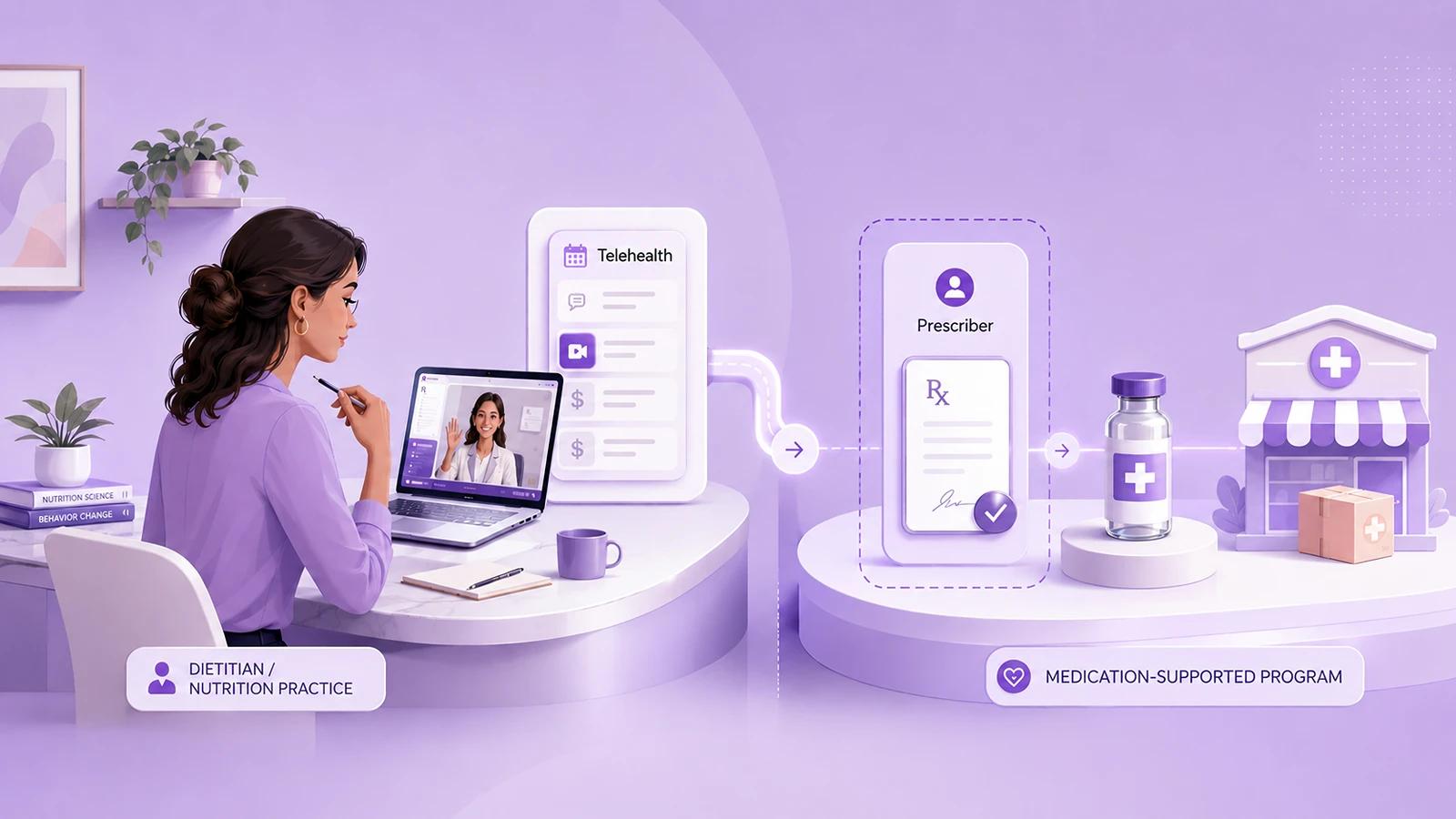
Telehealth platforms for dietitians all solve the same four problems: booking, charting, messaging, payment. None of them changes what you are licensed to do. If you want a medication-supported program under your brand, you need a prescriber layer sitting behind the software, not a better calendar.
Telehealth platforms for dietitians have quietly become a solved problem. You can launch a compliant virtual nutrition practice this week for under $50 a month, take payment, chart, and run video visits without touching a line of code. That part is finished.
What is not finished is the part your prospects keep asking about. Somebody books a discovery call, spends nine minutes describing their weight history, and then asks whether you can get them on a medication. You say no. They go somewhere that says yes.
That gap is not a software problem. But it is fixable, and the fix has a specific shape.
What you actually get for $25 to $155 a month
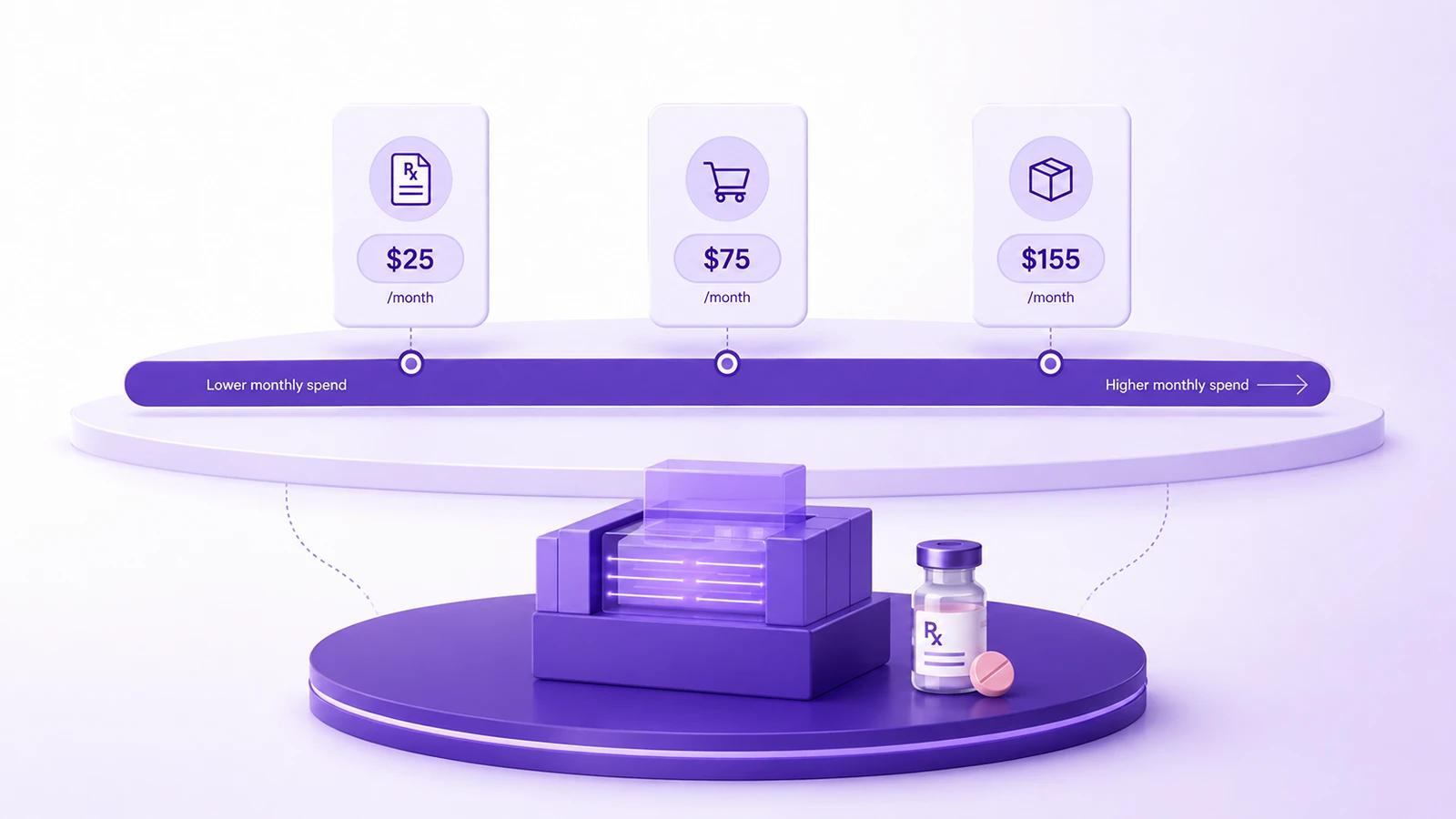
Here is the current field, priced as of August 2026. I have put FUSE in the table on purpose, because it belongs in a different column of your budget and comparing it side by side is the fastest way to see why.
| Platform | Entry price | Top tier | Prescribing | Compliance posture | Best fit |
|---|---|---|---|---|---|
| Nutrium | $25/mo, 10 clients | $39/mo unlimited | None | Secure messaging | Solo coaches building meal plans |
| Practice Better | $35/mo, 10 clients | $155/mo team | ePrescribe add-on, $49/mo | HIPAA, PIPEDA, GDPR | Solo to small group RD practices |
| Healthie | $19/mo, 10 clients | $149+/mo group | DoseSpot add-on, $40/clinician/mo | HIPAA, SOC 2 | Practices billing insurance at volume |
| Jane | $54/mo, 20 appts | $99/mo Thrive | None native | HIPAA | Multi-discipline clinics |
| FUSE Health | $499/mo DIY or $699/mo Growth | $3,000/mo Partner | Licensed providers in all 50 states, included | HIPAA, SOC 2 Type II, LegitScript | Operators selling a branded medication-supported program |
Two things jump out of that table.
First, the four incumbents sit within about $130 of each other at the top end. Choosing between them is a workflow preference, not a strategic decision. Healthie wins if claims volume is your bottleneck, because ClaimMD eligibility checks and CMS 1500 forms are built in. Practice Better wins if programs and client engagement are the product. Jane wins if you share a building with a physio. Nutrium wins if you are price-sensitive and meal plans are the deliverable.
Second, and this is the part the 2024-era comparison posts miss entirely: Practice Better and Healthie both sell e-prescribing. Neither of them gives it to you. The add-on wires a prescription pad into the chart. It does not put a prescriber behind it. We broke the same category down by business model rather than by clinical specialty, and the split holds there too.
The line the software cannot cross
An RD credential is not a prescriptive authority. The Commission on Dietetic Registration's 2024 Scope and Standards of Practice for the RDN is explicit that the document does not supersede state practice acts, and that as of 2023, 48 states plus Puerto Rico and the District of Columbia have statutory provisions regulating dietetics practice. Where RDNs do get order-writing privileges, CMS frames it narrowly: hospitals may extend privileges for therapeutic diets and nutrition-related services, and only where state law allows it. The federal and state picture on what you can prescribe is a separate map, and it is worth reading before you design a program around it.
Nothing in that framework touches independent prescribing.
The reimbursement picture is just as tight. Medicare covers medical nutrition therapy only for people with diabetes, kidney disease, or a kidney transplant inside the last 36 months. It pays for three hours in the first year and two hours annually after that, and it requires a physician referral to start.
So the economics of a pure MNT practice are capped in two directions at once. Narrow eligibility, and a per-hour ceiling that does not move.
Why this got urgent in 2026
Gallup's May 28 to June 5, 2026 survey put current GLP-1 use for weight loss at 11% of US adults, with 15% having ever used one. In 2024 the current-use figure was 3%. That is close to a fourfold increase in two years, and it landed squarely on top of the category dietitians have owned for forty years.
The supply side moved in the opposite direction. On April 30, 2026, the FDA proposed permanently excluding semaglutide, tirzepatide, and liraglutide from the 503B bulk drug substances list, citing 455 adverse event reports tied to compounded semaglutide and 320 tied to compounded tirzepatide. If that proposal finalizes, the compounded workaround that carried most of the 2024 and 2025 telehealth boom closes for good.

Read those two facts together and the conclusion is uncomfortable but clear. Demand for medication-supported weight care is at an all-time high. The improvised supply routes are being shut. What survives is the part that was structured properly from the start: a licensed prescriber, a legitimate pharmacy, and a documented clinical workflow.
Capital already noticed. Fay and Berry Street, both nutrition-first telehealth companies, each raised $50 million in 2025 on the strength of building real clinical and billing infrastructure rather than better scheduling.
How a prescriber-partnership program actually runs
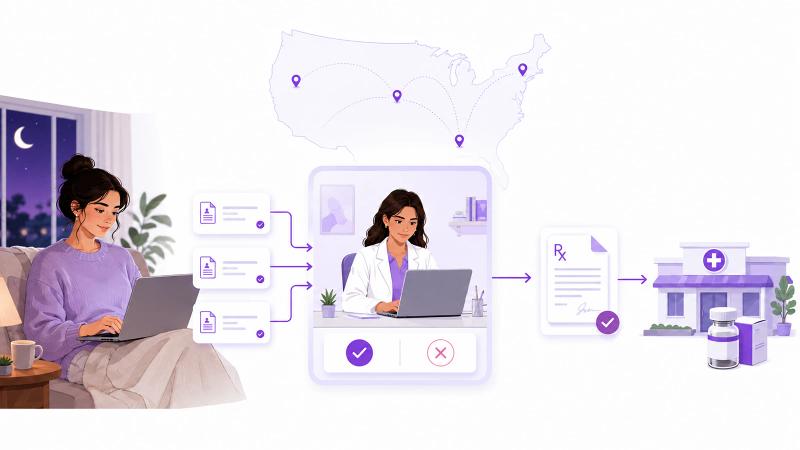
The mental model that trips people up is thinking they need to hire a doctor. You do not. The storefront model separates who sells the program from who makes the clinical decision, and it keeps those two jobs in different hands on purpose. Here is how this works, step by step.
1. You own the front. Your brand, your domain, your pricing, your intake questions, your follow-up cadence. The client never sees a third-party logo.
2. A structured intake collects the clinical picture. Not a form you wrote on a Tuesday. A protocol-specific questionnaire built for the category, so the provider receives a complete file rather than a paragraph.
3. A licensed provider reviews independently. They are licensed in the client's state, they can decline, and their name is on the decision. FUSE runs provider review in under 24 hours on average across a network covering all 50 states. You are not in that loop, and that is the whole point.
4. A licensed pharmacy fulfills. 503A or 503B, cold chain where the product needs it, tracking back to the patient record.
5. You handle everything you were already good at. Behavior change, adherence, food, the parts that determine whether anyone is still on the program in month six. FUSE operators see 94% refill retention, and retention is almost entirely a coaching outcome, not a pharmacy one.
Your scope never widens. The program's scope does.
What breaks, and what holds
I have watched enough of these launches to know where they fail, and it is rarely the medical side. The pattern is consistent enough that we mapped the five places launches break at scale.
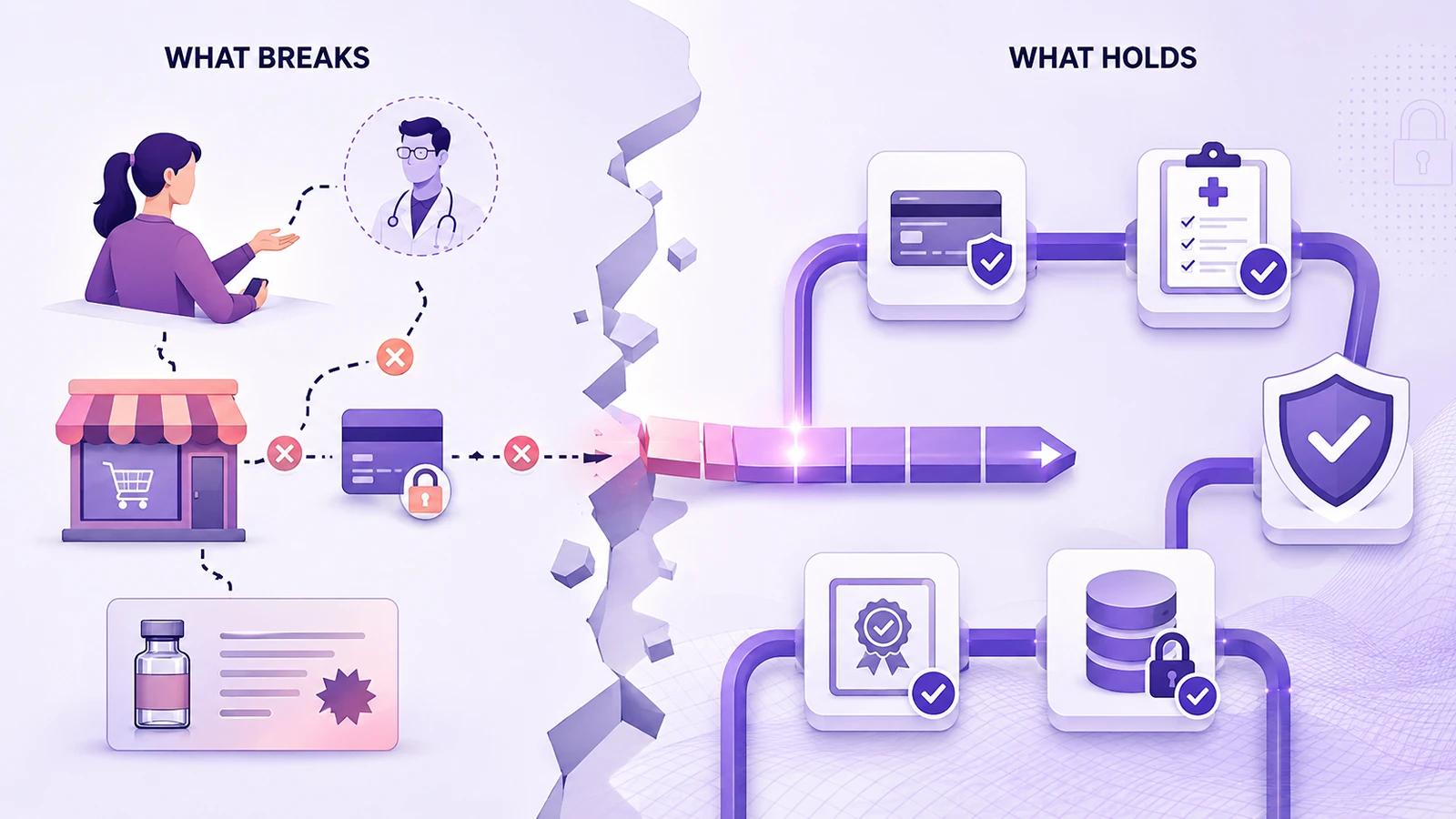
What breaks
- A coach who sources a prescriber through a personal contact and has no written protocol.
- A storefront that takes payment before clinical review, which inverts the entire compliance argument.
- A payment processor handling health-adjacent transactions with no underwriting conversation. It works until the day it freezes.
- Marketing copy that promises a specific outcome or names a compound in a way that reads as a purchase offer.
What holds
- Payment infrastructure underwritten for the category before the first transaction.
- Provider review as a gate, not a formality.
- LegitScript certification, which is what most ad platforms actually check before they let you spend.
- SOC 2 Type II on the data side, because a HIPAA claim without an audit behind it is a sentence, not a control.
The difference between those two lists is not effort. It is whether the compliance work happened before launch or after the first complaint.
Choosing, honestly
If your practice is one-to-one nutrition counseling and you bill insurance, buy Healthier or Practice Better and stop reading comparison posts. You do not need anything else, and adding a prescriber layer to a practice that does not want one is expensive theater.
If you are building a brand where nutrition coaching is the retention engine and a medication-supported protocol is the acquisition hook, the scheduling tools are not competitors. They are a different budget line. You will likely run one of them for your one-to-one clients and a storefront platform for the program. It is the same route coaches and educators take when they add a clinical layer to an audience they already have.
The real question is not which software. It is whether you want to be the person who says no when a prospect asks about medication.
The decision in front of you

The 2024 listicles were right about their moment. Practice Better, Healthie, Jane, and Nutrium solved the operational problem of running a virtual nutrition practice, and they solved it well enough that nobody needs to solve it again.
Two years later the problem moved. Eleven percent of American adults are on a GLP-1, the compounded shortcut is closing, and the operators who capture that demand will be the ones who built a real prescriber and pharmacy layer instead of hoping the category would slow down. It did not.
FUSE Health exists for exactly that transition: a branded storefront on the front, licensed providers and pharmacy fulfillment on the back, and compliance infrastructure that was designed rather than assembled. You keep your scope. Your brand gets a bigger one.
Pick the calendar you like. Then decide whether you want a program behind it.
This article is educational and operator-facing. It is not medical advice and does not recommend any medication or treatment. Prescribing decisions rest with licensed clinicians, and scope of practice is governed by the laws of the state in which a practitioner is licensed.
References
- Nutrium. Pricing.
- Practice Better. Pricing and plans.
- Healthie. Pricing.
- Jane. Pricing.
- FUSE Health. Pricing.
- Commission on Dietetic Registration. Revised 2024 Scope and Standards of Practice for the RDN.
- Medicare.gov. Medical nutrition therapy services.
- Gallup. In U.S., GLP-1 Usage Reaches New High (June 2026).
- Pharmacy Times. FDA Moves to Permanently Close the Door on Compounded GLP-1s (April 2026).
- Fierce Healthcare. Startups Fay and Berry Street each bank $50M (February 2025).

Daniel is a two-time founder who has scaled service businesses across major U.S. markets. A Y Combinator competition winner, he focuses on removing operational and regulatory barriers so operators can build and scale modern healthcare businesses.
- Background
- Startup Operations & Service Systems
- Experience
- 2x Founder, Multi-Market U.S. Scaling
- Qualifications
- Healthtech Market Expertise & Operational Scaling
- Key Achievement
- Scaled Premier Staff & Eventstaff across major U.S. markets