Which peptides fit long-term wellness goals? Start with your goal, get a licensed clinician's review, and source from a verified pharmacy. This guide covers FDA status after the 2026 FDA and HHS actions, long-term safety, real US costs, and how FUSE Health builds compliance into every program.
Roughly 80 peptide drugs have been approved worldwide, and the peptides people ask about most for everyday wellness are not on that list. BPC-157, TB-500, MOTS-c and several others are still waiting on final FDA action. So when you ask what peptides you should use for long-term wellness, the honest answer starts with your goal, moves to a licensed clinician, and ends at a verified pharmacy. This guide walks through each step in plain English, with the November 2026 regulatory picture, real cost ranges from US cities, and the checks operators should build into any peptide program.
Executive Summary
Peptides are short chains of amino acids that act as messengers in your body. A small group, including insulin, semaglutide and tirzepatide, are FDA-approved medicines with large trials behind them. Most wellness peptides you hear about for recovery, sleep, energy and longevity are not approved for those uses, and their human evidence is limited. As of mid-November 2026, an FDA advisory panel has backed six of them for compounding and HHS has issued a draft enforcement policy, and neither step makes them approved. The safest order is goal first, licensed clinical review second, and a verified pharmacy third. Cash prices run from roughly $150 to $700 a month depending on the peptide and the city. FUSE Health builds that order into every program it powers.
What Is the Purpose of Peptides?
What Are Peptides and How Do Peptides Work?
The NHGRI describes a peptide as a short chain of amino acids, typically 2 to 50, linked by peptide bonds. Your body makes many of them, and a lot of them work as messengers. One tells your pancreas to release insulin, and others help regulate hormones, appetite and tissue repair. That messenger role is the purpose of peptides in medicine: a therapeutic peptide either copies a signal your body already uses or nudges a pathway that has slowed down.
Fun fact: insulin, Ozempic, Wegovy and Zepbound are all peptides. If you know someone on one of those, you know someone on a peptide medicine.
Peptides vs Supplements
A supplement supplies raw materials such as vitamins or amino acids. A peptide medicine delivers a specific signal and is regulated as a drug. The word "peptide" on a label tells you very little until you know which of three buckets the product sits in.
| Type | Examples | Where it stands |
|---|---|---|
| FDA-approved peptide drug | Semaglutide, tirzepatide, tesamorelin | Approved for defined uses after clinical trials |
| Compounded peptide | BPC-157, TB-500 | Not approved; compounding rules still moving |
| Research-use-only vial | Peptides sold online "not for human use" | No clinical oversight or approved use |
What Is Peptide Therapy?
Peptide therapy means a licensed provider prescribes a peptide for a specific goal such as metabolic health or recovery, a pharmacy prepares it, and the provider follows up on how it's going. That prescribing relationship is the line between a clinical program and a vial bought online.
What Peptides Should I Use? Start With Your Goal for Long-Term Wellness
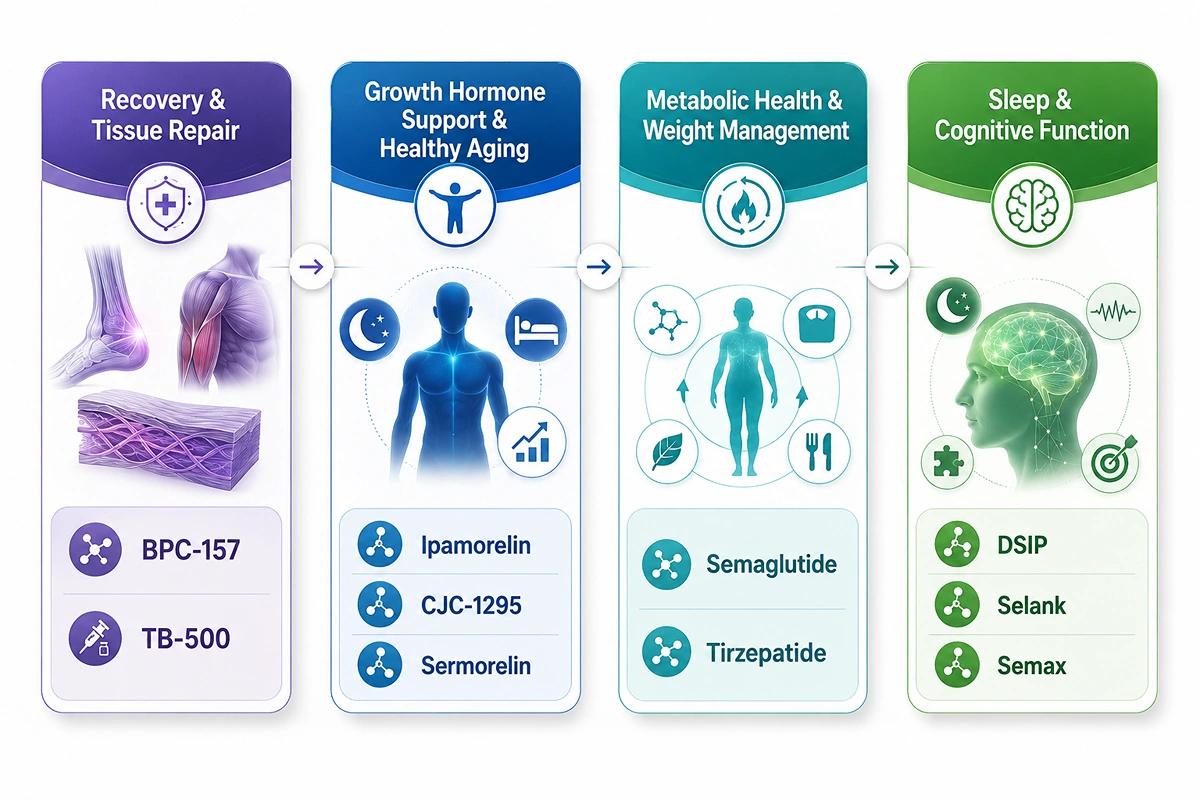
Picking a peptide because it's trending is the most common mistake. Pick the goal first, then ask a clinician which options have real evidence and a legal path. Here's how the main goals line up and where each peptide stands in November 2026.
| Goal | Peptides people ask about | Status, November 2026 |
|---|---|---|
| Metabolic health | Semaglutide, tirzepatide | FDA-approved for specific uses |
| Recovery | BPC-157, TB-500 | Not approved; panel backed, nonbinding |
| Energy | MOTS-c | Not approved; panel backed 7 to 5 |
| Sleep and cognition | DSIP, Semax, Selank | DSIP rejected 7 to 6; Semax backed |
| Healthy aging | Epitalon, GHK-Cu, ipamorelin, CJC-1295 | Mixed; ipamorelin on FDA Category 2 table |
Peptides for Recovery
BPC-157 and TB-500 get the most attention for tendon, ligament and muscle recovery, and most of the evidence comes from lab and animal studies. When the FDA panel reviewed these peptides, agency scientists pointed to a general lack of quality data on safety and effectiveness. Bring recovery goals to a clinician who can walk you through the evidence for your situation.
Peptides for Energy and Metabolic Health
For metabolic health, semaglutide and tirzepatide are the FDA-approved options, and they carry the strongest data of any peptide in this guide. In the STEP 1 trial, adults on semaglutide 2.4 mg lost 14.9% of body weight over 68 weeks versus 2.4% on placebo. In SURMOUNT-1, tirzepatide 15 mg produced a 20.9% average reduction over 72 weeks versus 3.1% on placebo. Interest in MOTS-c for energy is growing, and the advisory panel backed it for compounding, though it has no FDA approval.
Peptides for Sleep and Cognition
Sleep and focus are where you'll hear DSIP, Semax and Selank. The advisory panel rejected DSIP, listed as emideltide, by a 7 to 6 vote. Semax cleared the panel and sits inside the HHS draft policy, while Selank is outside it.
Peptides for Longevity and Healthy Aging
Longevity is the newest and most speculative category. Epitalon, GHK-Cu and growth hormone-releasing peptides such as sermorelin, ipamorelin and CJC-1295 come up most. No peptide is FDA-approved for anti-aging. Sermorelin's brand version, Geref, was approved and later pulled from sale in 2008, and the FDA lists ipamorelin in its Category 2 table.
Peptides for Beginners
If you've never used peptides, start with a consultation. Bring your goal, your medical history and your current medications, then ask three questions:
- Is this peptide FDA-approved or compounded?
- Which pharmacy prepares it, and can it show a certificate of analysis?
- How will we measure whether it's working?
Are Peptides FDA Approved?
Which Peptides Are FDA Approved?
FDA-approved peptide drugs include insulin, semaglutide, tirzepatide, tesamorelin and teriparatide, each approved for defined uses. Wegovy and Zepbound for weight management are the two most relevant to wellness programs, and both need a prescription.
Is BPC-157 Legal?
Not fully yet. In July 2026, FDA's Pharmacy Compounding Advisory Committee voted 8 to 6, with one abstention, to back BPC-157, according to AJMC. The panel also backed KPV, TB-500, MOTS-c, Semax and Epitalon. Those votes are nonbinding, and none of the six is FDA-approved or on the 503A bulks list. In October 2026, HHS published a draft enforcement discretion policy for the same six peptides in the Federal Register. Venable puts it plainly: enforcement discretion is not legalization.
Fun fact: the panel went against FDA staff, who had recommended against all seven peptides under review.
What the HHS Policy Means for Operators
If you run a clinic, med spa or coaching brand, the draft policy sets ten conditions. The headline ones:
- The peptide must be one of the six named.
- The bulk ingredient must come from an FDA-registered facility with a certificate of analysis.
- The label must carry the "compounded, not for resale" statement.
- Each product can contain only one covered ingredient.
The comment window closed November 13, 2026. Our HHS policy guide covers all ten conditions, and the 503A bulks list explainer tracks where each peptide stands.
Are Peptides Safe Long Term?
What We Know About Long-Term Peptide Safety
It depends on the peptide. Approved GLP-1 medicines have multi-year trial data and still carry side effects that need monitoring. For most wellness peptides, long-term human data are limited. The FDA describes immunogenicity and impurity concerns for compounded BPC-157, and serious adverse events, including increased heart rate, for CJC-1295.
A Safety Checklist Before You Start
- Work with a licensed prescriber who reviews your history and medications.
- Ask whether the peptide is FDA-approved or compounded, and by which pharmacy.
- Confirm the pharmacy is FDA-registered and can show a certificate of analysis.
- Schedule baseline and follow-up bloodwork, and revisit your goal at each check-in.
- Skip research-use-only vials sold online.
Fun fact: part of the HHS policy's stated aim is to discourage the widespread use of research-use-only peptides from foreign manufacturers that pose a safety risk.
Why Are Peptides So Expensive?
What Drives the Cost of Peptides
Peptides are built one amino acid at a time, then purified and tested batch by batch for identity, sterility and endotoxins. Most injectables need refrigeration from the lab to your door, and compounding pharmacies working under US rules carry oversight that supplement makers don't. A price far below the going rate is a prompt to ask which step was skipped.
Peptide Therapy Cost by City
Compounded peptides are almost never covered by insurance, so these are cash prices from HealingMaps clinic directories.
| Market | Typical cash price |
|---|---|
| Dallas-Fort Worth clinics | $150 to $700 a month, depending on the peptide |
| Local clinics, sermorelin | $200 to $400 a month, plus $150 to $500 for the first consult and labs |
| Concierge clinics in Los Angeles, Miami and New York | $300 to $600+ a month for sermorelin |
Operators can see the wholesale side in our peptide margins breakdown.
How FUSE Health Makes Long-Term Peptide Programs Accessible and Compliant
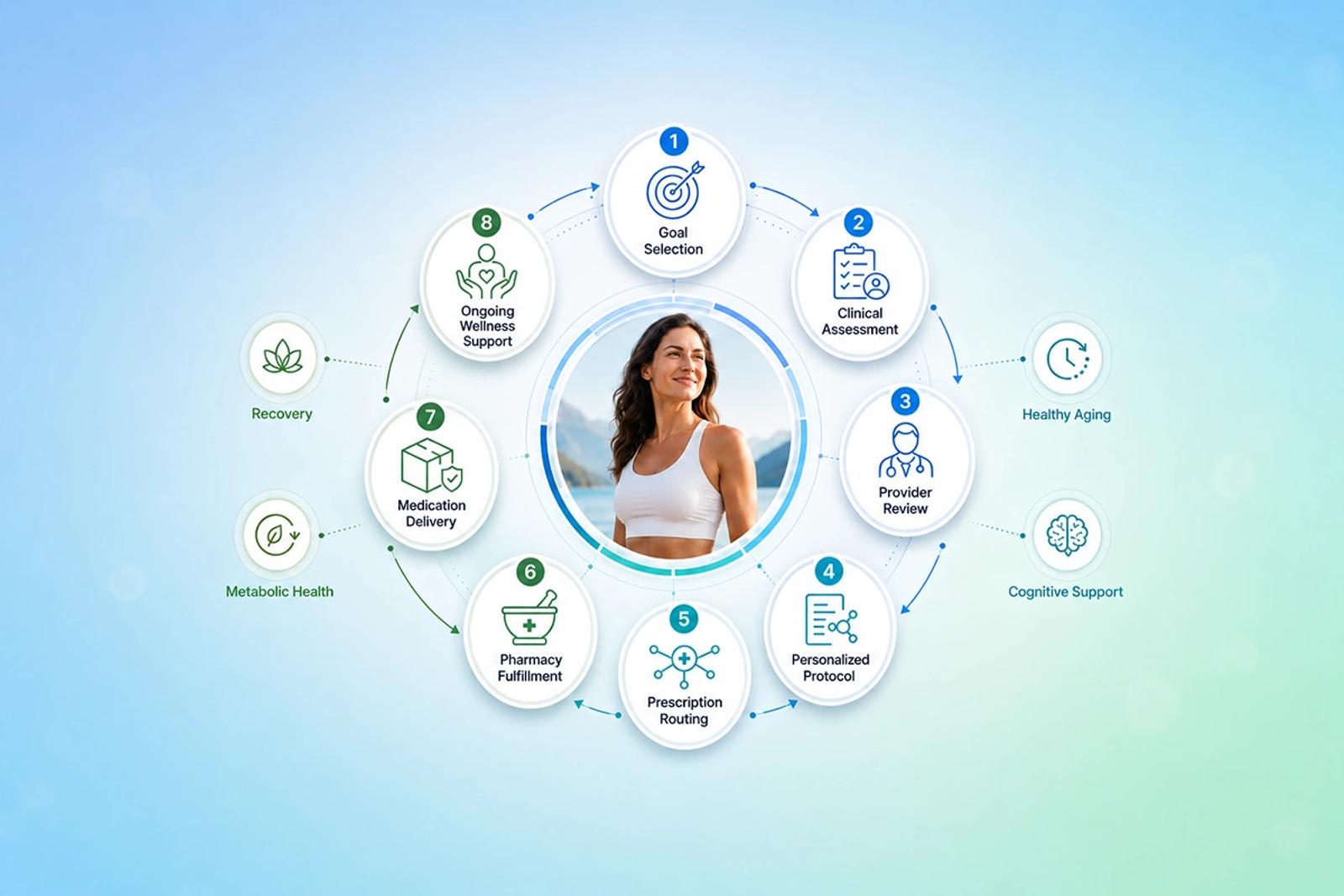
FUSE Health is white-label telehealth infrastructure. Operators run their peptide program under their own brand, and FUSE handles clinical review, prescription routing and pharmacy fulfillment.
How the Workflow Runs
- The client completes a health intake through the operator's branded platform.
- A licensed provider in the FUSE Health network reviews and approves the protocol.
- The prescription routes to an FDA-registered compounding pharmacy for fulfillment.
- The operator manages the client relationship while FUSE Health holds the compliance layer.
Why Operators Trust FUSE Health
| Trust signal | What it means for you |
|---|---|
| Licensed provider review | Every prescription is tied to a provider's review before it reaches a pharmacy |
| FDA-registered pharmacies | Fulfillment runs through registered compounding pharmacies; see 503A or 503B for how to choose |
| Regulatory tracking | Status pages follow FDA, advisory panel and HHS actions, with the latest check dated November 17, 2026 |
| Public pricing | Growth is $5,600 upfront plus $699 a month; Partner is $30,000 onboarding plus $3,000 a month after year one (see pricing) |
Choosing Long-Term Wellness Peptides in the Right Order
Goal First, Clinical Review Second, Verified Sourcing Third
So, what peptides should you use for long-term wellness? Start with the goal, get a licensed clinician's review, and source only from a pharmacy that can show its paperwork. The evidence is strongest for approved GLP-1 medicines and thinner for wellness peptides, and the rules are still moving, so check status before any purchase or launch.
Where to Go Next
Operators ready to build can see how peptide telehealth works on FUSE, or compare models and costs in our guide to starting a peptide business.
References
- Zheng B, Wang X, Guo M, Tzeng C-M. Therapeutic Peptides: Recent Advances in Discovery, Synthesis, and Clinical Translation. PMC12154100.
- National Human Genome Research Institute. Peptide (Talking Glossary).
- Wilding JPH, et al. Once-Weekly Semaglutide in Adults with Overweight or Obesity (STEP 1). N Engl J Med. 2021;384:989-1002.
- Jastreboff AM, et al. Tirzepatide Once Weekly for the Treatment of Obesity (SURMOUNT-1). N Engl J Med. 2022;387:205-216.
- Steinzor P. FDA panel backs 6 peptides for compounding. AJMC, July 31, 2026.
- HHS. Enforcement Discretion Policy Regarding 503A Compounding Using Certain Peptide Bulk Drug Substances. Federal Register, Oct 30, 2026 (FR Doc. 2026-22192).
- Venable LLP. HHS Announces Interim Enforcement Discretion for Section 503A Compounding with Certain Peptide Bulk Drug Substances, Nov 2026.
- FDA. Certain Bulk Drug Substances for Use in Compounding that May Present Significant Safety Risks (content current as of 04/22/2026).
- HealingMaps. The 9 Best Peptide Clinics in Dallas-Fort Worth (2026).
- HealingMaps. How Much Does Sermorelin Cost? The 2026 Pricing Guide (updated May 5, 2026).

Daniel is a two-time founder who has scaled service businesses across major U.S. markets. A Y Combinator competition winner, he focuses on removing operational and regulatory barriers so operators can build and scale modern healthcare businesses.
- Background
- Startup Operations & Service Systems
- Experience
- 2x Founder, Multi-Market U.S. Scaling
- Qualifications
- Healthtech Market Expertise & Operational Scaling
- Key Achievement
- Scaled Premier Staff & Eventstaff across major U.S. markets