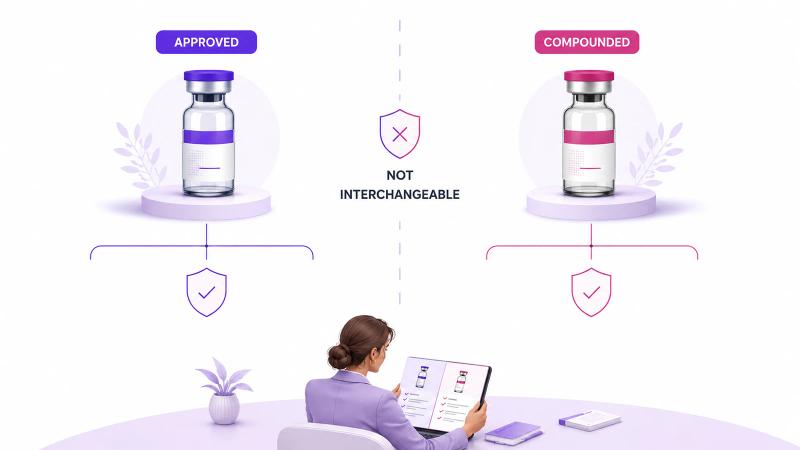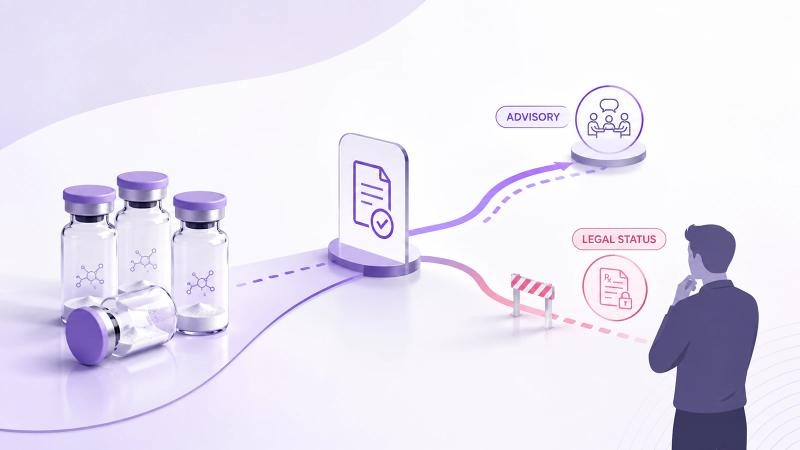

The 503A bulks list contains zero peptides. Six peptides won a July 2026 advisory vote and an October HHS enforcement pause, but neither one is a rule. Operators who mix up the vote, the rule and the pause end up with catalogs that break.
The 503A bulks list contains zero peptides. Search the topic anyway and you'll find a dozen confident answers describing a dozen different lists. One says BPC-157 is "Category 1 now." Another says it's banned. Both are wrong, and both cost operators money, because a pharmacy fills orders against the statute, not a headline.
This guide covers the 503A bulks list itself, the interim categories around it, how a substance gets added, and where each popular peptide stands as of November 17, 2026. The full Category 2 table lives on our FDA peptide ban list tracker. For "can my business sell this?", use the Operator Legality Ledger.
Executive Summary
Six peptides won a July 2026 advisory vote and an October HHS enforcement pause, but neither is a rule, and none of them sits on the 503A bulks list. Below you'll find what the list is, how Category 1 and Category 2 differ, the five steps to a listing, a dated status table for every popular peptide, and what the February 2027 review could change.
What is the 503A bulks list?
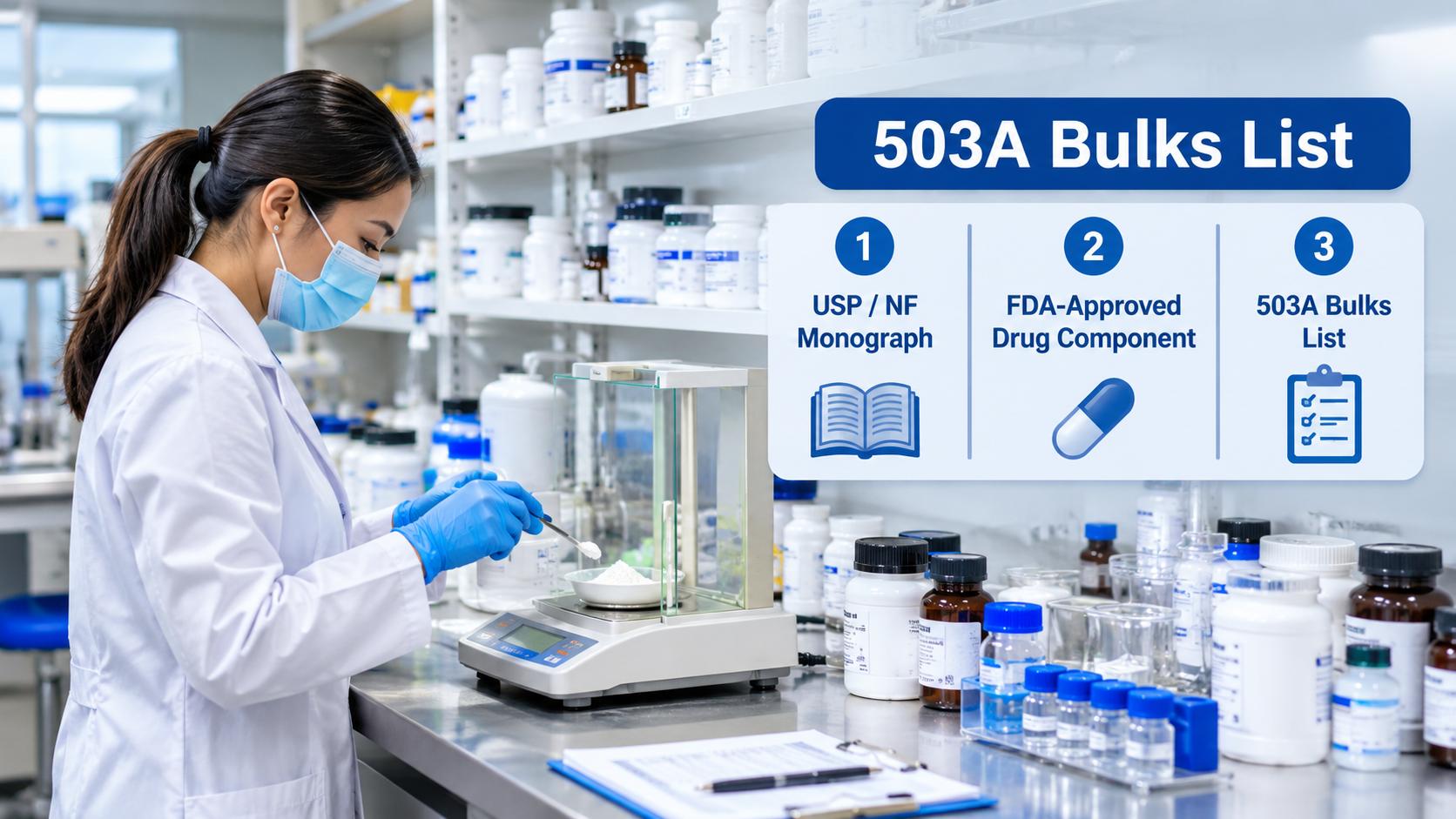
The 503A bulks list is the federal list of bulk drug substances a state-licensed 503A pharmacy may compound with when the ingredient has no USP or NF monograph and isn't a component of an FDA-approved drug. It's codified at 21 CFR 216.23 and changes only through notice-and-comment rulemaking.
So section 503A gives a 503A pharmacy three doors for a bulk ingredient:
- A USP or NF monograph (gonadorelin, for example).
- A component of an FDA-approved drug (bremelanotide, the active ingredient in Vyleesi).
- A place on the 503A bulks list.
Most in-demand peptides fail the first two tests. That's why the third door draws so much attention.
Which substances are on the 503A bulks list today?
Six, and none is a peptide. Section 216.23(a) names brilliant blue G, cantharidin, diphenylcyclopropenone, N-acetyl-D-glucosamine, squaric acid dibutyl ester and thymol iodide, most limited to topical use. The first final rule took effect March 21, 2019. Seven years later, that's still the whole list.
When a supplier says a peptide is "on the 503A bulks list," they almost always mean an interim category, a committee vote or the HHS policy.
What is the difference between Category 1 and Category 2?
Rulemaking is slow, so FDA uses an interim policy (first issued in 2017, revised January 2025) to sort nominated substances while it evaluates them. That's where "category 1 peptides" comes from. These buckets aren't the 503A bulks list.
| Bucket | What FDA says | 503A compounding from bulk? | Peptide examples, Nov 2026 |
|---|---|---|---|
| Category 1 | Under evaluation, enough information supplied | Yes, with a patient-specific prescription | GHK-Cu (non-injectable), vasoactive intestinal peptide, glutathione |
| Category 2 | May present significant safety risks | No | Kisspeptin-10 |
| Category 3 | Nominated without adequate support | No | None of the popular peptides |
| No category | Never nominated, or nomination withdrawn | No, unless another door applies | BPC-157, TB-500, Melanotan II, CJC-1295 |
Two points get missed. Category 1 is permission FDA can withdraw, not a spot on the 503A bulks list. And leaving Category 2 isn't entering Category 1. On April 15, 2026, FDA said it would remove twelve peptides from Category 2 after their nominations were withdrawn, and all twelve landed in no category. The ban list tracker has the full breakdown.
How does a peptide get onto the 503A bulks list?

Five steps, and only the last one binds anyone.
| Step | Who acts | Binding? | Effect on a pharmacy |
|---|---|---|---|
| 1. Nomination | Anyone, via FDA's docket | No | None. Review starts |
| 2. FDA evaluation | CDER reviewers: characterization, safety, effectiveness, historical use | No | None, though an interim category may follow |
| 3. PCAC vote | Pharmacy Compounding Advisory Committee | No | None |
| 4. Proposed rule | FDA, in the Federal Register | No | None. Comments open |
| 5. Final rule | FDA, at 21 CFR 216.23 | Yes | Lawful 503A bulk ingredient |
The six peptides recommended in July sit between steps 3 and 4. As of this review, FDA hasn't published a proposed rule for any of them.
How is an advisory vote different from a rule or HHS enforcement discretion?
This is the confusion running through the search results, and it decides whether your orders ship.
| Instrument | Issued by | Binding? | Reversed by | What a 503A pharmacy can do |
|---|---|---|---|---|
| PCAC vote, July 23 to 24, 2026 | FDA advisory committee | No | FDA, by not acting | Nothing new |
| Final rule | FDA, after notice and comment | Yes | Another rulemaking | Compound from bulk |
| HHS enforcement discretion, filed October 28, 2026 | HHS Office of the Secretary | No, "creates no rights" | HHS, at any time | Compound six peptides if all ten conditions hold |
Venable's summary is the cleanest: "The immediate federal enforcement posture has changed; the underlying statutory status has not." State boards aren't bound, 503B facilities aren't covered, and the draft's comment window closed November 13, 2026. Our HHS policy explainer lists all ten conditions.
The operator translation: the vote shows direction, the rule settles the law, the pause sets today's risk. Build on the pause, plan for the rule, and never sell on the vote.
Where does each peptide stand on the 503A bulks list today?
As of November 17, 2026, no peptide below is FDA-approved or on the 503A bulks list.
| Peptide | Interim category | July 2026 PCAC vote | HHS policy (October 2026) |
|---|---|---|---|
| BPC-157 | None | For, 8 to 6, 1 abstention | Covered: acetate; subcutaneous, intramuscular, oral, topical |
| TB-500 | None | For, 8 to 6, 1 abstention | Covered: acetate; subcutaneous or intramuscular |
| KPV | None | For, 8 to 6, 1 abstention | Covered: acetate; topical or oral |
| MOTS-c | None | For, 7 to 5 | Covered: acetate; subcutaneous or intramuscular |
| Semax | None | For, 8 to 5 | Covered: free base; intranasal |
| Epitalon | None | For, 7 to 4 | Covered: acetate; injectable, intermittent courses |
| Emideltide (DSIP) | None | Against, 7 to 6 | Not covered |
| GHK-Cu | Category 1, non-injectable only | Injectable queued for Feb 2027 | Not covered |
| Melanotan II, LL-37, dihexa, PEG-MGF | None | Queued for Feb 2027 | Not covered |
| Kisspeptin-10 | Category 2 | Not scheduled | Not covered |
| CJC-1295, AOD-9604, selank | None (withdrawn) | Not scheduled | Not covered |
Two details catch catalogs out, and neither shows up on the 503A bulks list itself. The HHS policy requires a single active ingredient, so a BPC-157 and TB-500 blend sits outside it. And CDER's reviewers recommended against all seven July peptides; the committee overrode them, then HHS departed from CDER too. A conditional route deserves conditional confidence.
Peptides with an approved-drug basis don't need the 503A bulks list at all. See our FDA-approved peptides list.
What could the February 2027 advisory review change?
FDA said a second PCAC meeting would be held before the end of February 2027 for five peptides: GHK-Cu, LL-37, dihexa acetate, Melanotan II and PEG-MGF. No final date had been posted at the time of writing.
| If this happens | Day-one effect | Later effect |
|---|---|---|
| Committee votes yes | None for pharmacies | Feeds rulemaking; HHS could extend its policy, as it did in October |
| Committee votes no | None | A 503A bulks list spot less likely, though FDA isn't bound |
| FDA proposes a rule | Comment period opens | First binding step |
| HHS revises its policy | Risk for the six changes at once | New conditions possible |
Opposition is on the record, too. The Partnership for Safe Medicines filed a citizen petition on October 23, 2026, asking FDA not to allow compounding of these peptides through enforcement discretion. A yes vote in February is plausible, not guaranteed.
How do operators keep a catalog in step with a moving list?
Broken programs tend to break the same way. Someone reads "HHS allows BPC-157," lists a blend, routes everything to one pharmacy and names the peptide in an ad. The pharmacy rejects the order, or LegitScript declines the site.
Programs that hold up treat the 503A bulks list as an input, not a dependency:
- Tag every SKU to its legal door: monograph, approved-drug component, Category 1 or the HHS policy.
- Get pharmacy proof in writing, including a certificate of analysis showing the manufacturer's FDA Establishment Identifier. Picking that partner is your most consequential decision.
- Check the state before approval. Federal discretion doesn't override state boards or pharmacy licensing.
- Pause without rebuilding. Pulling one peptide should leave the storefront, payments and other programs untouched.
That's the storefront-first model FUSE Health runs on. You own the brand, pricing and customer. Independent licensed clinicians review each intake, pharmacy partners compound for the named patient, and FUSE runs the state checks, routing, records, payments and certification readiness underneath. When the 503A bulks list or the HHS policy moves, the change happens in configuration, not in your funnel.
What should you do with the 503A bulks list right now?
Treat the 503A bulks list as short, slow and binding, and everything around it as provisional. Sell the six HHS peptides only through a 503A partner that can prove all ten conditions. Keep the February queue off your storefront. Recheck FDA's pages before every catalog change, because this year the list and the headlines split more than once.
The operators still standing in 2027 won't be the ones who guessed the next vote. They'll be the ones whose program absorbs a ruling as a settings change. Book a consultation with FUSE and launch on infrastructure built for a list that moves.
Regulatory note. This article is general information for healthcare business operators. It isn't legal or medical advice, it doesn't describe the use or effects of any substance, and it doesn't recommend any treatment. FDA lists and the HHS policy can change without notice, and state rules add requirements beyond the federal picture. Confirm current status with FDA, your pharmacy partner and qualified counsel before changing your catalog. Independent licensed clinicians make all prescribing decisions on programs powered by FUSE.
References
- eCFR, 21 CFR 216.23, Bulk drug substances that can be used to compound drug products under section 503A
- Federal Register, Final rule establishing the 503A bulks list, February 19, 2019 (effective March 21, 2019)
- FDA, Bulk Drug Substances Used in Compounding Under Section 503A of the FD&C Act
- FDA, Interim Policy on Compounding Using Bulk Drug Substances Under Section 503A, revised January 2025
- FDA, Certain Bulk Drug Substances for Use in Compounding That May Present Significant Safety Risks (Category 2)
- Orrick, FDA Announces Removal of 12 Peptides from Category 2 and Schedules PCAC Meetings, April 2026
- Buchanan Ingersoll & Rooney, FDA PCAC Recommends Six Peptides for the 503A Bulks List
- HHS, Enforcement Discretion Policy Regarding 503A Compounding Using Certain Peptide Bulk Drug Substances, with Appendices A and B, October 2026
- Federal Register, Doc. 2026-22192, Docket HHS-OASH-2026-0496, published October 30, 2026
- Venable LLP, HHS Announces Interim Enforcement Discretion for Section 503A Compounding with Certain Peptide Bulk Drug Substances, November 2026
- Partnership for Safe Medicines, Citizen Petition, October 23, 2026

Daniel is a two-time founder who has scaled service businesses across major U.S. markets. A Y Combinator competition winner, he focuses on removing operational and regulatory barriers so operators can build and scale modern healthcare businesses.
- Background
- Startup Operations & Service Systems
- Experience
- 2x Founder, Multi-Market U.S. Scaling
- Qualifications
- Healthtech Market Expertise & Operational Scaling
- Key Achievement
- Scaled Premier Staff & Eventstaff across major U.S. markets