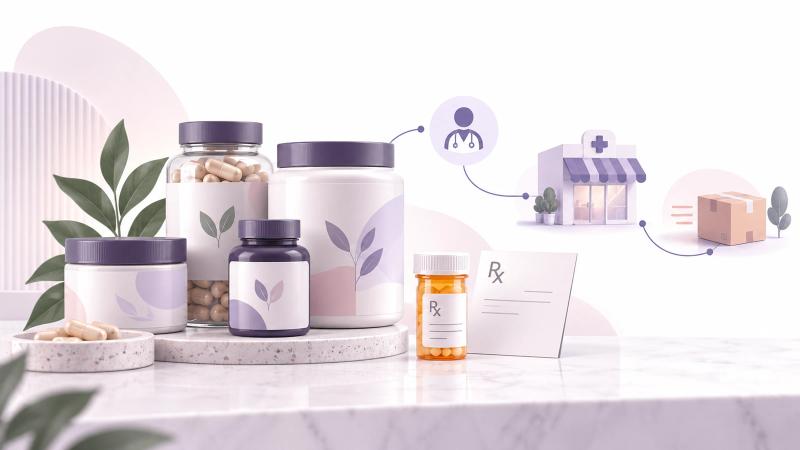
Peptide telehealth gives a weight-loss clinic a second recurring program next to GLP-1, without hiring prescribers or signing pharmacy contracts. You keep the brand and the patient relationship, independent clinicians make every prescribing decision, and FUSE runs the workflow behind your storefront, usually live in 3 to 5 business days.
About 12% of American adults say they take a GLP-1 drug right now, and 18% have taken one at some point, according to the latest KFF national poll. If you run a weight-loss clinic, those numbers describe your patient list, and your members already trust you with a weekly routine.
Peptide telehealth lets you serve those same members with a second program, and you can launch it without hiring prescribers, negotiating with pharmacies, or building intake software. This use case covers the workflow, costs and compliance, and every figure comes from a source you can open.
Executive Summary
Weight-loss clinics add peptide telehealth by putting a branded storefront on infrastructure that already includes independent licensed clinicians in all 50 states and 503A and 503B pharmacy partners. The clinic keeps pricing, marketing and the patient relationship. Platform costs start at $499 a month once you go live, and the rules for specific peptides keep shifting, so catalog decisions come before launch dates.
Why Weight-Loss Clinics Add Peptide Telehealth Next to GLP-1
What GLP-1 patients already show you about demand
KFF's poll of 1,350 adults, fielded October 27 to November 2, 2025, describes the audience you already serve:
- 18% of adults have used a GLP-1 drug, and 12% use one now, up 6 points in 18 months.
- 56% of people who have used one said it was hard to afford.
- 14% of people who have used one say they stopped because of cost.
Those figures point to churn risk, and a second recurring program gives each member another reason to stay.
How the compounded GLP-1 landscape changed in 2026
On March 3, 2026, the FDA sent 30 warning letters to telehealth companies over claims that compounded GLP-1s match approved drugs and branding that obscured who compounded the product. Since September 2025, the agency has sent thousands of warning letters over misleading drug and telehealth ads, more than in the entire previous decade.
Competitors are moving too. Bloomberg Law reported on August 11, 2026 that Hims & Hers plans to sell already allowed peptides such as sermorelin and glutathione by year-end. A clinic that wants a second program through peptide telehealth, with a named clinician and a named pharmacy behind every order, has good reason to start now.
What Peptide Telehealth Means for a Weight-Loss Clinic
How the prescription route works
Peptide telehealth is the prescription route to peptides, and FUSE runs it behind your brand.
- Async intake. Your patient completes a medical intake on your storefront, with no video visit to schedule.
- Independent review. A licensed clinician in the patient's state approves, adjusts or declines. FUSE reports an average review time under 24 hours.
- Pharmacy fill. A 503A or 503B compounding pharmacy fills the prescription.
- Direct fulfillment. The pharmacy ships with tracking, and refills follow the terms of the prescription.
Where white label peptides fit
Search results for white label peptides mostly describe research-use-only vials sold in bulk with your logo on the label, a route with no clinician, no patient labeling and real payment processor exposure. A clinic with patients belongs on the prescription route, which still gives you your own domain, intake, portal and shipping emails. The pharmacy's required disclosures stay on the medication, which matches what the FDA flagged in March when it cited branding that implied a telehealth firm was the compounder.
Which Peptide Telehealth Programs Can Sit Next to GLP-1
The five program categories clinics see most
FUSE groups peptide telehealth demand into five categories: weight loss and metabolic, recovery and repair, hormone and longevity, sexual health, and skin, hair and immune. GLP-1 stays your anchor, and our peptide telehealth page notes that weight-loss customers often grow into longevity and skin programs.
What the July 2026 FDA vote means for your catalog
On July 23 and 24, 2026, an FDA advisory committee recommended six peptides for the 503A bulk list, including BPC-157. That vote passed 8 to 6 with one abstention, and the committee sided against FDA's own reviewers, who had recommended against all seven peptides under review.
The votes are advisory and the FDA still has to act through rulemaking, so build your catalog around what pharmacies can lawfully compound today. FUSE's legality guide, last verified August 6, 2026, lists NAD+, glutathione and sermorelin among the peptides compoundable under current FDA categories and places the six recommended peptides in a group with no lawful route yet. Your clinician and pharmacy partner make the final call.
How to Launch Peptide Telehealth Next to Your GLP-1 Program
Five steps from decision to first order
A clinic launches peptide telehealth on FUSE in this order:
- Pick one anchor program. One program with a tight funnel beats a wide catalog, so start with the one your GLP-1 members ask about most.
- Build your storefront. Choose your colors, fonts, domain and retail prices.
- Let FUSE wire the backend. Providers in all 50 states, 503A and 503B pharmacies, payments and compliance connect behind your domain.
- Check certification and state coverage. LegitScript certification gates card payments and ads, and your provider and pharmacy state maps need to match.
- Go live. FUSE lists 3 to 5 business days from signup to a live storefront, and timing depends on your paperwork and third parties.
What your clinic still owns
- Your brand, domain, pricing and margin, with no per-visit fees from FUSE.
- Your marketing claims: advertise the program, describe the sourcing, and skip outcome promises.
- Your patient relationship, support and retention.
Clinical decisions stay with independent licensed clinicians, and FUSE does not prescribe, diagnose or treat patients, so you can run the brand without a medical license.
What Peptide Telehealth Costs a Weight-Loss Clinic
FUSE platform pricing
Every price sits on FUSE's published pricing page, and every plan includes the full platform.
| Plan | Upfront | Monthly |
|---|---|---|
| DIY | $0 | $499 once you go live |
| Growth | $5,600, including expedited LegitScript coordination and your first month | $699 from month 2 |
| Partner | $30,000, including the first 12 months of platform | $3,000 from month 13 |
The merchant service fee is 3% on DIY and 2% on Growth and Partner, with no per-visit or per-prescription fees. Clinical, pharmacy and payment-processing costs may apply and are shown before you commit.
Year-one certification costs in Chicago, Dallas and Atlanta
LegitScript fees are the same in every city, so these examples show how setups add up, using the fees in our LegitScript guide. A Chicago clinic with one website on the standard track pays $3,125 in year one ($975 application plus $2,150 annual). An Atlanta clinic adding the $2,500 expedited review pays $5,625. A Dallas group certifying three domains in one application pays $9,375 before any expedite fee.
A simple break-even check
Our peptide business guide gives one example: a $149 monthly program returns about $74 per customer per month after product and supplies, so roughly 10 members cover the $699 Growth fee before marketing and the 2% merchant fee. Your pricing and retention will move that result.
How Peptide Telehealth Stays Compliant as Volume Grows
Clinician and pharmacy coverage by state
Telehealth rules follow the patient's location, and a pharmacy needs a nonresident license in every state it ships into. When the provider map and the pharmacy map disagree, approved patients end up unfillable, which our pharmacy licensing guide covers in detail. Check the patient's state against both maps at intake, before payment.
Marketing claims and sourcing
The FDA's March letters cited marketing claims, labeling and sourcing disclosure, all storefront decisions you control. Describe your program, name the pharmacy that fills each order, and keep outcome promises out of ads. LegitScript reviews the whole website, so a restricted substance named on any page can slow certification.
Payments, data and volume
FUSE runs billing on Stripe with the category underwritten up front, uses HIPAA-compliant intake and records, and lists SOC 2 Type II controls and LegitScript certification. FUSE reports 1,200+ programs launched and 94% refill retention on its homepage, so ask for the definitions in your demo. Provider capacity and refill logistics tend to break first as peptide telehealth volume grows, so automate intake routing and refill triggers before you raise ad spend.
Adding Peptide Telehealth Beside GLP-1 With FUSE
Your GLP-1 members already trust you with a weekly routine. Peptide telehealth on FUSE puts licensed clinicians, pharmacy fulfillment, payments and compliance behind your storefront, with published prices and no per-visit fees. Start with one anchor program, check your state maps, and confirm which peptides pharmacies can lawfully compound today. Research-use-only white label peptides carry processor and regulatory exposure that a clinician-reviewed program does not.
Next step: Book a walkthrough and bring your program list and your state list.
This use case is written for business operators and covers operational and regulatory topics only. It is not medical or legal advice, and it does not recommend or give dosing guidance for any peptide or compounded medication. Regulatory status changes and figures were checked on October 16, 2026, so confirm current requirements with the FDA, your state board of pharmacy and qualified counsel before launching or changing any program.
References
- KFF Health Tracking Poll: Prescription Drug Costs, Views on Trump Administration Actions, and GLP-1 Use (November 14, 2025)
- FDA: FDA Warns 30 Telehealth Companies Against Illegal Marketing of Compounded GLP-1s (March 3, 2026)
- McDermott Will & Schulte: PCAC backs majority of peptides in two-day public meeting (July 27, 2026)
- DLA Piper: FDA AdComm recommends adding six peptides to the 503A Bulks List (July 31, 2026)
- Bloomberg Law: Hims & Hers Plans to Offer Some Allowed Peptides by Year-End (August 11, 2026)
- FUSE Health: Which Peptides Are Legal? The 2026 Operator's Guide
- FUSE Health: LegitScript Certification for Telehealth and Peptide Brands (October 9, 2026)
- FUSE Health: How to Start a Peptide Business in 2026 (October 12, 2026)
- FUSE Health: Pricing
- FUSE Health: White-Label Telehealth Platform

Daniel is a two-time founder who has scaled service businesses across major U.S. markets. A Y Combinator competition winner, he focuses on removing operational and regulatory barriers so operators can build and scale modern healthcare businesses.
- Background
- Startup Operations & Service Systems
- Experience
- 2x Founder, Multi-Market U.S. Scaling
- Qualifications
- Healthtech Market Expertise & Operational Scaling
- Key Achievement
- Scaled Premier Staff & Eventstaff across major U.S. markets