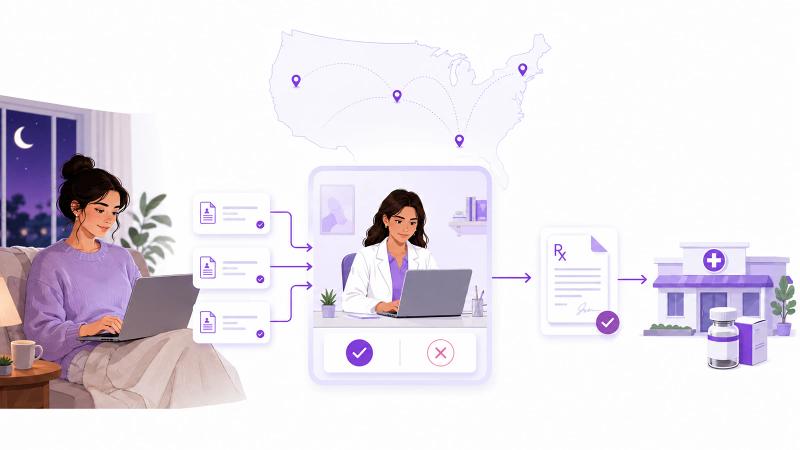

PII is any information that identifies a person. PHI is health information tied to an identifiable person and held by a HIPAA covered entity or business associate. Every piece of PHI is also PII, and context decides the label. For telehealth operators the difference shows up in intake forms, emails, patient messages, marketing tools and advertising pixels.
Your customer's email address is ordinary personal data right up until your system puts the name of a treatment next to it. At that point the same email address can become protected health information, and a stricter set of rules starts to apply to every system that touches it.
That shift is what PHI vs PII is all about, and it matters a lot when you sell health programs online. You collect names, emails, intake answers, shipping addresses and payment details every day, and each one lands in a different legal category depending on where it sits and who holds it. This guide explains both terms in plain language, shows you when HIPAA applies, and walks through what it means for your intake forms, emails, marketing tools and tracking pixels.
See how a compliant storefront workflow would run for your brand. Book a walkthrough and we'll map intake, provider review and fulfillment against your catalog.
Executive Summary
PII is any information that can identify a person. PHI is health information tied to an identifiable person and held by a HIPAA covered entity or one of its business associates. Every piece of PHI is also PII, while plenty of PII has nothing to do with health, and context decides which label applies. For telehealth operators the difference shows up in five places: intake forms, emails, patient messages, marketing tools and advertising pixels. This guide defines both terms, compares them side by side, explains when HIPAA applies, and ends with a checklist you can run against your own program. It's informational and doesn't replace advice from your own counsel.
What PII and PHI Stand For
PII stands for personally identifiable information, and PHI stands for protected health information. Both describe data about a real person, and the gap between them comes down to whether health information and a HIPAA-regulated holder are involved.

What Does PII Stand For?
PII is any data that can point to one specific person, either on its own or when you combine it with other details. NIST, the federal standards agency, describes it as information that can distinguish or trace someone's identity, plus any other information that's linked or linkable to that person. A Social Security number points to someone all by itself, while a birth date, a ZIP code and a job title can single someone out once you put them together.
No single federal law covers PII across every industry, so the rules come from a mix of state privacy laws, industry rules and contracts. That means your obligations depend on where your customers live and what you sell.
What Does PHI Stand For?
PHI is individually identifiable health information that relates to a person's past, present or future health condition, the care they receive, or the payment for that care, and that a covered entity or its business associate holds or sends. HHS gives simple examples: a medical record, a lab report or a hospital bill counts as PHI because each one pairs health details with a name or other identifying information. The word protected points to HIPAA, the federal law that sets privacy and security rules for this kind of data.
PHI vs PII Comparison Table
Here's the quick view before we get into the details.
PHI and PII Side by Side
| Aspect | PII | PHI |
|---|---|---|
| Full name | Personally identifiable information | Protected health information |
| Meaning | Information that identifies a person | Health information connected to an identifiable individual |
| Scope | Any industry | Health, healthcare services and payment for care |
| Governing rules | State privacy laws, industry rules and contracts | HIPAA Privacy, Security and Breach Notification Rules |
| Who must follow them | Most organizations that collect personal data | Covered entities and their business associates |
| Example | A person's email address | A patient's name connected to prescription details |
Is PII the Same as PHI?
They overlap without being identical. PHI is a subset of PII, so every piece of PHI is also PII, and a large share of PII has no connection to health at all. The rest of this guide shows how to tell which one you're handling.
The Difference Between PII and PHI
All PHI Is PII but Not All PII Is PHI
Think of PII as a big bucket and PHI as a smaller bucket sitting inside it. Three questions decide whether a piece of data belongs in the smaller one.
- Does it relate to health? PHI covers a person's condition, the care they receive or the payment for that care.
- Does it identify someone? Names, contact details and other identifiers tie the health details to a real person.
- Who holds it? PHI status applies when a HIPAA covered entity or business associate creates, receives, maintains or transmits the data.
A name and phone number in a phone book aren't PHI, because nothing links them to health data. HHS notes that the same details become PHI once they're listed alongside something like treatment at a certain clinic.
When PII Becomes PHI
Context flips the label, so the same data point can be PII in one system and PHI in another. Here's how that plays out for a telehealth brand.
| Data point | Where it sits | Label |
|---|---|---|
| Email address | Newsletter signup list on your marketing site | PII |
| Email address | Attached to a GLP-1 intake in the clinical record | PHI |
| Home address in Chicago | Shipping label on a supplement order | PII |
| Home address in Chicago | Linked to a filled prescription | PHI |
| Phone number | Contact list for a store event | PII |
| Phone number | Refill reminder tied to a medication | PHI |
The PHI rows assume the data sits with a covered entity or business associate, which we'll sort out in the HIPAA section below.
PHI vs PII Examples

Examples of PII
Five common examples of PII are a full name, a Social Security number, a personal email address, a home address and a phone number. Driver's license numbers, passport numbers, birth dates and IP addresses also qualify when they can be linked to a person.
Examples of PHI
In a telehealth program, PHI usually looks like one of these:
- A customer's name next to their GLP-1 intake answers
- A prescription record tied to a patient's email address
- Lab results or provider review notes in a patient's file
- A billing record that links a payment to a specific treatment
- A refill reminder that names the person and the medication
Is Height and Weight PHI?
Height and weight are health information, and they become PHI when a covered entity or business associate holds them together with something that identifies the person, like a name or an email address. A weight figure in an anonymous survey doesn't point to anyone. The same figure inside a customer's intake record does.
What Information Isn't Protected as PHI?
HHS excludes education records covered by FERPA and employment records a covered entity holds in its role as an employer. De-identified data falls outside PHI as well, and so does health information someone types into an app run by an organization that HIPAA doesn't regulate. Identifying details with no health connection, like the entries in a phone book, don't count either. Knowing what sits outside PHI keeps you from over-labeling data and building controls you don't need.
The 18 HIPAA Identifiers That Turn PII Into PHI
HIPAA names 18 types of identifiers that link health information to a person. Under the Safe Harbor method for de-identification, all 18 have to be removed before data stops being PHI.
What Are the 18 Identifiers of PHI?
| Group | Identifiers |
|---|---|
| Names and locations | Names; geographic areas smaller than a state, including street address, city, county and most ZIP codes |
| Dates | Dates directly tied to a person except the year, such as birth, admission and discharge dates, plus ages over 89 |
| Contact details | Phone numbers; fax numbers; email addresses |
| ID numbers | Social Security numbers; medical record numbers; health plan beneficiary numbers; account numbers; certificate and license numbers |
| Devices and online | Vehicle identifiers and serial numbers; device identifiers and serial numbers; web URLs; IP addresses |
| Biometrics and images | Biometric identifiers such as fingerprints and voiceprints; full-face photographs and comparable images |
| Catch-all | Any other unique identifying number, characteristic or code |
How De-Identification Works
HHS recognizes two routes. Safe Harbor removes all 18 identifiers and requires that you have no actual knowledge the remaining data could identify someone. Expert Determination has a qualified statistician document that the risk of identifying anyone is very small. Data that meets either standard is no longer PHI under HIPAA.
Here's a fun fact behind the ZIP code rule. HHS cites research estimating that a birth date, sex and five-digit ZIP code together are unique for over half of U.S. residents, which is why Safe Harbor limits ZIP codes so tightly.
When HIPAA Applies to PHI and PII
HIPAA applies when a covered entity or business associate handles health information. If you don't fit either role, HIPAA doesn't apply to you, although other rules still can.

Covered Entities and Business Associates
HHS defines a covered entity as a health care provider that transmits certain information electronically for standard transactions, a health plan, or a health care clearinghouse. A business associate is a person or company that performs services for a covered entity that involve PHI, such as a cloud vendor, a billing service or a software platform that stores intake data. Business associates are directly liable for parts of the HIPAA Rules, and a covered entity needs a written business associate agreement, or BAA, with each one.
Where Telehealth Operators Usually Sit
In the structure FUSE Health uses, a physician-owned professional corporation acts as the covered entity and holds the medical record, while a brand running the storefront typically sits in the business associate role. Our MSO structure guide explains how that split works. Your own status depends on your contracts and the data you handle, so have healthcare counsel confirm where you land.
Resiliency Box
- Storefront data: Traffic, newsletter signups and order totals are PII governed by general privacy rules.
- Clinical data: Intake answers, provider review and prescriptions are PHI inside the HIPAA-covered workflow.
- Vendors: Any vendor that touches PHI needs a signed BAA before data flows.
- Marketing: PHI stays out of ad platforms unless the right authorizations and agreements are in place.
What the Three HIPAA Rules Require
Three HIPAA rules protect PHI. The Privacy Rule limits how PHI can be used and shared. The Security Rule requires administrative, physical and technical safeguards for electronic PHI, such as access controls and encryption where it's reasonable and appropriate. The Breach Notification Rule requires notice to affected people, to HHS and sometimes to the media, no later than 60 days after you discover a breach. Our guide to telehealth compliance shows how those requirements map to an operating workflow.
When HIPAA Doesn't Apply but Other Rules Do
Health data held by a company outside HIPAA still carries obligations. The FTC enforces its Health Breach Notification Rule and general consumer protection law against companies HIPAA doesn't reach, and state privacy laws can add their own requirements for health data. Ask counsel which states you sell into, because a brand serving customers from Boston to Atlanta can face a different mix in each one.
Want the clinical layer set up before your first order? Book a consultation and we'll show you which parts of your data flow sit inside it.
How PHI vs PII Affects Patient Intake Forms
Intake is the first place PHI shows up in your program, so it's the first place to get the setup right.
Where Intake Data Should Live
Picture a customer in Dallas filling out an intake form with their weight, medications and health history. The moment that submission lands in your clinical system it's PHI, and the tool holding it needs a signed BAA and documented safeguards. That rules out the order notes and custom fields in a standard e-commerce store, which our guide to Shopify and HIPAA covers in more detail.
Collect Only What the Provider Needs
HIPAA's minimum necessary standard asks you to limit PHI to what a task requires, and the same habit protects you on the PII side. Every extra field on an intake form is one more piece of data you have to secure, so write down why each question is there and drop the ones nobody uses. Limit internal access too, since your marketing team doesn't need to see raw intake answers. If you're mapping the whole patient journey, keep each handoff inside the same covered system.
How PII and PHI Affect Emails and Patient Communication
An email can carry PHI without anyone noticing, because a name and a treatment in the same message is all it takes.
Emails About Orders and Refills
A subject line like “Your semaglutide refill ships Tuesday” pairs a person with a medication, which makes it PHI. A line like “You have a new update in your account” carries no health detail, and the full message can wait behind a secure login. Whatever platform sends these emails needs a signed BAA whenever it handles health details.
Marketing messages deserve extra attention. HHS says a covered entity generally needs written authorization before using PHI for marketing, with exceptions for things like refill reminders from the treating provider.
Texts and Support Tickets
The same logic covers SMS, chat and your support inbox. Patients will type medication names and symptoms into a support chat whether you ask them to or not, so decide ahead of time where those conversations live. Secure messaging inside patient portals keeps them in a controlled place, and role-based access plus audit logs show who saw what. You'll find those features on most lists of compliance tools, and it helps to train support staff on which details never belong in a plain text thread.
PHI vs PII in Marketing Tools and Tracking Pixels
Marketing tools see more than most teams realize, and a pixel firing at the wrong moment can send health details to a third party.

CRM and Email Marketing Platforms
Any tool that stores a customer's health details needs a BAA, and many mainstream marketing and analytics platforms don't sign one. Check each vendor's terms before you sync program names, treatment status or intake answers into a CRM or an email platform. Plain contact data, like a name and email on a newsletter list, is PII you can handle under general privacy rules. Your privacy policy should also match what your tools really do, since a mismatch can slow a LegitScript certification review.
Advertising Tracking Pixels
A tracking pixel is a small piece of code that reports what visitors do on a page to a third party. The OCR bulletin on online tracking says tracking technologies on logged-in pages like patient portals generally have access to PHI, and pages where someone books an appointment or types symptoms can expose it too. HHS also says a cookie banner doesn't count as a HIPAA authorization, and a vendor's promise to remove PHI doesn't replace a BAA.
In June 2024 a federal court in Texas vacated one slice of that bulletin, the part saying an IP address plus a visit to a public page about a health condition triggers HIPAA. HHS posted a notice about the ruling and left the rest of the bulletin online. The sensible takeaway for operators is to keep pixels, session replay and similar scripts off intake forms, portals and any page where someone types health details, and to ask counsel to review what each event sends on checkout and confirmation pages.
What the FTC Has Done About Pixels
The FTC has gone after digital health companies over tracking tools even when HIPAA wasn't the hook.
- GoodRx: In February 2023 the FTC announced its first Health Breach Notification Rule enforcement action, with a $1.5 million civil penalty and a ban on sharing health data for advertising.
- BetterHelp: The final order requires $7.8 million for partial refunds and bars sharing health data for advertising, after the FTC alleged the company passed email addresses, IP addresses and intake questionnaire answers to ad platforms.
- Cerebral: In April 2024 the FTC announced an order requiring more than $7 million in payments, after alleging the company sent the data of nearly 3.2 million consumers to third parties such as LinkedIn, Snapchat and TikTok through tracking tools.
One detail from the BetterHelp case stands out for small teams. According to DLA Piper, the FTC noted that the company had handed most decisions about its Facebook advertising to a junior marketing analyst with no training in protecting health data. Whoever controls your pixels needs to understand what flows through them.
PHI vs PII Checklist for Healthcare Business Owners
Run your own program against this list. It's grouped by the places where risk tends to hide.
Data Mapping and Vendors
- List every place customers enter or receive information: storefront, checkout, intake, email, SMS, chat, support and analytics.
- Label each data point as PII, PHI or both, and note who holds it.
- Confirm in writing who is the covered entity and who is the business associate in your structure.
- Collect a signed BAA from every vendor that creates, receives, maintains or transmits PHI for you.
Intake and Communication
- Keep intake answers in a HIPAA-covered tool and out of e-commerce order notes and custom fields.
- Ask only the questions your providers need, and write down why each one is there.
- Send health details through a secure portal or a BAA-backed channel, and keep email subject lines generic.
- Set role-based access so marketing and support staff see only what their jobs require.
Marketing and Incident Response
- Remove ad pixels, session replay and similar scripts from intake, the portal and any page where health details are typed.
- Review with counsel what each pixel and event sends on checkout and confirmation pages.
- Get written authorization before using PHI for marketing.
- Write a breach response procedure that tracks the 60-day notification window.
- Schedule a yearly review, since vendors, pages and rules change.
What to Consider Before Collecting or Sharing PHI and PII
A few questions asked up front save a lot of cleanup later.
Before You Collect Anything
- What's the purpose, and can you name the exact step that needs this data?
- Does a provider need it to make a decision, or is it a nice-to-have?
- Where will it be stored, and which roles can see it?
- How long will you keep it, and how will you delete it?
Before You Share Anything
- Who's receiving it, and are they acting as your business associate?
- Is there a signed BAA or a valid HIPAA authorization in place?
- Are you sending the minimum necessary?
- Would de-identified data do the job?
- Do the state laws where your customers live add rules?
Write the answers down. A short record of why you collected or shared something is the first thing a pharmacy partner, a LegitScript reviewer or an investor will ask for.
Why PHI vs PII Decides Your Launch Plan
Your Next Step
If you sell health programs online, PHI vs PII questions show up on day one, long before your first ad runs. Map your data, sort each piece into the right bucket, and put the PHI inside systems that have BAAs and documented safeguards. Once that's in place, choosing vendors gets a lot easier, and our comparison of HIPAA-compliant telehealth platforms shows what to ask each one.
FUSE Health runs intake, provider review and prescribing inside a HIPAA-covered clinical layer, with BAAs in place across the stack. A brand running a white label telehealth storefront keeps its customer relationship, and the clinical data stays in a controlled workflow.
Map your data flow with an operator, not a sales rep. Book a demo and we'll show you which data stays in your storefront and which sits inside the clinical layer.
This article is informational and written for operators. It isn't legal, regulatory or medical advice, and it contains no treatment guidance. HIPAA status, state privacy rules and agency guidance change, so confirm the details with qualified counsel before you act on them.
References
- HHS. Guidance Regarding Methods for De-identification of Protected Health Information in Accordance with the HIPAA Privacy Rule.
- HHS. Covered Entities and Business Associates.
- HHS OCR. Use of Online Tracking Technologies by HIPAA Covered Entities and Business Associates.
- HHS. Marketing (HIPAA Privacy Rule guidance).
- HHS. Breach Notification Rule.
- NIST. Guide to Protecting the Confidentiality of Personally Identifiable Information (PII).
- FTC. Health Breach Notification Rule.
- FTC. FTC Gives Final Approval to Order Banning BetterHelp from Sharing Sensitive Health Data for Advertising, Requiring It to Pay $7.8 Million (July 2023).
- FTC. Proposed FTC Order Will Prohibit Telehealth Firm Cerebral from Using or Disclosing Sensitive Data (April 2024).
- Data Privacy and Security Insider. GoodRx Settles with FTC for Sharing Health Information for Advertising (February 2023).
- DLA Piper. FTC Orders BetterHelp to Pay $7.8 Million and Limit Information Disclosures (March 2023).

Daniel is a two-time founder who has scaled service businesses across major U.S. markets. A Y Combinator competition winner, he focuses on removing operational and regulatory barriers so operators can build and scale modern healthcare businesses.
- Background
- Startup Operations & Service Systems
- Experience
- 2x Founder, Multi-Market U.S. Scaling
- Qualifications
- Healthtech Market Expertise & Operational Scaling
- Key Achievement
- Scaled Premier Staff & Eventstaff across major U.S. markets